
Hello and welcome to Regions Calling, your guide to developments beyond the Russian capital from The Moscow Times.
This week, we are zooming in on a racial profiling incident that unfolded just 36 kilometers (22 miles) south of central Moscow earlier this month. Despite its proximity to the capital, the incident and the ensuing standoff has been closely watched by dozens of Indigenous Asian communities across Russia, especially in the Mongolia-bordering republic of Buryatia.
But first, here is the latest news from the regions:
The Headlines
People in the Far East Kamchatka region are still struggling to return to normal life after the peninsula was brought to a standstill by record-breaking snowfalls earlier this month.
Local reports suggest that only 15% of roads in the capital Petropavlovsk-Kamchatsky have been cleared so far, hindering emergency services and the supply of food and fuel across the city and wider region. On Tuesday, the region’s head Vladimir Solodov appealed to the federal government for assistance.
On Wednesday, at least 13 people were injured and one killed during a Ukrainian air attack on the southern republic of Adygea.
Independent military analysts and exiled Russian media said footage of the explosion suggested that the apartment building was likely struck by a Russian anti-air missile that had lost its course and not a Ukrainian drone.
Also on Wednesday, an attack on seaport facilities in the village of Volna in the neighboring Krasnodar region left at least three people killed and eight injured, according to local officials.
In the republic of Sakha (Yakutia), a 16-year-old boy was killed on Tuesday after being crushed inside a tank on display at a military exhibition featuring equipment captured during Russia’s war in Ukraine.
Adam Kadyrov, the 18-year-old son and heir apparent of Chechnya’s head Ramzan Kadyrov, was airlifted to a Moscow hospital over the weekend after a car accident involving his motorcade unfolded in the capital Grozny, multiple media reports said.
Kadyrov’s motorcade allegedly collided with a passing car while speeding through Grozny in defiance of traffic rules last Friday. The driver of the other car was reportedly killed, while Kadyrov junior and most members of his team sustained non-life-threatening injuries, according to Novaya Gazeta Europe’s sources.
News of the incident came on the heels of fresh reports of Ramzan Kadyrov’s rapidly deteriorating health.
The Spotlight
‘Must Not Go Unpunished’: A Buryat Woman Stands Up to Russia’s Police Racism
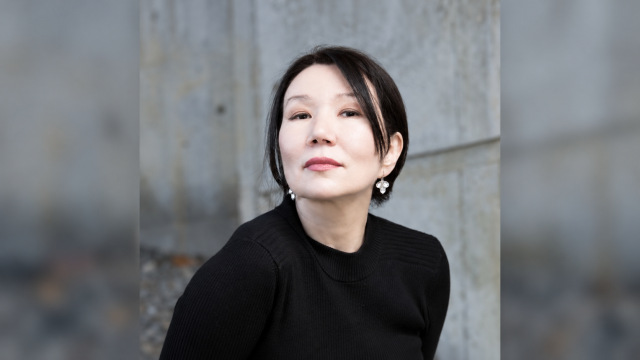
Maria Tsydenova, a native of the Siberian republic of Buryatia, was returning home from a Christmas party on Jan. 8 in the central Russian city of Podolsk when a group of police officers stopped her and demanded to see her documents.
“I was with my adult daughter and her friends. We were…behaving calmly and did not bother anyone. There were no grounds for detention,” 41-year-old Tsydenova recalled.
Tsydenova, who was not carrying her ID card, offered to verify her identity through state services app Gosuslugi or ask her daughter to fetch the documents from their apartment a few meters away. She also recalled asking the officers to present their badges and state their reason for stopping her.
The policemen then grabbed Tsydenova, “twisted my arms, twisted my hands, hit me in the back, hit me on the head” and took her to the nearest police station.
Tsydenova said she then spent nearly 20 hours in detention with no access to food or water. The injuries that she sustained in detention were recorded by an independent medical examiner.
“[At the station] they insulted me in all possible ways, called me a ‘Buryat scum,’ a ‘Buryat slut’...They said that all the Buryats will be killed on the front lines of the special military operation … and that Buryats will rot in hell, that our nation will disappear,” Tsydenova said in a viral video address, using the Kremlin-sanctioned term for the war in Ukraine.
“I said that I will raise a complaint [about their actions], to which they said that I should go and complain to the ‘Buryat president and pray to Buryat gods’,” she added.
Buryats, a Mongolic ethnic group indigenous to southern Siberia, were colonized by Russia in the 17th century, with their lands subsequently divided between the modern-day Irkutsk and Zabaikalsky regions, as well as the republic of Buryatia.
Buryatia, which came under Moscow’s complete control following a brief period of limited sovereignty in the 1990s, is one of Russia’s most economically depressed regions despite having ample deposits of critical raw materials.
Lack of employment opportunities and limited avenues for social mobility have forced many Buryats to seek education and employment elsewhere in Russia, including the capital Moscow and its satellite cities like Podolsk.
Economic marginalization coupled with disproportionate forced mobilization, in turn, has led to the overrepresentation of Buryatia’s residents among Russia’s Ukraine war casualties.
Contrary to what the police officers told Tsydenova, Buryatia has not had its own president since 2012, while many ethnic Buryats identify as Buddhist.
Law enforcement officials have denied Tsydenova’s allegations against them, maintaining that she was arrested for “appearing in public while intoxicated in a manner that insults human dignity and public morality.”
“I lived in Moscow for 14 years, so when I learned what happened to Maria, I was neither surprised nor shocked,” said Marina Saidukova, a decolonial researcher from Buryatia at the University of Montana.
“Police racism is a daily reality for many Buryat-Mongols and, more broadly, for all non-Russian people in Russia. And it doesn’t matter who you are: a citizen of this country, a labor migrant or a foreign student,” Saidukova told The Moscow Times.
Saidukova notes that the story of Tsydenova should be treated as yet another testament to a systemic problem that exists in Russia rather than an isolated incident.
She said that racialized policing in Russia is enabled by a state ideology that enshrines the superiority of people with Slavic appearance, especially ethnic Russians.
“The security forces are not lawbreakers but agents of state ideology. Their function is to exercise control over ‘others’ and maintain the racial hierarchy in Russia,” said Saidukova.
These sentiments were echoed by prominent Buryat activist Viktoria Maladaeva, who said Tsydenova’s story made her feel “angry and desperate” as it brought back memories of her own mother being detained by the police in St. Petersburg some 15 years ago.
“She went to the airport to pick up a friend and forgot her passport in a rush. The police saw her, a non-Russian woman, running to the metro, stopped her and took her to the police station,” Maladaeva recalled.
Maladaeva said her mother was held in custody for five hours, with her personal belongings and phone confiscated.
“She told them she was Buryat and a Russian citizen, but it was useless,” the activist recalled, meaning that police officers suspected that an Asian woman could not be a Russian citizen and must have been in the country illegally. “A Kalmyk police officer arrived later on and, of course, immediately believed her and let her go.”
“Every non-Russian knows what it’s like to be racially profiled or discriminated against…We know of Maria’s incident now, but how many more go unpublicized every day?” she added.
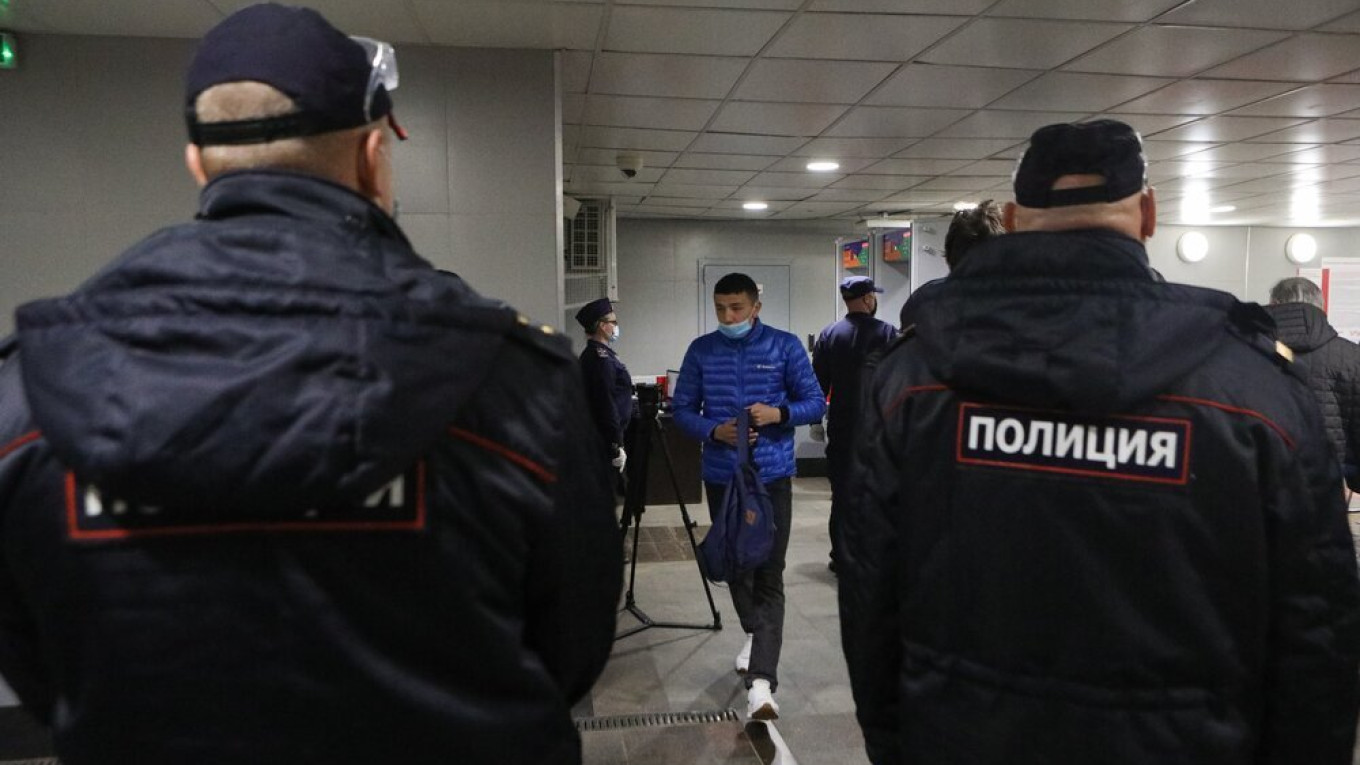
While Russian citizens are not legally required to carry identification with them at all times, random identity checks of non-ethnic-Russian citizens and their arbitrary detentions are commonplace — a phenomenon exacerbated by the state’s wartime crackdown on migrants from Central Asia.
Last year, the videotaped detention of a Buryat woman by a volunteer police patrolman in the Moscow metro triggered public outrage in Buryatia and other Russian republics with predominantly Asian indigenous and minority populations.
In response, Buryatia’s Kremlin-appointed head Alexei Tsydenov called on fellow Buryats to always carry identification documents.
“We look different [from Russians] on the outside — that’s an objective fact. Please be understanding and calmly show your documents,” Tsydenov said at the time.
Maladaeva called this response “a spit in the face for all Buryats” in a conversation with The Moscow Times, noting that having a Russian passport on hand does not offer protection from the intimidation and harassment that Buryats face.
This time around, Buryatia’s head assured the public that Russia’s Interior Ministry and Investigative Committee had launched an official inquiry into Tsydenova’s case.
“We are keeping the situation under control. I ask everyone to remain calm about what is happening — we will sort everything out and provide updates on the results,” Alexei Tsydenov said.
Researcher Saidukova believes that the ordeal deserved more than a simple acknowledgment or verbal condemnation by officials, but instead should have turned into “a political scandal that would raise the issue of systemic racism within law enforcement.”
“With its silence and performative responses, the Russian government is sending a clear signal: ‘This is the price one has to pay for having the “wrong” appearance. And this is normal’,” said Saidukova.
But despite seemingly having an entire system against her, Tsydenova on Sunday vowed to seek legal justice in her case, noting that State Duma deputy from Buryatia Vyacheslav Markhaev backed her actions.
“My goal is to show that physical violence and moral humiliation by police officers are unacceptable and must not go unpunished,” she wrote on her Telegram channel, which she vowed to maintain until her case is resolved on favorable terms.
“Because it is me today, and it could be any of you tomorrow,” Tsydenova added.
Photo of the Week
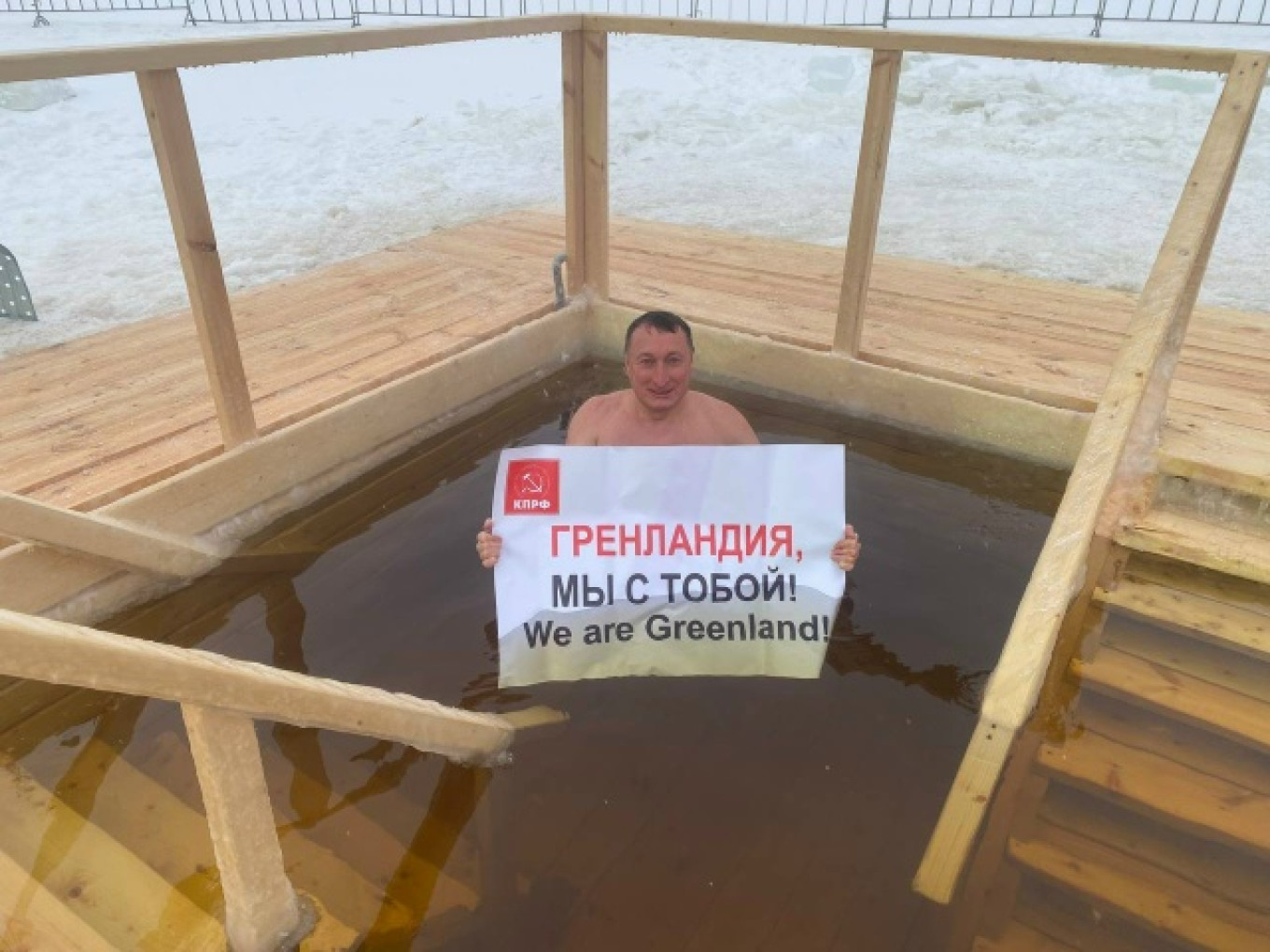
Alexander Andreyev, the head of Russia’s Communist Party in the republic of Chuvashia, holds up a sign saying “Greenland, we are with you! We are Greenland!” while performing his traditional Epiphany ice plunge on Jan. 19.
“On a remote northern island, the local Communist Party enjoys great popularity. We decided to demonstrate our solidarity with Eskimo workers in their struggles against American imperialism,” said Andreyev, referring to members of Greenland’s democratic socialist party Inuit Ataqatigiit.
Police summoned Andreyev for questioning after the photo of his stunt went viral.
Culture & Entertainment
- On Jan. 27, London-based NGO Pushkin House will hold an online and in-person talk with Irina Sadovina and Ilona Yazhbin Chavasse, who translate Indigenous literature from Russia. More information about the event is available here.
- A documentary short film by Oscar-nominated Sakha director Evgenia Arbugaeva will premiere at the 76th annual Berlin International Film Festival in February. “Chuura” tells the story of an Indigenous scientist in the republic of Sakha who ventures to search for an ancient creature in the depths of the permafrost.
- “Completely Cut Off’: Kamchatka Calls for Moscow’s Help as Record Snowfall Paralyzes Region” by Anastasia Tenisheva
- “What Will 2026 Bring for Russia’s Regions? This Is What Experts Say” by Leyla Latypova
- “Chechnya’s Kadyrov Is Reportedly Gravely Ill (Again). Here’s What We Know.” by Anastasia Tenisheva
- “Russia's Opposition Is Leaving Indigenous People Behind. We Will Not Remain Silent.” by Viktoria Maladaeva
- “We Need to Recognize Russia’s Colonial Violence’: Buryat Illustrator Seseg Jigjitova” by Leyla Latypova
A Message from The Moscow Times:
Dear readers,
We are facing unprecedented challenges. Russia's Prosecutor General's Office has designated The Moscow Times as an "undesirable" organization, criminalizing our work and putting our staff at risk of prosecution. This follows our earlier unjust labeling as a "foreign agent."
These actions are direct attempts to silence independent journalism in Russia. The authorities claim our work "discredits the decisions of the Russian leadership." We see things differently: we strive to provide accurate, unbiased reporting on Russia.
We, the journalists of The Moscow Times, refuse to be silenced. But to continue our work, we need your help.
Your support, no matter how small, makes a world of difference. If you can, please support us monthly starting from just $2. It's quick to set up, and every contribution makes a significant impact.
By supporting The Moscow Times, you're defending open, independent journalism in the face of repression. Thank you for standing with us.

Remind me later.