
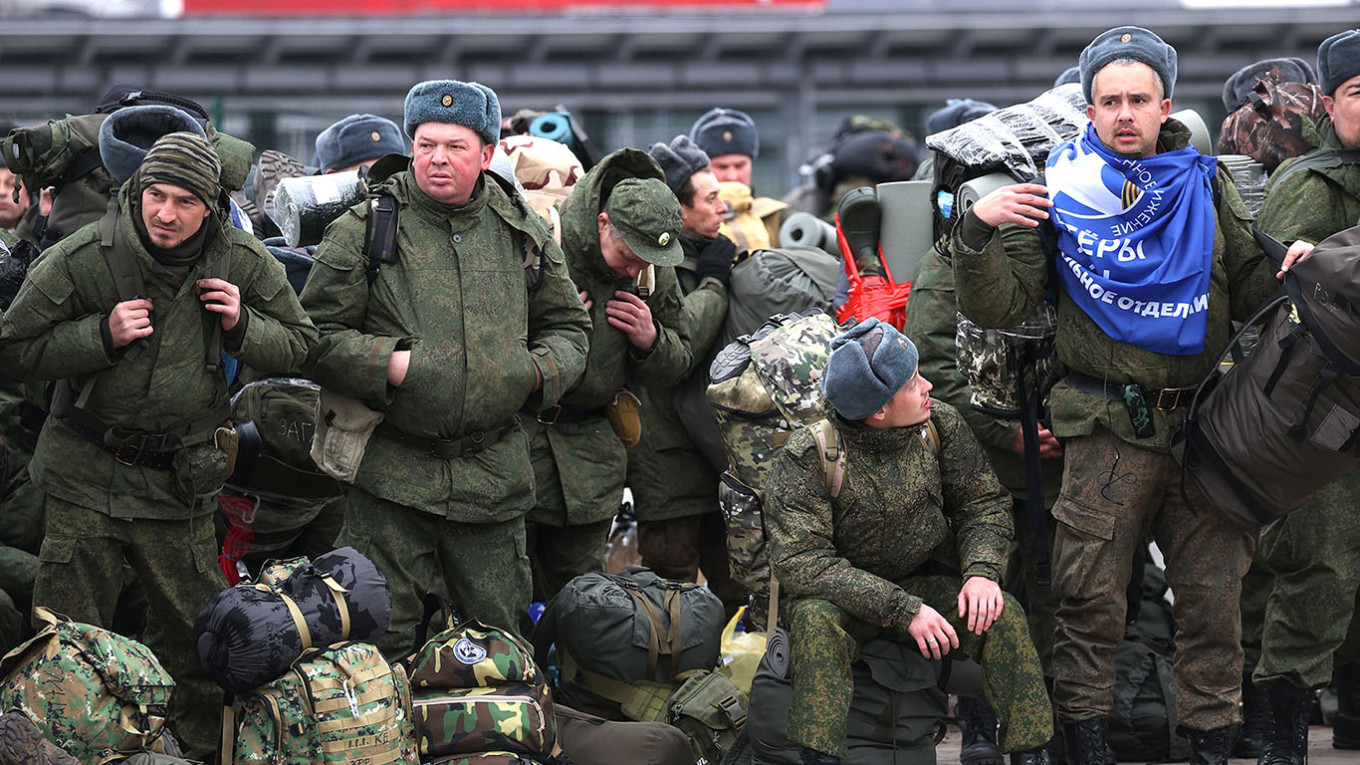
Russia’s regions and ethnic republics have borne a disproportionate share of the burden in supplying manpower for the front lines in Ukraine since the onset of Moscow’s full-scale invasion.
With no peace deal in sight, regional officials are buckling up for yet another year of trying to fulfill the Kremlin-imposed military recruitment quotas — an increasingly difficult task.
The Moscow Times spoke to Maria Vyushkova, a leading researcher of regional and ethnic disparities in Russia’s war casualties, to understand how and where Moscow will search for fresh manpower in 2026.
This interview has been edited for length and clarity.
The Moscow Times: Do you expect authorities in Russia’s regions and ethnic republics to employ new war recruitment tactics in the coming year?
Maria Vyushkova: Yes.
For the Russian army, 2025 was marked by the greatest number of human losses since the start of the full-scale invasion of Ukraine. To continue the war, the Russian military requires a constant influx of new soldiers.
Meanwhile, both the federal and regional budgets in Russia are facing enormous difficulties. Authorities are running out of money needed to attract men into the army. Contract payments in some regions have already been reduced as a result.
This means that recruitment tactics based on coercion and deception will be used more frequently. Enterprises might be obliged to provide a certain number of ‘volunteers’ for the front and they will, in turn, pressure male employees to enlist. Authorities might also use unlawful detentions to force detained men into signing a contract.
There will also be increased pressure on conscripts to sign contracts, though it will come directly from the military authorities. Back in 2024, experts estimated that around 30% of conscripts end up signing contracts, so there is room for this figure to be increased.
Conscription service in Russia has become extremely dangerous. Authorities use physical abuse against conscripts, torture them with sleep deprivation, forge signatures on contracts and even kill them for refusing to sign them. I think these kinds of actions will become systemic in 2026.
MT: Do you expect any changes in the list of regions bearing the brunt of military casualties?
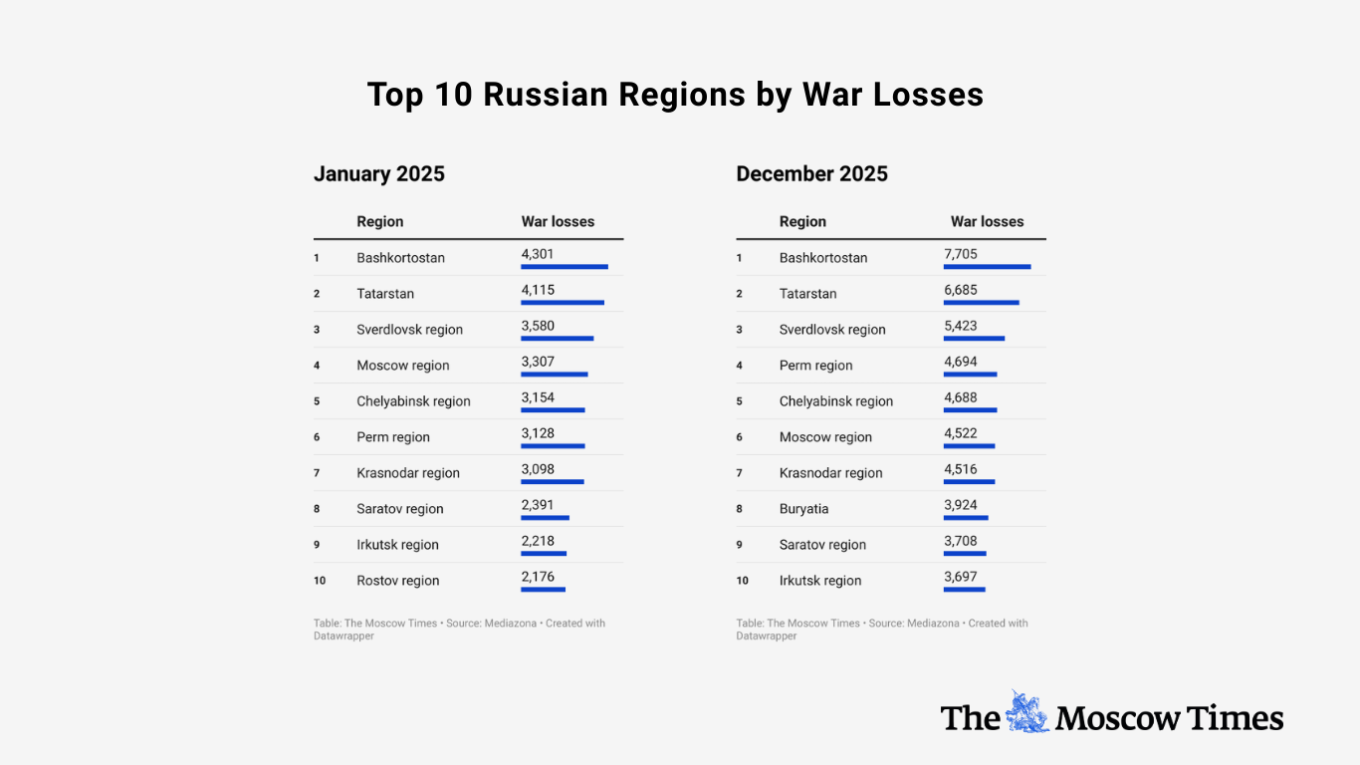
MV: The republics of Bashkortostan and Tatarstan, which were the leaders in terms of total regional losses throughout 2025, will likely remain at the top of the list. Meanwhile, Moscow, despite its enormous population, will stay relatively unaffected.
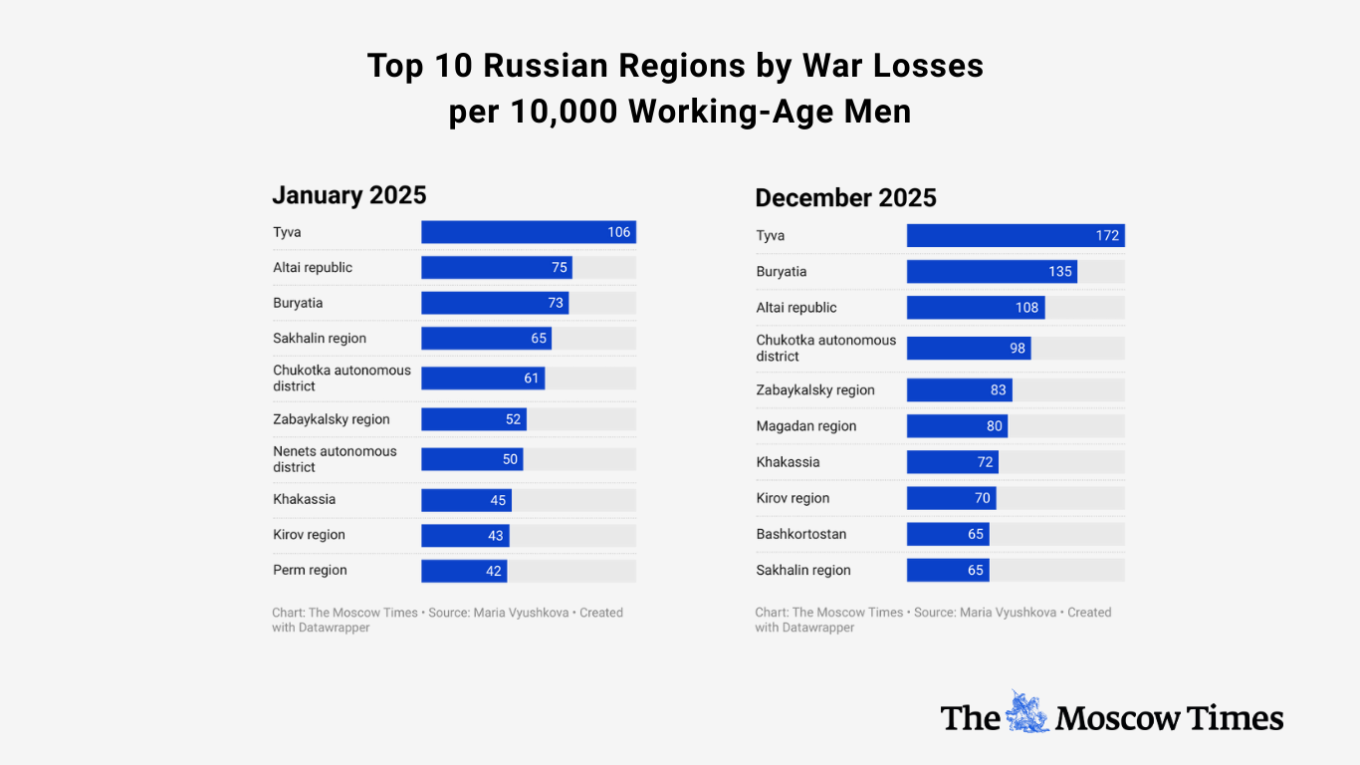
In 2025, the Perm and Kirov regions’ military losses increased sharply — this will continue next year.
I expect all the main trends to largely remain the same. That is, if a second mobilization doesn’t happen. If it does, then it will be a completely different story.
MT: What about the number of military deaths per capita?
MV: Ethnic republics will continue to rank in the top 10 of the deaths per capita ranking.
The republics of Tyva, Buryatia and Altai, as well as the Chukotka autonomous district, will remain the leaders. These regions were disproportionately affected by the 2022 mobilization, and it cannot be ruled out that the same will happen in the event of a second mobilization.
Curiously, the republics of the North Caucasus, except for North Ossetia, have a very low number of identified war fatalities per capita. Only Moscow and St. Petersburg rank lower on the list.
I can only speculate on the reasons: perhaps the Kremlin fears an explosion of instability in the Caucasus if many people with weapons and combat experience appear there? Nevertheless, the more important question is whether this will change next year due to the shortage of soldiers at the front.
MT: What is the situation like in Buryatia, your home region?
MV: The situation in Buryatia really pains me. At the beginning of 2025, Buryatia dropped out of the top 10 regions by the total number of war deaths. At that time, I had hoped that the people of Buryatia had finally stopped going to this war.
Now the republic has returned to this list at eighth place. I link this with the increase in monetary rewards for signing a military contract instituted in April.
This measure in itself is extraordinary. Buryatia was a poor region even before the most recent budgetary crisis. Yet while some other regions chose to cut the payments, Buryatia raised them and continues to keep them at a high level.
This is probably because the regional authorities are tracking trends related to the recruitment of contract soldiers in the republic. When they saw a decline, they decided to raise payments to incentivize residents to go to war.
Buryatia’s head Alexei Tsydenov is a fairly young and ambitious man, but he can offer little to Moscow except soldiers — Buryatia has no oil and no critical manufacturing.
Supplying cannon fodder for the war is now considered the main indicator of effectiveness for Russian governors, so the fact that Buryat authorities have not reduced military payments clearly shows where their political priorities lie.
A Message from The Moscow Times:
Dear readers,
We are facing unprecedented challenges. Russia's Prosecutor General's Office has designated The Moscow Times as an "undesirable" organization, criminalizing our work and putting our staff at risk of prosecution. This follows our earlier unjust labeling as a "foreign agent."
These actions are direct attempts to silence independent journalism in Russia. The authorities claim our work "discredits the decisions of the Russian leadership." We see things differently: we strive to provide accurate, unbiased reporting on Russia.
We, the journalists of The Moscow Times, refuse to be silenced. But to continue our work, we need your help.
Your support, no matter how small, makes a world of difference. If you can, please support us monthly starting from just $2. It's quick to set up, and every contribution makes a significant impact.
By supporting The Moscow Times, you're defending open, independent journalism in the face of repression. Thank you for standing with us.

Remind me later.