
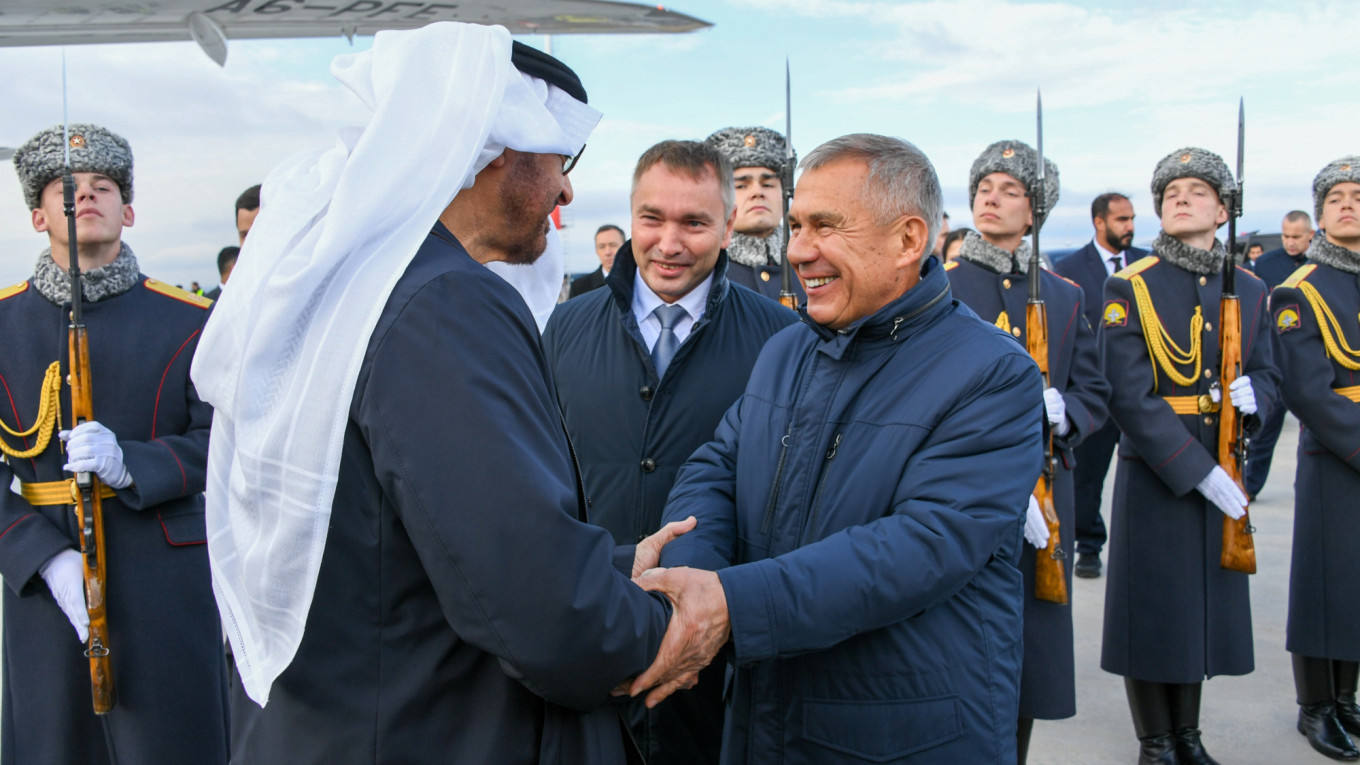
Hello and welcome to Regions Calling, your guide to developments beyond the Russian capital from The Moscow Times.
At a first glance, Russia’s regional politics and the latest turmoil in the Middle East may seem to have little, if anything, in common. Yet it is none other than the head of Tatarstan who has been one of the main drivers of the Kremlin’s growing engagement in the region over the past decade.
This week, our special correspondent Leyla Latypova takes a closer look at the personality and prospects of the Kremlin’s man in the Islamic world.
But first, here is the latest news from the regions:
The Headlines
Russia’s regions ran a record combined budget deficit of around 1.48 trillion rubles ($19.22 billion) in 2025 as spending continued to outpace revenue growth, according to the Kommersant business daily.
In absolute terms, Moscow recorded the largest deficit at 229 billion rubles ($2.97 billion). The Yamalo-Nenets autonomous district, Russia’s largest natural gas-producing region, and the Khanty-Mansi autonomous district, one of its top oil producers, followed with deficits of 84 billion rubles ($1 billion) and 72 billion rubles ($933.5 million), respectively.
Supporters of Russia’s Communist Party (KPRF) in the Nenets autonomous region staged a protest against government restrictions on Telegram on Saturday. Last month, a similar gathering took place in Syktyvkar, the capital of the northwestern republic of Komi.
Opposition groups sought government approval for related rallies in the Irkutsk, Novosibirsk and Altai regions in Siberia, as well as the Far East Primorye and Kamchatka regions. Local officials declined to authorize the rallies, citing various reasons including “public safety” concerns.
Law enforcement in the Irkutsk region last week arrested the mayor of the town of Bodaybo, where more than 1,000 people have not had access to water since early January.
This week, the small gold-mining town was rocked by a new outage that left nearly 94 households without heating, according to regional authorities.
In the Altai region, Communist Party deputy Alexander Volobuev was arrested last week on charges likely linked to alleged violations of LGBTQ+ “propaganda” laws, local media reported.
Volobuev is the 12th KPRF deputy to be arrested in the region since November. (You can read more about the crackdown on Communist Party members in Altai in the previous edition of Regions Calling.)
The Spotlight
For Putin’s Chief Islamic World Envoy, Regional Escalation Could Offer Respite
On Sunday, just hours after President Vladimir Putin expressed condolences over the “assassination” of Iran’s supreme leader in U.S.-Israeli strikes, Tatarstan’s head Rustam Minnikhanov followed suit.
In a message published by regional government-linked news agencies, Minnikhanov called for an immediate ceasefire and return to negotiations, calling the U.S.-Israeli attack on Iran “barbaric” and “a gross violation of international law.”
“[The strikes] are bringing chaos and escalating violence throughout the Middle East," he added.
Though Minnikhanov was the only Russian regional official to publicly comment on the crisis, the move had little to do with his gubernatorial duties or with stroking Putin’s ego.
Since 2014, Minnikhanov has served as Putin’s lead envoy for the Middle East and Muslim-majority African countries, a position that he himself has described as a “coordinator of workings with the Islamic world.”
Minnikhanov played a key role in rerouting Russia’s trade flows and fostering new economic partnerships in the Global South after the full-scale invasion of Ukraine, while Tatarstan became the country’s main producer of Iranian-designed military drones.
But as Minnikhanov finds himself facing new geopolitical turmoil, experts question the extent of his skills, acumen and even will to execute Moscow’s increasingly complex balancing act in the Middle East.
‘No diplomat’
“Minnikhanov is no diplomat,” said expert Rim Gilfanov, the director of Radio Free Europe/Radio Liberty’s Tatar-Bashkir service Azatlıq Radiosı. “If not for Moscow, he wouldn’t have ended up in this role.”
“Nothing in Minnikhanov’s education or biography” points to his exceptional diplomatic abilities, noted Gilfanov.
Minnikhanov was born in 1957 to ethnic Tatar parents in a small village in Tatarstan, a Turkic-majority, resource-rich republic in Russia’s Volga region with a population of over 4 million.
The son of a timber factory head, Minnikhanov holds degrees in mechanical engineering and commodity trading.
Minnikhanov’s official biography paints an impressive picture of a man who started as an engineering inspector in his native Sabinsky district in 1978, became the same district's deputy head by 1992 and by 1996 rose to the post of the republic’s finance minister.
Family connections were of paramount importance for Minnikhanov's career. His parents were closely acquainted with Tatarstan’s first president Mintimer Shaimiev, who in 2010 appointed the young protégé as his successor to lead the republic.
Minnikhanov also inherited from Shaimiev the role of Moscow’s envoy to the Islamic world.
Shaimiev and the diplomat Yevgeny Primakov — often dubbed “Russia’s Kissinger” — founded the Russia-Islamic World Strategic Group in 2006 as a platform for dialogue between Moscow and member states of the Organization of Islamic Cooperation (OIC), where Russia became an observer a year prior.
For the Kremlin, which was fighting its second war on Chechnya at the time, the Group also offered a way to “shield Russian Muslims from the so-called ‘corrupting influence of radical Islamists’,” expert Gilfanov told The Moscow Times.
“There is no proof that it was done at the state level, but various public organizations — Saudi, Turkish and Jordanian — provided support [to Chechnya] because of the fairly large Chechen and Circassian diaspora in the Middle East,” he said.
Putin likely tapped a politician from Muslim-majority Tatarstan to head the Group as a safe contrast to Chechnya. Unlike the North Caucasus republic, Tatarstan’s attempt at secession from Russia following the 1992 sovereignty referendum was stopped in its tracks by Shaimiev.
The Russia-Islamic World Strategic Group, which had been Putin’s brainchild, was suspended during Dmitry Medvedev’s presidency — only to be revived after the annexation of Crimea in 2014 with Minnikhanov at the helm.
Connections in jeopardy
What Minnikhanov lacks in diplomatic abilities, he has made up for in entrepreneurial flair.
In over a decade in the role, Minnikhanov has built “an institutionalized system” of working with Muslim-majority countries, rallying Tatarstan’s business community and career diplomats to the cause, said Tatar political expert and journalist Ruslan Aysin.
In 2025, Minnikhanov went on more state visits than any other regional head in Russia.
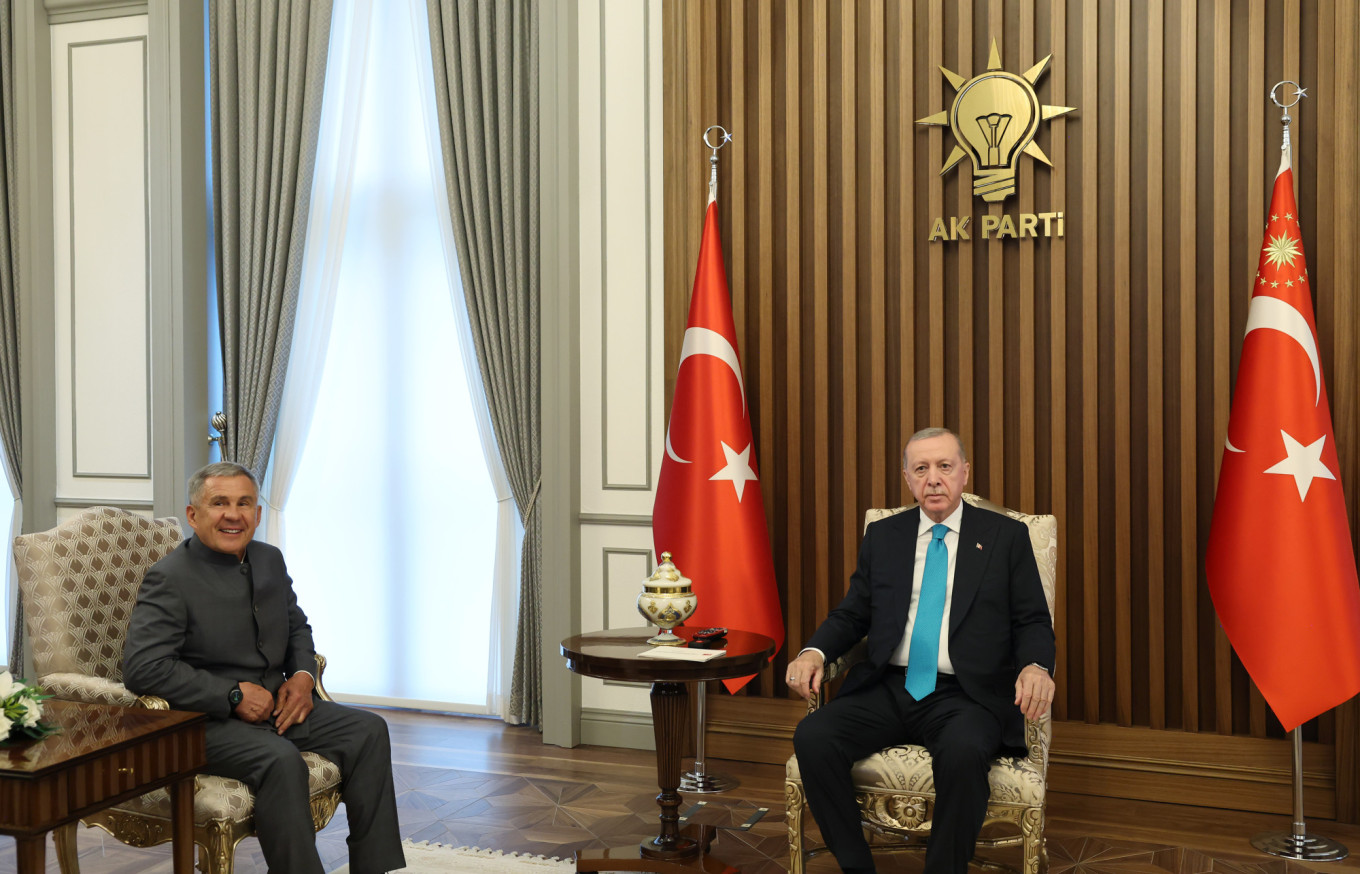
Most of his 11 foreign trips were to the OIC member states, where Minnikhanov met with Dubai Crown Prince Hamdan bin Mohammed Al Maktoum, Qatari Emir Sheikh Tamim bin Hamad Al Thani and Turkish President Recep Tayyip Erdoğan, among others.
“Moscow used the UAE for sanctions evasion, money laundering and other similar things,” said expert Aysin. “Minnikhanov…was involved in the manual setup of this complicated mechanism.”
Aysin believes that Minnikhanov, as a practicing Muslim, is likely an appealing partner for heads of Middle Eastern monarchies, who find dealing with a man of the same faith “more pleasant and natural to have.”
But relations fostered by Tatarstan’s head could easily be jeopardized during a region-wide conflict, with Middle Eastern heads of state unlikely to have time for economic dealings.
“Minnikhanov’s position will weaken because the entire region is slipping into chaos. Everyone is worried about how to stop the war and protect their own territories,” Aysin told The Moscow Times.
‘Too many responsibilities’
Though the Kremlin is not expected to involve Minnikhanov in any attempts to broker a ceasefire in the region, his no-longer-so-useful role is unlikely to imperil his standing with Moscow, experts told The Moscow Times.
Minnikhanov’s ability to maintain a firm grip on the socio-political situation in Tatarstan and deliver manpower and drones to the front lines in Ukraine are far more vital for the Kremlin than his success in the Middle East.
“I don’t think that Iranian escalation will impact Minnikhanov. Iran is not exactly his domain of work,” said Tatar political blogger Abdullah Rinat Mukhametov.
He added that Minnikhanov could even be feeling relief at the possibility of downsizing his foreign policy involvement.
While he once shared many of his direct diplomacy duties in the Gulf with Chechnya’s Ramzan Kadyrov, the Chechen head has taken a step back in recent years amid rumors of his rapidly deteriorating health.
“Tatarstan was given too many responsibilities…including when it comes to lobbying Russia’s interests in Muslim countries, especially Turkey,” Mukhametov told The Moscow Times. “I have a feeling that Kazan is annoyed by it and hopes to show Moscow that the republic has enough problems on its plate as is.”
Photo of the Week
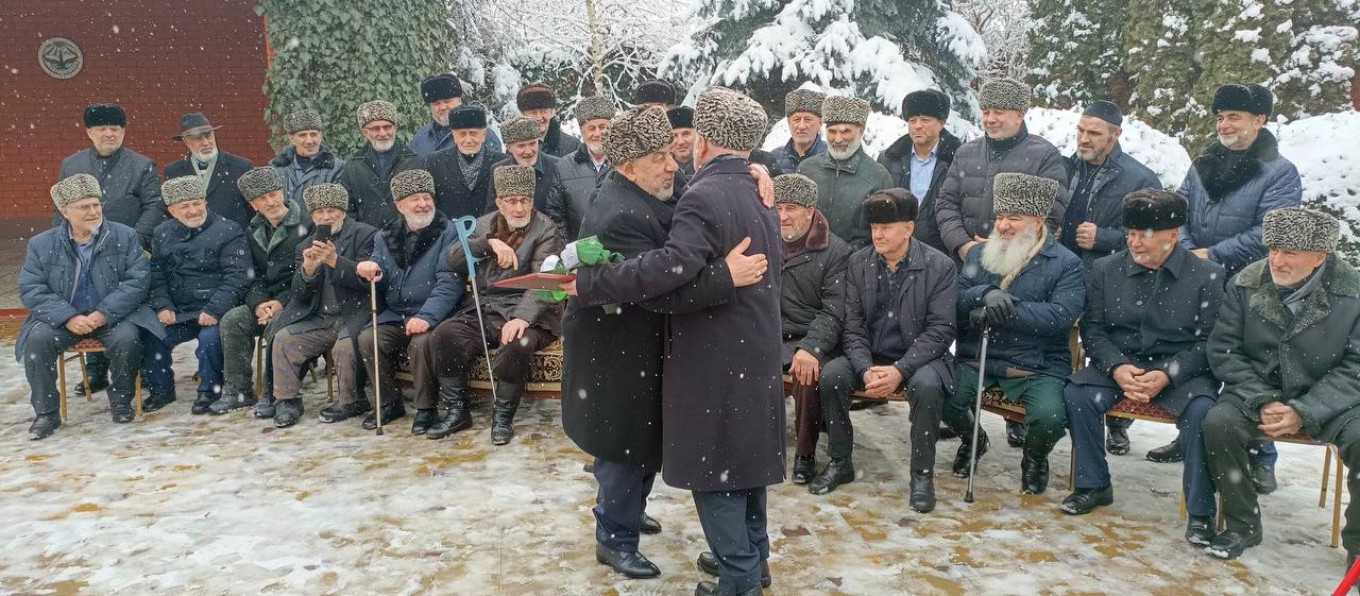
Recently released political prisoner Malsag Uzhakhov is greeted by relatives and loved ones upon returning to his native republic of Ingushetia on Saturday.
Uzhakhov, 73, was sentenced to nine years in prison in 2019 on charges linked to protests against a controversial land-swap deal between Ingushetia and Chechnya.
With two other defendants in the so-called “Ingush case” also released in February, the only one remaining behind bars is Ingushetia’s former Interior Minister Akhmed Pogorov, who also participated in the protests.
Culture & Entertainment
- Works by Russian artist and former political prisoner Sasha Skochilenko, who was released in the historic 2024 prisoner swap with the U.S., are being auctioned in support of Teal House, a California-based charity that supports displaced artists. More information is available here.
Would you like to feature information about your upcoming Russia-related event or webinar in the next Regions Calling newsletter? Drop us a line at [email protected].
A Message from The Moscow Times:
Dear readers,
We are facing unprecedented challenges. Russia's Prosecutor General's Office has designated The Moscow Times as an "undesirable" organization, criminalizing our work and putting our staff at risk of prosecution. This follows our earlier unjust labeling as a "foreign agent."
These actions are direct attempts to silence independent journalism in Russia. The authorities claim our work "discredits the decisions of the Russian leadership." We see things differently: we strive to provide accurate, unbiased reporting on Russia.
We, the journalists of The Moscow Times, refuse to be silenced. But to continue our work, we need your help.
Your support, no matter how small, makes a world of difference. If you can, please support us monthly starting from just $2. It's quick to set up, and every contribution makes a significant impact.
By supporting The Moscow Times, you're defending open, independent journalism in the face of repression. Thank you for standing with us.

Remind me later.