
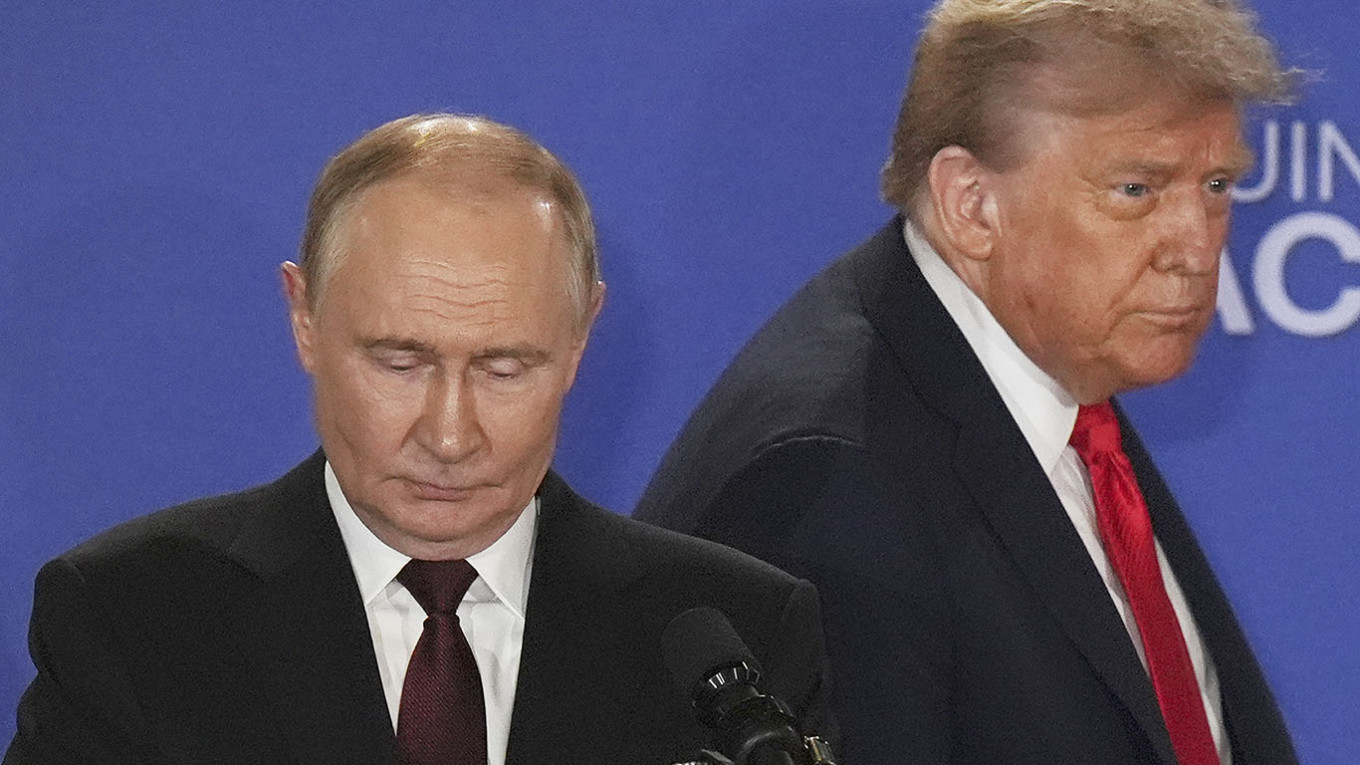
In the late 1960s and early 1970s, American and Soviet negotiators met in Helsinki and Vienna for a series of talks on arms control that led to a breakthrough. For more than half a century, the treaties born out of those conferences — and their successors — largely precluded an unrestrained buildup of nuclear weapons between the U.S. and Russia.
Until now.
When the clock strikes midnight on Thursday, New START, the last of these arms treaties still remaining, will expire, ushering in an era of uncertainty over nuclear stockpiles not seen since the Cold War.
President Donald Trump says that he wants a more far-reaching deal that includes China as well as Russia.
But experts say betting on that kind of arrangement — which would face steep obstacles — is unwise and could increase the chance of a nuclear arms race between Washington, Moscow and Beijing.
“We are at a historic turning point and it is a massive failure, in my view, that the world’s two largest nuclear possessor states are failing to meet some of their basic obligations,” Daryl Kimball, executive director of the Arms Control Association, told The Moscow Times.
New START, or Strategic Arms Reduction Treaty, includes broad provisions capping the number of deployed nuclear warheads at 1,550 and their deployment systems at 800. Stocks of non-deployed intercontinental and submarine-launched ballistic missiles are not limited, but they are allowed to be inspected by each side.
Its expiration leaves the U.S. and Russia, the world’s two largest nuclear powers, without a specific mutual agreement on how big their arsenals can grow and how many nuclear weapons can be deployed.
Russia has 5,459 nuclear warheads while the U.S. has 5,177, according to data from the Federation of American Scientists. This number accounts for about 90% of all nuclear weapons in the world.
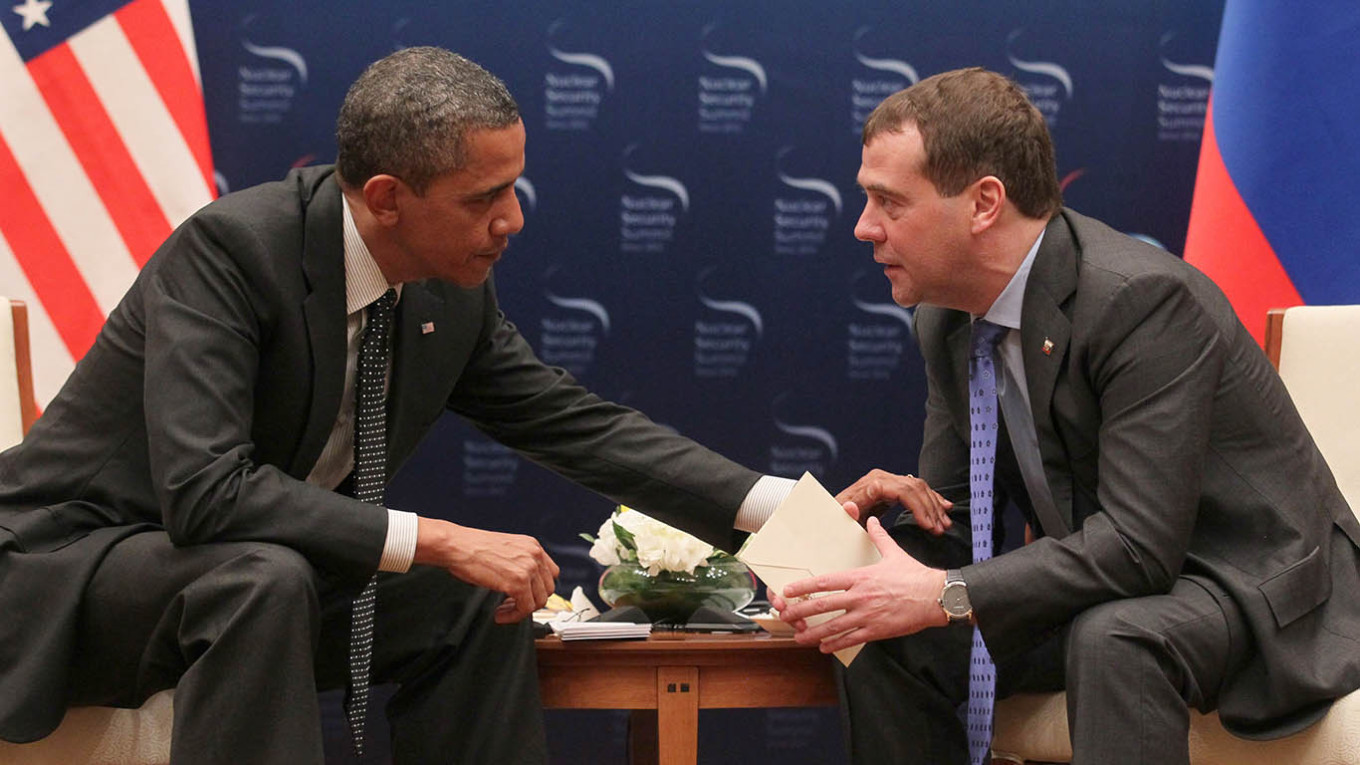
Signed in 2010 by presidents Barack Obama and Dmitry Medvedev, New START was the latest in a long line of bilateral agreements intended to limit the potential for those stockpiles to wreak destruction.
Like its predecessors, New START was a temporary measure — it was supposed to last for 10 years.
The treaty’s provisions say it can be extended once for five years, which then-President Joe Biden did in 2021. Any subsequent arms agreement would need to come in the form of a new deal or voluntary, self-imposed limits.
President Vladimir Putin dealt what many consider to be the death blow to the arms control agreement in 2023 when he suspended Russia’s participation in New START but, notably, did not withdraw. The Russian president attributed his decision to the West’s military support for Ukraine.
For months, as the expiration date in early February approached and experts sounded the alarm, Putin and Trump seemed unfazed by the impending absence of any regulation on their nuclear stockpiles.
In September, Putin offered to voluntarily continue abiding by its provisions if the U.S. does the same. Experts told The Moscow Times at the time that the offer was diplomatic “low-hanging fruit” — something that is mutually beneficial and should be easy to agree on.
Trump said the offer sounded “like a good idea” but never officially followed up. In an interview with The New York Times in January, he seemed unfazed by New START’s imminent end.
“If it expires, it expires,” Trump said. “We’ll do a better agreement.”
Hours after New START expired, the Pentagon said that the U.S. and Russia had agreed to reestablish high-level military-to-military dialogue that had been suspended in 2021.
The agreement also came after "productive and constructive progress" at Ukraine peace talks in Abu Dhabi attended by Trump's special envoy Steve Witkoff and son-in-law Jared Kushner, the U.S. military's European Command said in a statement.
Instead of a bilateral deal with Russia, the American president hewed to his self-image as a peacemaker and voiced support for striking a broader deal involving China, the world’s third-largest nuclear power and, according to vocal groups in Washington, the U.S.’ main geopolitical rival.
An administration official told The Moscow Times and other outlets that Trump remains interested in limiting nuclear stockpiles but would like to involve China in talks.
That’s easier said than done. Experts told The Moscow Times that allowing New START’s provisions to expire in the hope of securing a better deal is irresponsible given the destructive potential of a new nuclear arms race.
Pavel Podvig, director of the Russian Nuclear Forces Project, said there is no reason why the U.S. couldn’t have accepted Putin’s offer while pursuing a deal with China at the same time.
“One doesn’t necessarily exclude the other,” he said. “It’s possible to still search for a deal with China but at the same time say that, ‘Okay, we’ll keep these New START limits for another year’.”
And if Trump’s goal is to replace New START with a deal involving China, the plan could actually backfire, Kimball said. That’s because China’s goal in building up its nuclear stockpiles is to maintain the capability to counter a nuclear threat from the U.S.
“If the United States and Russia begin to increase the number of deployed nuclear weapons, it is going to send a signal to China that they must continue with their strategic nuclear buildup and probably accelerate it and move to the higher end of what they might be contemplating,” Kimball said.
In 2010, the chief U.S. negotiator on New START, Rose Gottemoeller, said that without the treaty’s ratification, “our knowledge of Russian nuclear forces would substantially erode over time … increasing the risks of misunderstandings, mistrust and worst-case analysis and policymaking.”
Her statement embodied a fear that persists into the present.
Beyond the potential for reining in ballooning nuclear stockpiles, New START also instituted a series of checks, data exchanges and verifications mechanisms — many of which have been paused due to the war in Ukraine — to ensure neither side is surprised by a development in the other’s nuclear arsenal.
A future without such mechanisms is one with greater uncertainty and risk, experts and officials say.
In an interview with Reuters, Security Council deputy chairman and former President Dmitry Medvedev said that letting New START lapse would speed up the “Doomsday Clock,” a metaphor for humankind’s self-destruction.
“I don’t want to say that this immediately means a catastrophe and a nuclear war will begin,” Medvedev said, “but it should still alarm everyone.”
“In just a few days, the world will be in a more dangerous position than it has ever been before,” Kremlin spokesman Dmitry Peskov said this week.
As of Tuesday, Peskov said, Trump had not responded to Putin’s offer. Trump has not yet provided details on a deal to replace New START.
Updated to add that the U.S. and Russia have reestablished high-level military-to-military dialogue.
A Message from The Moscow Times:
Dear readers,
We are facing unprecedented challenges. Russia's Prosecutor General's Office has designated The Moscow Times as an "undesirable" organization, criminalizing our work and putting our staff at risk of prosecution. This follows our earlier unjust labeling as a "foreign agent."
These actions are direct attempts to silence independent journalism in Russia. The authorities claim our work "discredits the decisions of the Russian leadership." We see things differently: we strive to provide accurate, unbiased reporting on Russia.
We, the journalists of The Moscow Times, refuse to be silenced. But to continue our work, we need your help.
Your support, no matter how small, makes a world of difference. If you can, please support us monthly starting from just $2. It's quick to set up, and every contribution makes a significant impact.
By supporting The Moscow Times, you're defending open, independent journalism in the face of repression. Thank you for standing with us.

Remind me later.