Because of my work, I am obliged to read closely, watch attentively and listen carefully whenever Russian politicians and officials talk about the economy.
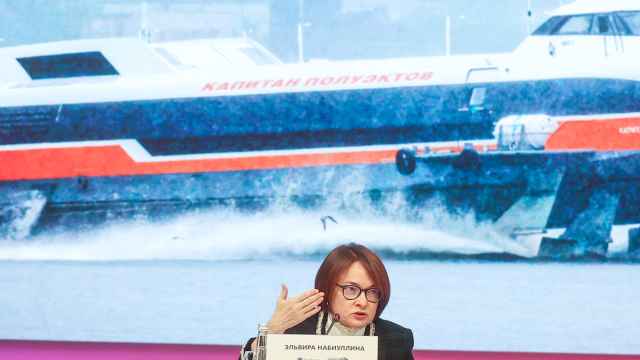
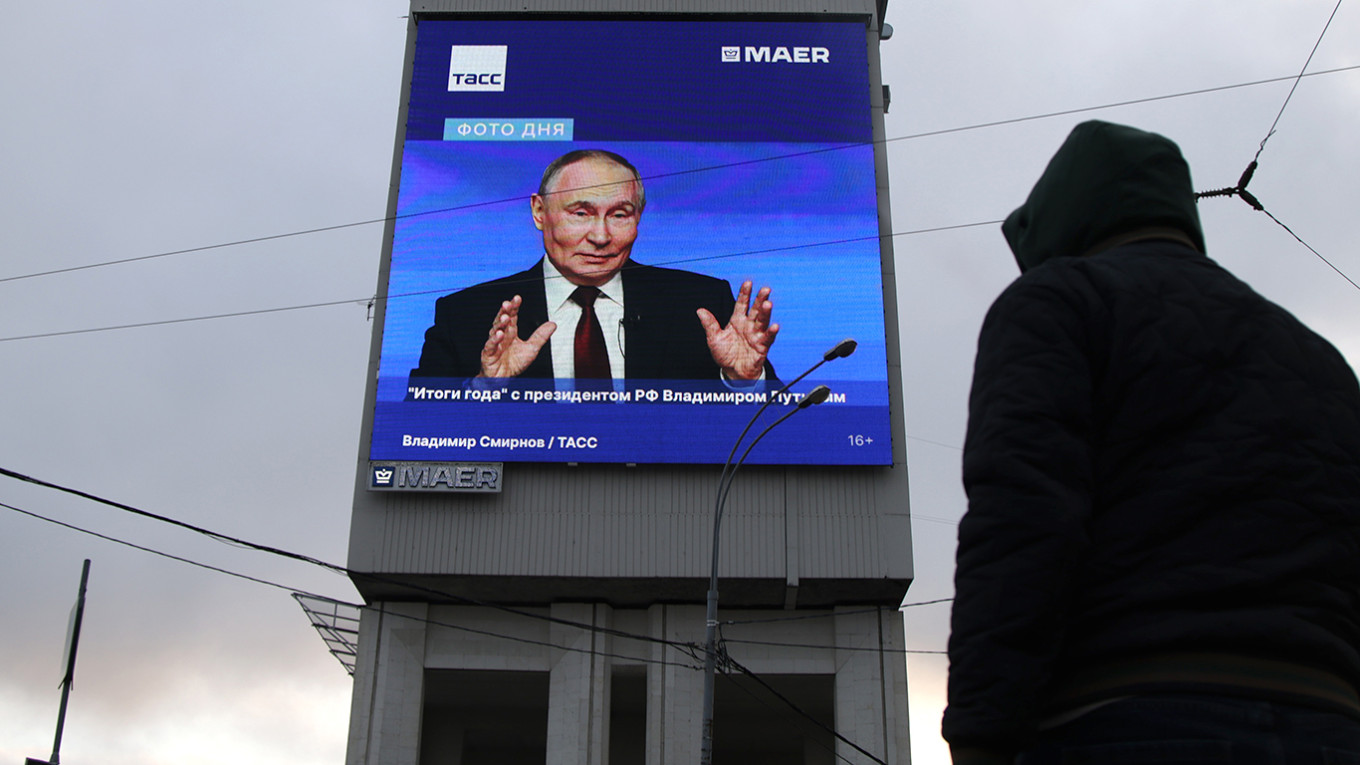
Lately, after working my way through the government’s budget forecast stretching all the way to 2042, listening to Central Bank Governor Elvira Nabiullina explain a modest 50-basis-point cut to the key interest rate and watching President Vladimir Putin’s annual call-in show, I was struck by a profound sense of déjà vu.
I have seen this before. I heard these words, these explanations, in the second half of the 1980s. The question now is not whether the parallels are real — they clearly are — but whether the story will end the same way, or whether Russia is headed for a different kind of finale.
Growth by creative accounting
I approached Putin’s “Direct Line” broadcast with genuine curiosity. For years, the president has opened public appearances by boasting of GDP growth above 4%.
But this year, GDP growth through the third quarter amounted to just 0.6%, and even that was driven almost entirely by state-funded sectors, above all defense.
Putin found a way around the problem.
“GDP growth is 1%,” he conceded. But then came the pivot: if one looks at the past three years as a whole, he argued, total growth comes to 9.7% compared with just 3.1% in the Eurozone.
I could not help recalling the late Soviet habit of comparing contemporary economic performance with 1913.
No matter how empty the shelves or how long the lines, official statistics invariably proved that citizens were living better and happier lives than ever before. Few believed that then, and few believe it now.
Today, many Russians, including economists, distrust official inflation figures, but the technique has evolved.
Instead of comparing the present with the pre-sanctions past, the authorities now add together several years of data beginning in 2023, when what might be called “military Keynesianism” took hold.
With enough creative arithmetic, even an economy sliding steadily downward can be made to look respectable for quite some time.
The numbers don’t add up
Boasting too much can be risky. In the Soviet planned economy, managers knew to exceed targets by exactly 1%. Anything more than that, and next year’s plan would be raised. One percent was enough to earn praise for heroic effort in the face of hostile imperialists.
Putin appears to have relearned this lesson. Explaining the anemic GDP growth, he described it as a deliberate policy choice by the government and the Central Bank in the name of inflation targeting. The task, he said, had been accomplished: inflation would end the year below 6%.
Yet the Central Bank undercut that narrative almost immediately. Contrary to expectations, it lowered the key rate from 16.5% to just 16%.
If inflation truly is below 6%, that implies a real interest rate of roughly 10% — among the highest in the world. Brazil, often cited as an outlier, sits at 9.2%, while Mexico at 5.3%. Turkey and Argentina, despite having interest rates of around 38% and 29% respectively, do not even make the list because inflation there is near or above those levels.
Nabiullina’s remarks after this month's rate meeting seemed to support this. Inflation has declined, she said, but not sustainably. The 6% figure only appeared in weekly data, which is not a reliable basis for identifying trends. And although inflation fell in November, it rose in October.
And beginning in January, it is expected to accelerate again, driven by a higher value-added tax (VAT), now applied to a wider swath of businesses, and by another round of increases in utility tariffs.
Familiar explanations
During the call-in show, a small bakery owner complained to Putin about the abolition of the patent tax regime, which will raise his taxes and force him to hire an accountant.
The president offered little help, suggesting instead that the baker use digital services from Sberbank. He did sample the man’s pastries on air, which may yet earn the baker some quiet leniency.
Nabiullina, who once cloaked bad news in careful technocratic language, sounded increasingly like a Soviet official reciting a familiar formula: yes, there are shortcomings, but the strengths outweigh them. When all else fails, there is always the reassurance that the economy is “returning to a trajectory of balanced growth.”
In other words, the economy is shrinking — but it is shrinking according to plan.
Planning until 2042
The government’s long-term budget forecast was striking in two respects. First, its sheer horizon: projections extend to 2042. Second, its candor: the budget is expected to remain in deficit throughout that entire period.
Even here, Soviet habits are evident. Oil is optimistically forecast at $69 a barrel by 2031. Officials stress that oil revenues will gradually give way to tax income. Putin promised that the higher VAT is not permanent, though he did not say when it would end. One might reasonably suspect it will end in 2042.
The date itself feels telling. It invites a grim literary echo of Venedikt Yerofeyev and Vladimir Voinovich’s dystopian “Moscow 2042.” It is hard to believe the choice was accidental.
Counting down
Oil, however, has a way of undoing the best-laid plans. Sanctions have pushed Russian crude prices below $35 a barrel — in real terms, perhaps $10 to $15 — precisely the range that crippled the Soviet economy in the 1980s.
And this is before a potential deflationary struggle for market share: Saudi Arabia has not lifted production quotas, Venezuelan oil has not fully returned to global markets and Iranian crude still sits offshore.
Then, too, Soviet decline was accompanied by triumphant propaganda. The language has changed, but not the function. Soon, Russians will be told daily how Ukrainian and European “militarism” obstructs Russia’s desire for peace. The euphemism of “forcing peace” requires no invention; it was tested long ago.
If this déjà vu is more than psychological, it is possible to sketch a timeline for how long the Russian economy will last. Oil prices collapsed in 1985. Though the Soviet Union survived until 1991, its economy became effectively nonviable by 1989.
Russia is starting from a stronger position. A market economy offers greater flexibility, and the population has shown remarkable tolerance for harsh measures like sky-high interest rates, rising taxes and growing tariffs.
But the Soviet example suggests that public patience can end suddenly and collectively. Military spending now stands at 7.3% of GDP, according to a presentation by Defense Minister Andrei Belousov, a figure comparable to late-Soviet levels.
The international context is also uncomfortably familiar. The U.S. has just approved a defense budget exceeding $900 billion, including funding for a new “Golden Dome” missile defense initiative, a clear echo of Ronald Reagan’s Strategic Defense Initiative.
Bloomberg has noted that even if fighting were to end, Russia will be paying for this war for years, not least through high interest costs on government bonds. This year alone, the state issued nearly 8 trillion rubles’ ($102.5 billion) worth.
Meanwhile, the government is already propping up struggling sectors ranging from carmakers and aircraft manufacturers to railways, coal, metals and oil.
Even defense enterprises are faltering. Workers at the Kingisepp Machine-Building Plant, a strategic supplier to the Navy, recently complained of unpaid wages. The company’s director responded angrily, accusing them of petty self-interest at a time of national struggle.
“It’s time to tighten our belts,” he said.
That phrase may be the most honest summary of what lies ahead.
How it ends
Whether this story concludes suddenly and almost bloodlessly, as the Soviet collapse did, or drags on in a long and painful decline is impossible to know. History does not repeat itself exactly.
But when economic narratives begin to sound this familiar, it is hard not to start counting the years.
A Message from The Moscow Times:
Dear readers,
We are facing unprecedented challenges. Russia's Prosecutor General's Office has designated The Moscow Times as an "undesirable" organization, criminalizing our work and putting our staff at risk of prosecution. This follows our earlier unjust labeling as a "foreign agent."
These actions are direct attempts to silence independent journalism in Russia. The authorities claim our work "discredits the decisions of the Russian leadership." We see things differently: we strive to provide accurate, unbiased reporting on Russia.
We, the journalists of The Moscow Times, refuse to be silenced. But to continue our work, we need your help.
Your support, no matter how small, makes a world of difference. If you can, please support us monthly starting from just $2. It's quick to set up, and every contribution makes a significant impact.
By supporting The Moscow Times, you're defending open, independent journalism in the face of repression. Thank you for standing with us.

Remind me later.