
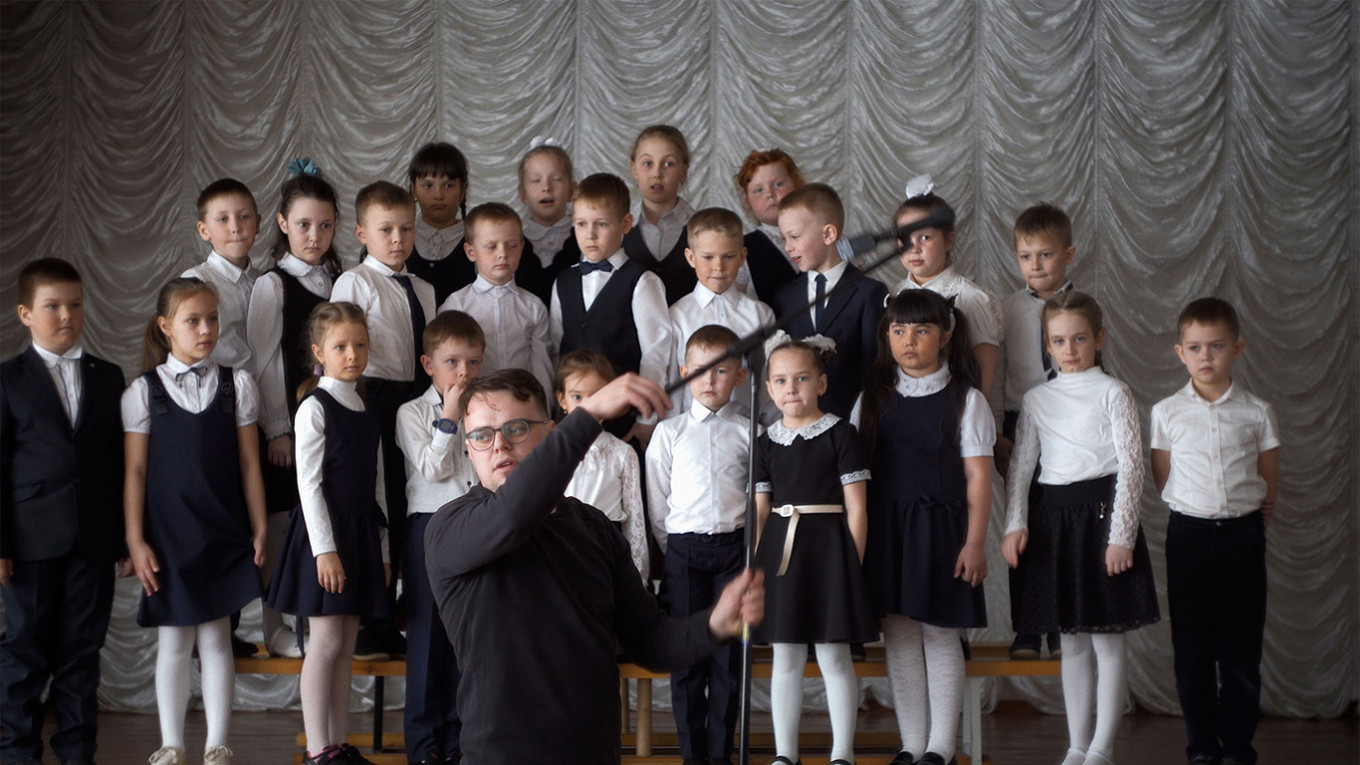
When Pavel Talankin answered a social media post looking for volunteers to share how the war changed their lives, he became the reluctant chronicler of a small town’s “descent into the abyss.”
The young teacher, born and raised in the mining town of Karabash, uses his position as school videographer to record what happens when compulsory patriotic education classes are rolled out in schools across Russia. Some staff grumble that the kids are falling behind as marching, saluting and grenade throwing practice replace maths and spelling; others take to the new curriculum with enthusiasm.
“Europe is struggling with sanctions,” drawls the history teacher. “Petrol will soon be so expensive in France that people will ride on horseback, like musketeers.”
Talankin’s camera captures the faces of the schoolchildren — uneasy, aware on some level that they are hearing lies but lacking the confidence to push back against someone they have been taught to trust and obey. The following shots of President Vladimir Putin’s televised speeches justifying his invasion make the subtext clear.
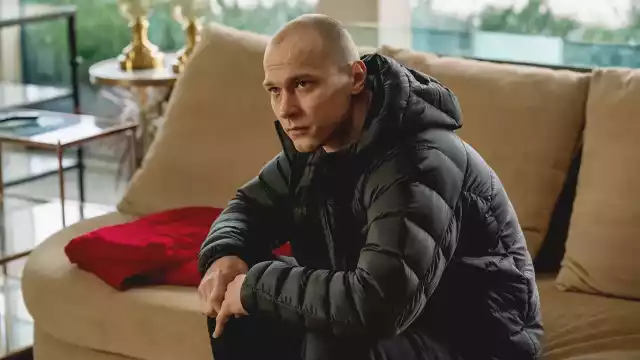
Talankin’s affection for his community does not blind him to the reality that many adults are indifferent or supportive of the war. When he tells his mother the invasion was wrong, she suggests: “People love to shoot each other. Have some sweets, son.” He watches as his former students are mobilized or volunteer for the front, shaving each other’s heads, saying goodbye.
He tries in small ways to get his students to see another future for themselves. Talankin’s office is a safe place for them, but they gradually fear being seen with “the guy who hangs the democracy flags” and he becomes isolated. Finally, he takes the painful decision to leave Russia forever.
With awards seasons underway, the film is scooping up the big prizes but not without some backlash. Notably, gritty Ukrainian battlefield documentary “2000 Meters to Andriivka” has been snubbed from the upcoming Oscars shortlist, while “Mr. Nobody” was not only nominated but is expected to perform well in the same category.
It is typical for contemporary art and documentaries about Russia (especially those made with Western producers and money) to be seen as overpraised by Western critics, to state that celebrating largely symbolic acts of individual resistance is neither meaningful nor reflective of reality. There is some logic in that — war marches on no matter who wins the Oscars.
Personally, I believe a work of art that gives hope to a single person is still worth making; I have lots of time for stories about gentle people trying to make their lives slightly better. But for the cynics, I have another argument. “Mr. Nobody” is not really a film about resistance. To view it solely as such is to miss its sharpness as a chronicle of war.
Whilst Talankin commits small acts of dissent — not least, the making of his film — what he is really doing is documenting how wars begin, how they are continued by ordinary people, and how children are taught that their own country is better than others. Nobody is born a soldier. There is a chilling sequence towards the end of “Mr. Nobody” where a boy of about eleven is given a rifle as part of a school visit by a mercenary group. At first the gun sits awkwardly in the child’s hands; he adjusts his grip, he looks through the rifle’s sights at his teacher, Talankin, whose own gaze is on his camera. The boy narrows his eyes and aims again — this time, with confidence.
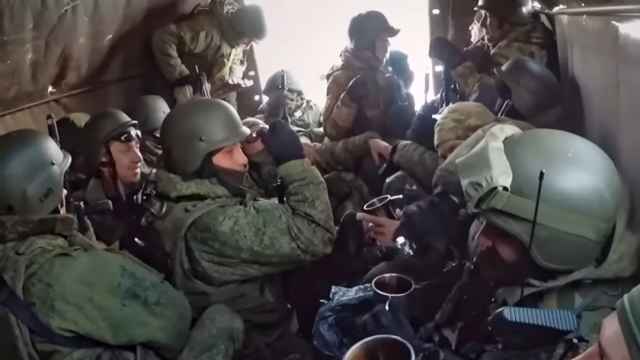
When I open “Mr. Nobody” and “2000 Meters to Andriivka” on separate tabs of my laptop and cut between them — from the boy in a small Russian town aiming a gun for the first time, to the Russian armed forces obliterating a Ukrainian town — I ask myself the question: what I am watching?
On one level, I am watching competing entries for the same prize, made by directors whose countries are at war. On another, I am watching the same story, filmed at two different points.
All films suffer from being reduced to national categories. Their message is flattened, the audience is encouraged to see them as conflicting, rather than complementary works. And I would argue that these two films are in fact complementary. How can a person become ‘the enemy’ without first being taught that it is righteous to kill?
Talankin’s film examines how it feels to consider yourself a patriot, yet to choose betraying your country over betraying your own moral compass. It holds a mirror to modern Russia. But as a study of the indoctrination of children it crosses borders and deserves to be seen in its own right. Talankin could have pushed harder at times — a teacher’s comment that ‘patriotic education’ will also take place in “new territories” swiftly passes. This felt like a missed opportunity, as the reeducation of children in occupied Ukraine is very much a part of the same military pipeline Talankin is depicting. But it is not a film that settles for easy answers and would be a deserving prize winner.

A Message from The Moscow Times:
Dear readers,
We are facing unprecedented challenges. Russia's Prosecutor General's Office has designated The Moscow Times as an "undesirable" organization, criminalizing our work and putting our staff at risk of prosecution. This follows our earlier unjust labeling as a "foreign agent."
These actions are direct attempts to silence independent journalism in Russia. The authorities claim our work "discredits the decisions of the Russian leadership." We see things differently: we strive to provide accurate, unbiased reporting on Russia.
We, the journalists of The Moscow Times, refuse to be silenced. But to continue our work, we need your help.
Your support, no matter how small, makes a world of difference. If you can, please support us monthly starting from just $2. It's quick to set up, and every contribution makes a significant impact.
By supporting The Moscow Times, you're defending open, independent journalism in the face of repression. Thank you for standing with us.

Remind me later.