
When Laurent Vinatier was a young man, he ventured to Russia seeking danger and self-discovery.
“There’s this romanticism,” Vinatier said in a recent interview. “It’s this huge territory where everything is possible.”
That romanticism died a year and a half ago in a Moscow courtroom, where Vinatier was sentenced to three years in prison for failing to register as a “foreign agent.”
Notions of a mythical Russia that once swirled in his imagination haven’t returned even though, last month, the French researcher and conflict mediator was freed in a prisoner swap.
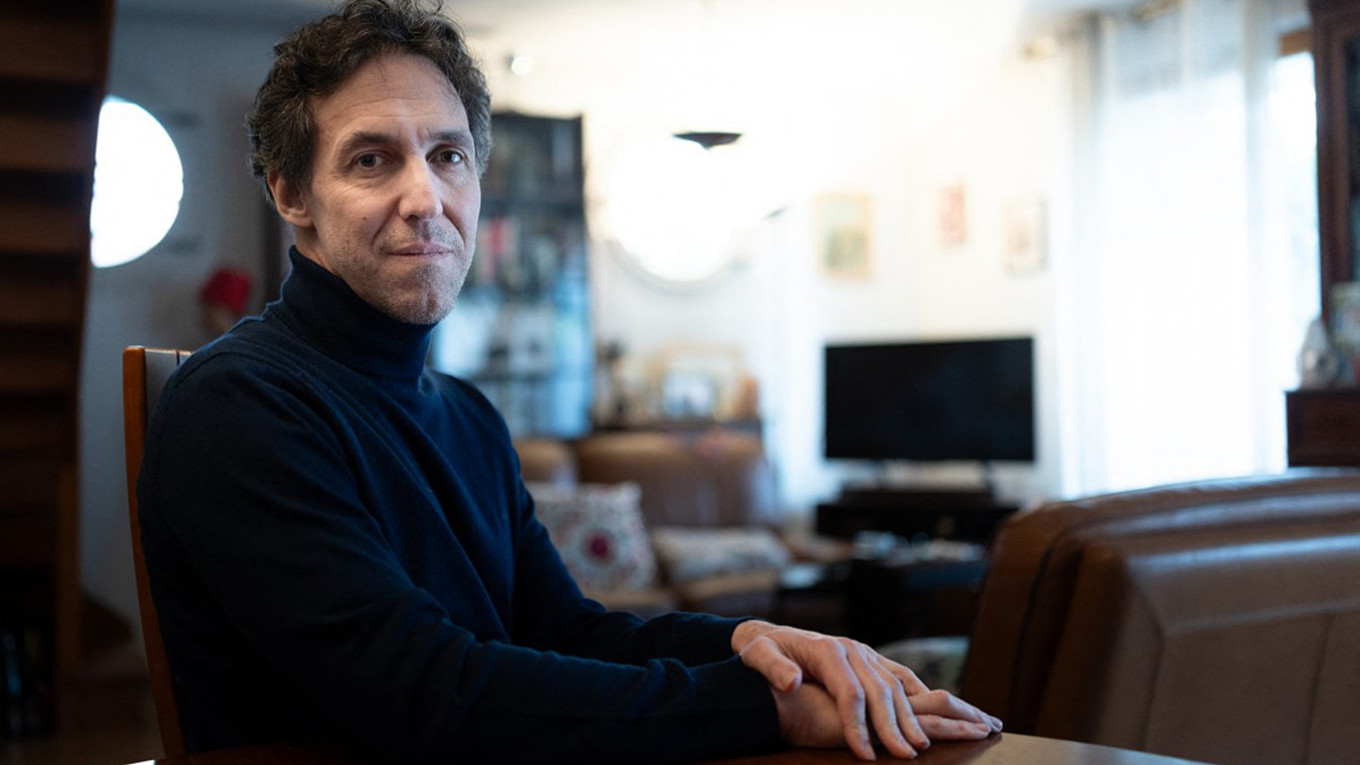
Speaking with The Moscow Times on a video call from his home in Switzerland whose exact location he declined to provide, Vinatier, 49, cut the figure of a man who had just returned from a harrowing odyssey.
Wearing a white T-shirt and wide-rimmed glasses, he recounted being shuffled between three prisons located hundreds of miles apart, grueling months of uncertainty and intense psychological distress.
Russia’s invasion of Ukraine has given authorities new pretext to continue a decades-old practice: using foreigners as bargaining chips with the West. People whose jobs inflame political sensitivities have been jailed on trumped-up charges as fodder for securing the release of Russians held overseas, Western officials say.
Vinatier’s case shows the surrealist lengths to which suspicion has stretched. He told The Moscow Times he was not in Russia to gather military intelligence as authorities claimed, but as a “messenger” facilitating dialogue.
Listening to a judge read out his sentencing in the fall of 2024, Vinatier realized that he’d been caught up in political interests outside of his control.
“After that, I could see clearly that I would only be released if Russia gets a benefit from it,” he said.
It all began in early June 2024 on a pleasant, overcast morning in Moscow.
Vinatier had a day of meetings ahead of him. As an employee of the Switzerland-based Center for Humanitarian Dialogue, a peacebuilding NGO, Vinatier’s job was to bring people together to discuss pressing issues in global conflict. Now, the Center was organizing a conference on AI, and Vinatier’s goal over the next 10 days in Russia was to try and recruit participants.
In hindsight, there were signs that something was amiss.
Three months prior, a trusted colleague in Russia alerted Vinatier to the fact that the FSB had a compiled “big file” on him. And it had only been a couple of days since his WhatsApp account was hacked.
In his first meeting that morning, the associate he was supposed to pitch the conference to seemed nervous and left after 10 minutes. Outside, Vinatier saw a man who he thought might be following him.
Just after 10 a.m., he went to the trendy European cafe Academiya on central Moscow’s Kamergerskiy Pereulok. There, it was more of the same: a colleague downed a quick glass of water and left abruptly, all while someone at the next table over discreetly kept a phone camera trained on Vinatier.
Suddenly, a truck pulled up next to the terrace where he was sitting, parked and sped off, and all the people around him left.
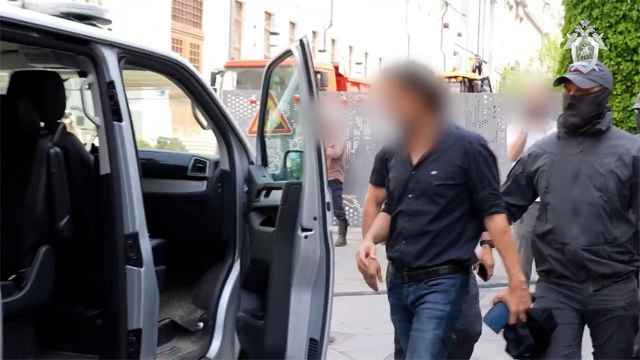
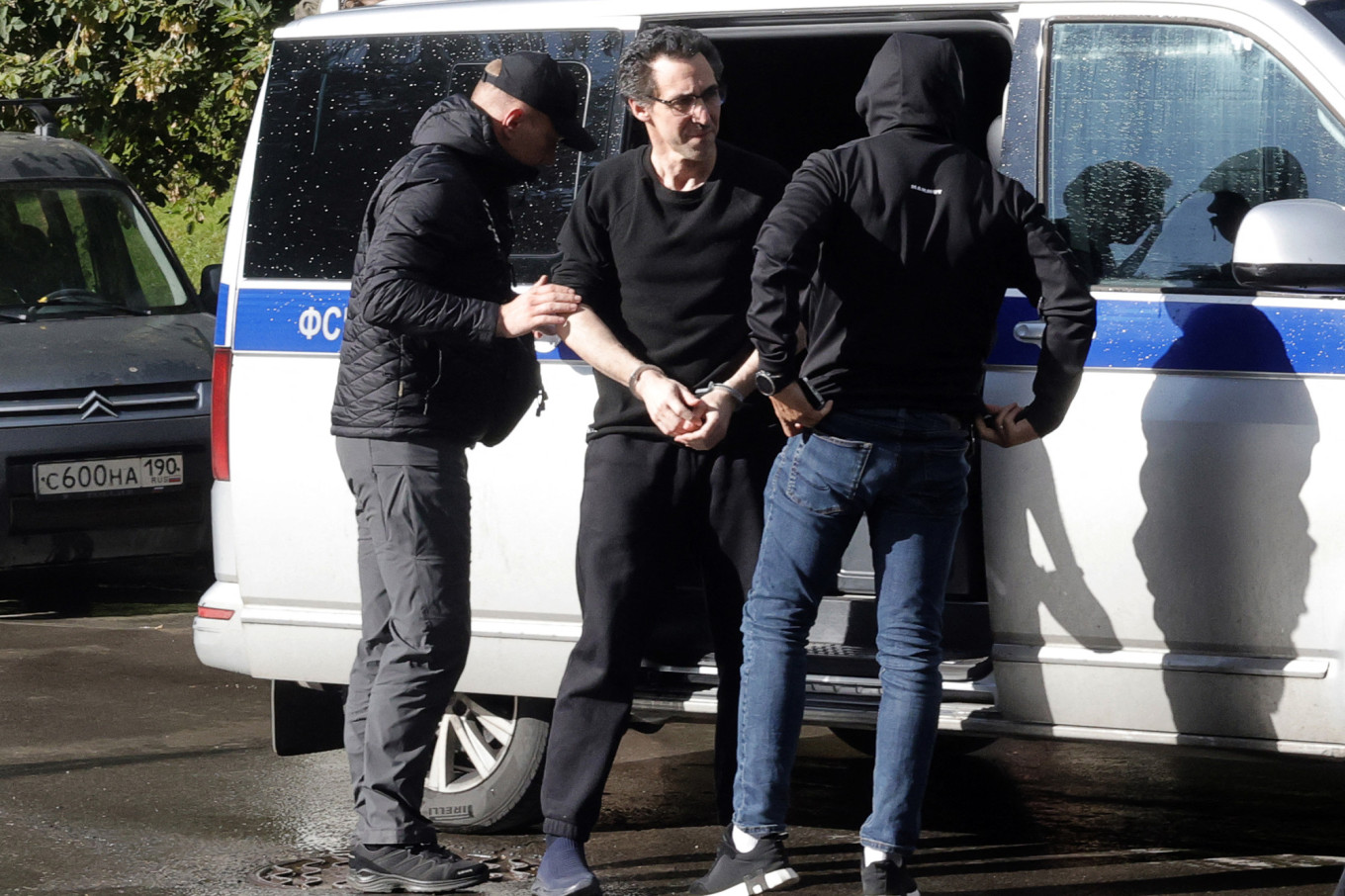
Vinatier was alone when two FSB agents wearing baggy gray jackets, face masks and baseball caps came in and escorted him into the back of a police van.
“It was not the first time I was questioned,” he said. “So I thought that they would ask me questions and I would have to explain what I’m doing.”
At the police station, it became clear this was not a misunderstanding. The authorities told Vinatier that he was under suspicion of gathering technical information on Russia’s military and failing to register as a foreign agent, a serious crime.
Russia’s foreign agent law, adopted in 2012, requires organizations receiving foreign money to register in a government database or risk fines and jail. Amendments made since the invasion of Ukraine have expanded the provisions to individuals and strengthened authorities’ power to imprison nearly anyone, including foreigners, engaged in remotely political activity.
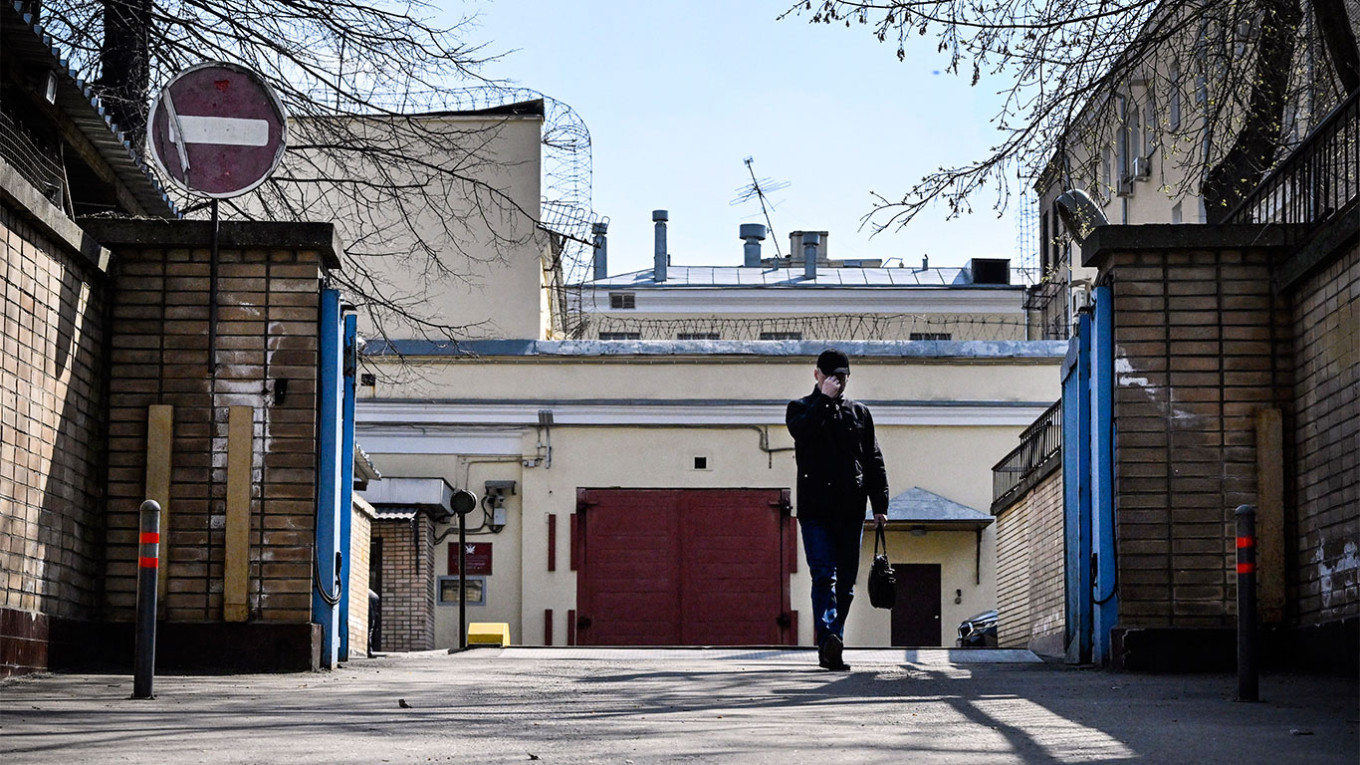
Early the next morning, Vinatier arrived at what would become his home for the next 10 months: a large, grim-looking building in southeast Moscow encompassed by a wall of concrete and barbed wire.
Here, in Pre-Trial Detention Center No. 7, Vinatier had his head shaved, a dehumanizing first step of entering the system, and was placed among an eclectic group of fellow cellmates. Many were high-level criminals: businessmen and deputy governors. One was a general in the Armed Forces whose name Vinatier declined to provide.
Less than 1% of those charged with crimes in Russia are acquitted. In a system that does not presume innocence, there is solidarity among the condemned, Vinatier said. Young or old, rich or poor, Russian or foreigner, guilty or innocent — all have an equally slim chance of being freed.
Life in prison was full of mental and emotional anguish. A persistent fear was that he would die, he said, and he regularly experienced panic attacks. Communication with the outside world came mostly in the form of writing and receiving letters.
“I could disappear,” he thought during his first night in prison.
His hope now depended on a day months in the future. If he could just make it to his sentencing hearing in October, he thought, he might be released.
When that day arrived, Vinatier recited a poem by Alexander Pushkin in the courtroom, “If Life Deceives You.” Containing a message of optimism — the first stanza ends “Merry days will come, believe” — it had been shared with him by the general in the early days of his imprisonment and bore a sentimental meaning.
“I learned [the poem] by heart, and I was telling it to myself every day to give me courage and to give me energy,” he told The Moscow Times. “And of course it was part of a kind of strategy to show that I have nothing against Russia.”
Vinatier had pleaded guilty, expecting leniency. The three years he was given were below the maximum sentence, but he was still shocked by the judgment and couldn't imagine being in prison that long.
France condemned the sentence as “extremely harsh.”
In April 2025, he was taken to a transfer facility in the city of Tula, located about 100 miles south of Moscow, where convicts are temporarily held before being sent to penal colonies across Russia to serve their sentence. He was only supposed to be there for 15 days.
One day, guards took Vinatier from the cell he was sharing with 10 other prisoners and brought him to a special room. They had some news to share: authorities had been collecting evidence and would soon slap him with a new charge, espionage, which carries a prison term of up to 20 years. It represented a major escalation of the case.
When Vinatier heard this, “all the emotion, all the anxiety, all the fear became multiplied.”
“I could not imagine that I could be so scared,” he said.
Instead of being sent to a penal colony in a far-flung region, Vinatier was to be taken to Moscow’s high-security Lefortovo Prison.
Lefortovo demands strict behavior of its inmates, but there was time for recreation, too. Vinatier read books, watched volleyball and gymnastics on his jailhouse TV, walked for a meager hour outside each day, wrote and reflected on how his life had brought him to this point.
There and back
In 2002, Vinatier, having just written a book on the role of Islam in Central Asia, wanted to turn his attention toward something more exciting.
Russia at the time was “a country where things happen, where you can have some adventure” and which was “changing fast,” he said.
He wound up focusing on the Chechen Wars, speaking to exiles and refugees from the region and visiting Russia for months at a time to write a Ph.D. dissertation on the topic. The Ph.D. led to more books, the books led to teaching positions, and the teaching positions led to the Center for Humanitarian Dialogue, which he joined in 2014.
There was a certain irony about Vinatier now finding himself inside a Russian prison — like a punishment for trying to help the country untangle its problems.
Everywhere he looked were markers of a system that didn’t make sense: in the sudden prison transfer, in the ambiguity of whether he would be released next week or in 20 years and in his rotating cast of cellmates.
He remembers one in particular, a Russian soldier who’d fought in Ukraine, was imprisoned on charges he wouldn’t talk about and still believed Moscow’s propaganda about waging a justified “messianic” war.
“He engaged for Russia, he ended up in prison, put there by his own people,” Vinatier said, “and still he was fighting and supporting Russia.”
The soldier would be Vinatier’s last cellmate.
On the morning of Jan. 8 of this year, a guard came to Vinatier’s cell and told him he had five minutes to pack all of his belongings. Vinatier, whose hair had grown back out, was brought to a room where he met with an investigator and Lefortovo’s deputy director.
They placed papers in front of him declaring he “had nothing against Russia.” He signed them. Then, the deputy director read aloud a document pardoning him for his crimes by the order of President Vladimir Putin.
After a brief car ride, he found himself on the tarmac of Moscow’s Vnukovo Airport, watching as a tall, blonde man in a black puffer jacket descended the stairs of the plane Vinatier was about to board.
It was already clear to Vinatier that he was in the process of being freed in a prisoner swap, and he was now looking at his Russian counterpart: Daniil Kasatkin, a 27-year-old basketball player arrested on hacking charges in the summer of 2025.
Later that day, French President Emmanuel Macron posted on social media: “Our compatriot Laurent Vinatier is free and back in France. I share the relief felt by his family and loved ones.”
Vinatier had spent 19 months in Russian prisons.
For all the trauma he endured, he said coming home has largely been a smooth transition.
“There was this kind of a feeling of normality because I had the impression that I did not leave for a long time,” he said of the moment he saw his family again.
Something that helped him get through his ordeal was writing each day, and he returned with about 500 pages of notes, the combined recountings of his daily life in prison and scraps of a novel he intends to write.
Asked if his view of Russia has changed, Vinatier said it had, but that he’s not interested in elaborating, talking about politics or ever returning there.
“I don’t want to make any moral judgment on what Russia is,” he said. “I just don’t want to have anything to do with Russia anymore.”
Whether he’ll continue doing work related to the country he spent his life studying is another matter. For now, he’s focusing on spending time with family while he works out those next steps.
The romanticism that drove his early career hasn’t entirely gone away. He and his family are currently taking a series of vacations to the north coast of France and Rome — places inspired by books that Vinatier read while imprisoned.
A Message from The Moscow Times:
Dear readers,
We are facing unprecedented challenges. Russia's Prosecutor General's Office has designated The Moscow Times as an "undesirable" organization, criminalizing our work and putting our staff at risk of prosecution. This follows our earlier unjust labeling as a "foreign agent."
These actions are direct attempts to silence independent journalism in Russia. The authorities claim our work "discredits the decisions of the Russian leadership." We see things differently: we strive to provide accurate, unbiased reporting on Russia.
We, the journalists of The Moscow Times, refuse to be silenced. But to continue our work, we need your help.
Your support, no matter how small, makes a world of difference. If you can, please support us monthly starting from just $2. It's quick to set up, and every contribution makes a significant impact.
By supporting The Moscow Times, you're defending open, independent journalism in the face of repression. Thank you for standing with us.

Remind me later.