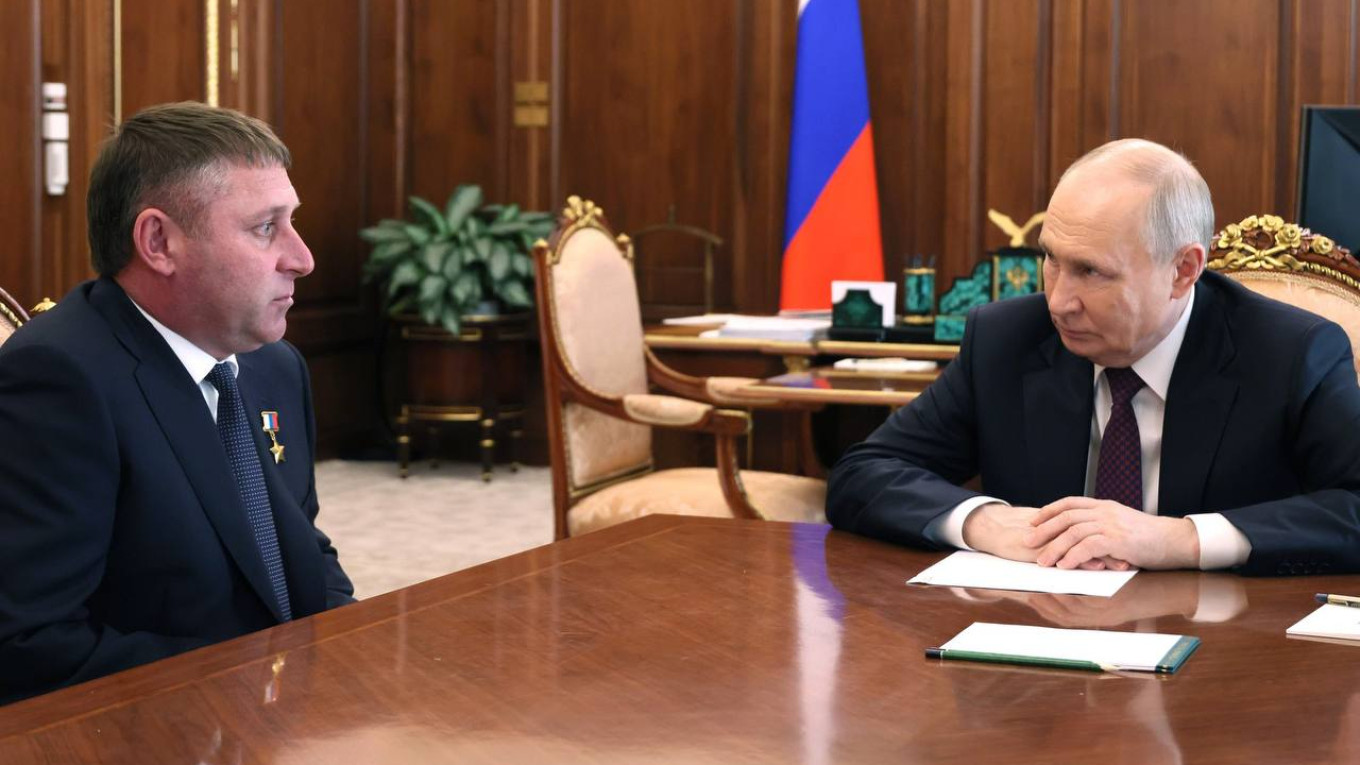
President Vladimir Putin replaced the governors of the Bryansk and Belgorod regions on Wednesday, installing a military general and a former official in occupied Ukraine to lead the two border regions.
The Kremlin said that Vyacheslav Gladkov of the Belgorod region and Alexander Bogomaz of the Bryansk region both stepped down at their own request. The two men, both under U.S. and British sanctions, had led their respective regions since before the 2022 invasion of Ukraine.
Gladkov’s departure follows weeks of rumors that he would soon be replaced. In mid-April, he announced that he was taking an extended vacation, which only further fueled speculation of his impending departure.
In his place, Putin appointed Alexander Shuvaev, a highly decorated army general, as the interim governor of the Belgorod region. Shuvaev, a native of the region, fought in the war against Ukraine and previously served in Russian military campaigns in Syria, Georgia and the North Caucasus.
In January, Shuvaev was appointed as deputy governor of the Irkutsk region as part of the Kremlin’s Time of Heroes program, a specialized initiative designed to transition military veterans into senior government roles.
For the Bryansk region, Putin appointed Yegor Kovalchuk as interim governor. Kovalchuk previously served as the head of the Russian-backed government of eastern Ukraine’s Luhansk region and has a background in banking and administration.
Putin met with both Shuvaev and Kovalchuk at the Kremlin on Wednesday, officials said.
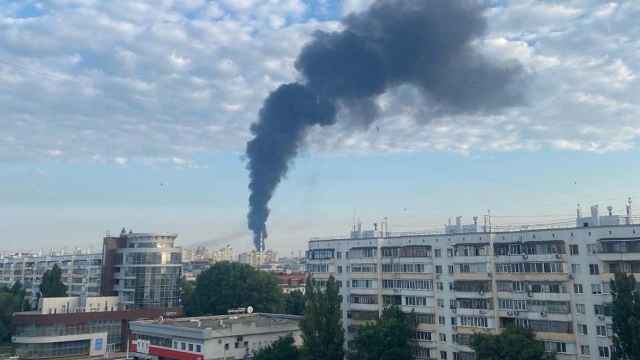
Some Russian political analysts argued that Gladkov’s tenure was a rare case of a “people’s governor” who maintained public faith in the state as the region shifted from a peaceful borderland to a primary battleground. As they noted, Gladkov gained prominence for his daily social media dispatches documenting Ukrainian strikes on Belgorod.
“It is almost startling that only five years have passed; it feels like an entire epoch. Usually, heads of regions only achieve this level of influence after twenty or thirty years in power,” wrote Sergei Starovoytov, head of the pro-government Club of Regions analytical platform.
Other observers offered a more critical view of Gladkov’s leadership. While acknowledging that he provided Belgorod with a “breath of fresh air” after the 2020 departure of his predecessor, Yevgeny Savchenko, a Yeltsin-era appointee, they suggested Gladkov’s populist touch masked a hardline approach.
“From a political standpoint, he’s no democrat. He’s a true autocrat. Tougher than the average Russian regional official,” political commentator Alexander Kynev told BBC News Russian.
“I think Gladkov’s main problem was his excessive personal ambition. Because the vertical power structure doesn’t allow for a strong emphasis on personal ambition,” Kynev added.
With the dismissal of both Gladkov and Bogomaz, Voronezh region Governor Alexander Gusev is the only remaining governor in a region bordering Ukraine to have held office before the 2022 invasion.
Later, on Thursday, Gladkov posted a farewell video message on Telegram expressing gratitude to those who stood “in the same ranks” during what he described as an extremely difficult period for the Belgorod region.
Bogomaz, who received a vacant seat in the lower-house State Duma from the ruling party United Russia, also issued a farewell statement in which he thanked Putin for his “trust and support.”
The shakeup in Belgorod and Bryansk comes ahead of regional elections in September, as well as two weeks after the head of the republic of Dagestan stepped down. The Kremlin often removes unwanted governors months before elections, known as gubernatorpad (literally, “the falling of governors”), in order to give their replacements time to build up a reputation.
A Message from The Moscow Times:
Dear readers,
We are facing unprecedented challenges. Russia's Prosecutor General's Office has designated The Moscow Times as an "undesirable" organization, criminalizing our work and putting our staff at risk of prosecution. This follows our earlier unjust labeling as a "foreign agent."
These actions are direct attempts to silence independent journalism in Russia. The authorities claim our work "discredits the decisions of the Russian leadership." We see things differently: we strive to provide accurate, unbiased reporting on Russia.
We, the journalists of The Moscow Times, refuse to be silenced. But to continue our work, we need your help.
Your support, no matter how small, makes a world of difference. If you can, please support us monthly starting from just $2. It's quick to set up, and every contribution makes a significant impact.
By supporting The Moscow Times, you're defending open, independent journalism in the face of repression. Thank you for standing with us.

Remind me later.