The number of Russian workers on reduced hours or in temporary downtime rose to its highest level since mid-2020, underscoring growing strain on businesses as the economy slows.
Around 1.6 million employees were placed on part-time schedules, shortened workweeks or idle status in the fourth quarter of 2025, the highest since the third quarter of 2020, when coronavirus restrictions disrupted economic activity, the Central Bank said in its Regional Economy report.
Over the full year, the figure increased by 14.3%, or 198,000 people.
The surge points to a widening use of reduced working hours as companies seek to cut costs without resorting to mass layoffs, highlighting weakening demand across key sectors and a broader cooling of economic activity.
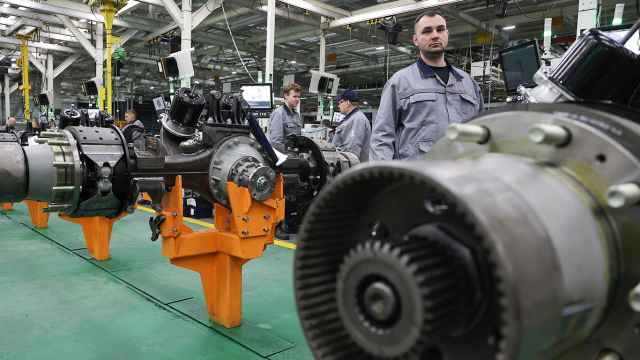
Oil producers, metallurgical firms, construction companies and automakers were among the most affected.
At least 10 major firms — including VSMPO-Avisma, Alrosa, Cemros, AvtoVAZ, GAZ and Kamaz — shortened workweeks or placed staff on forced leave in 2025 to manage financial pressures. Kamaz is again considering similar measures.
The trend has continued into 2026. In February, a large machinery manufacturer in the Saratov region shifted more than half its workforce to part-time schedules.
A knitwear factory in the Jewish autonomous region placed about half its production staff on unpaid leave for two months, while the rest moved to a four-day week, the Central Bank said.
In the Leningrad region, production at a former IKEA furniture factory that is now owned by timber group Luzales was halted due to delayed payments for shipped goods, which led to a shortage of working capital and prevented the purchase of raw materials.
From May 1, about 38% of workers at the IZ-Kartex excavator plant in Kolpino will move to a three-day workweek, citing falling demand and rising customer debt.
Companies are increasingly turning to reduced hours and downtime as a crisis-response tool amid high interest rates, stagnating domestic demand and declining exports.
Russia’s Economic Development Ministry said GDP fell 1.8% year-on-year in the first two months of 2026, while the Russian Academy of Sciences estimated a 1.5% contraction for the quarter.
That contrasts with the Central Bank’s earlier forecast of 1.6% growth in the first quarter.
Consumers have also shifted to a more cautious stance. Russians have cut spending even on essentials such as food, medicine, clothing and footwear, and are postponing purchases of electronics and vehicles.
A survey by CSP Platforma and OnIn found that 82% of respondents are concerned about the economic outlook and expect prices and utility tariffs to rise faster than incomes over the coming year.
Read this article in Russian at The Moscow Times' Russian service.
A Message from The Moscow Times:
Dear readers,
We are facing unprecedented challenges. Russia's Prosecutor General's Office has designated The Moscow Times as an "undesirable" organization, criminalizing our work and putting our staff at risk of prosecution. This follows our earlier unjust labeling as a "foreign agent."
These actions are direct attempts to silence independent journalism in Russia. The authorities claim our work "discredits the decisions of the Russian leadership." We see things differently: we strive to provide accurate, unbiased reporting on Russia.
We, the journalists of The Moscow Times, refuse to be silenced. But to continue our work, we need your help.
Your support, no matter how small, makes a world of difference. If you can, please support us monthly starting from just $2. It's quick to set up, and every contribution makes a significant impact.
By supporting The Moscow Times, you're defending open, independent journalism in the face of repression. Thank you for standing with us.

Remind me later.