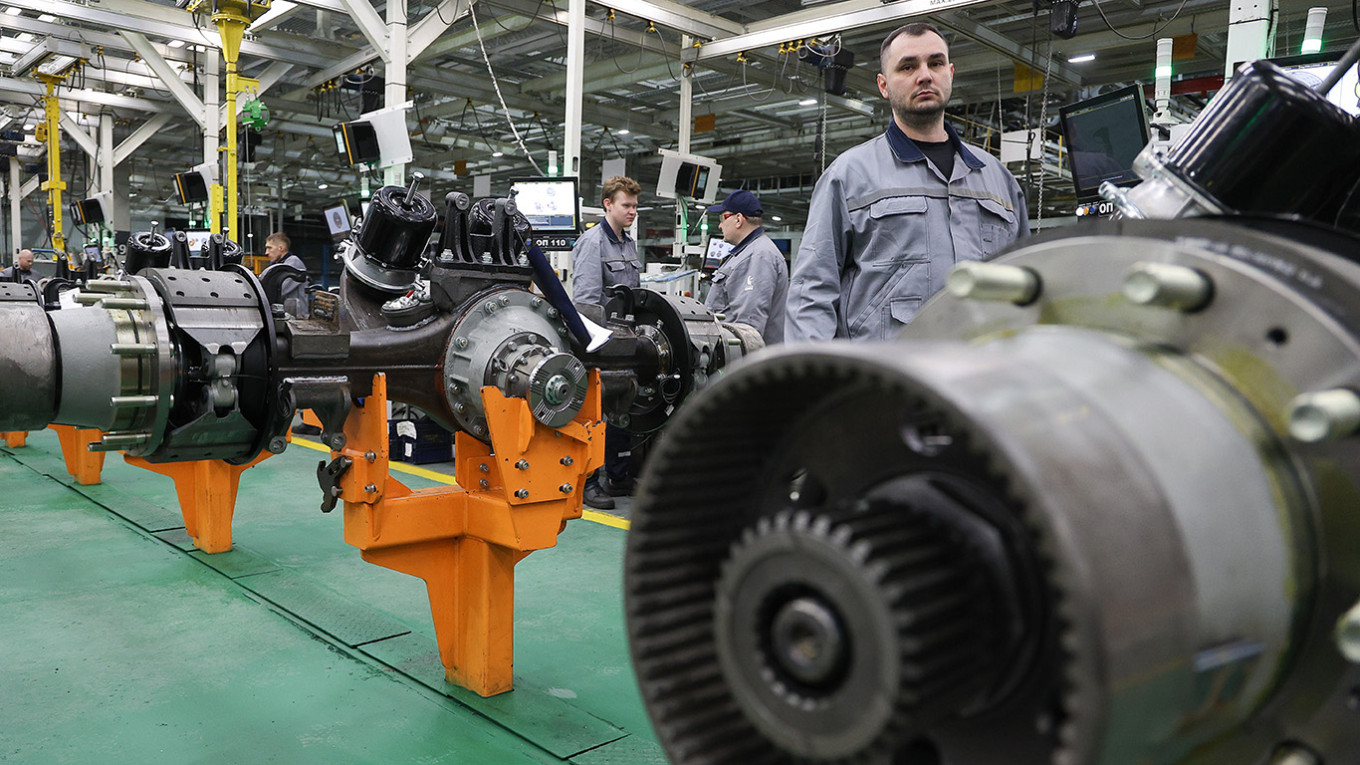
Russia’s largest truck maker KamAZ will reintroduce a four-day workweek for most of its divisions starting June 1, as a sharp downturn in the domestic heavy truck market forces the company to scale back production plans, Russian media reported.
A preliminary order has already been signed, the Biznes Online outlet reported, citing sources at the plant. The company confirmed the move, pointing to a steep drop in demand.
The decision underscores the deepening crisis in Russia’s commercial vehicle sector, where high interest rates, weakening demand and a glut of unsold trucks — including vehicles returned to leasing firms after payment defaults — are weighing on manufacturers and raising broader concerns about industrial output and employment.
KamAZ said the Russian heavy truck market shrank by 40% in the first two months of 2026. While its own sales fell by a more modest 15% over the same period, its market share rose to 37%.
The company had already introduced a four-day week in August 2025 after the commercial vehicle market collapsed by nearly 60% in the first half of the year.
It returned to a full schedule in November following a large order from state security agencies, but conditions have since deteriorated again.
Data from industry agency Avtostat showed sales of trucks with a capacity above 16 tonnes fell 33% year-on-year in February to 2,900 units, and were down 40% over January–February.
“Nothing surprising here. The first two months’ figures show the decline is continuing,” Alexander Solntsev, editor-in-chief of Comvex Review, told Biznes Online.
KamAZ sold 1,063 trucks in February, down 11% year-on-year.
Analysts say the market has been hit by persistently high borrowing costs, excess inventories and a growing share of repossessed trucks returning to the market.
The structure of demand has also shifted, with dump trucks, traditionally accounting for 25–27% of sales, now making up just 16%, while the share of specialized vehicles has risen to 35%, reflecting weaker commercial activity.
KamAZ reported a net loss of 37 billion rubles ($458.8 million) in 2025 under Russian accounting standards, up more than elevenfold from the previous year.
Revenue fell 2.5% to 315.2 billion rubles ($3.91 billion), while interest expenses reached 35.6 billion rubles ($441.4 million).
CEO Sergei Kogogin said in December that the truck market was in a “deep crisis,” citing high interest rates, inflation and market oversupply.
The Center for Strategic Research said the automotive industry was the worst-performing segment of Russian industry in the first 10 months of 2025, with vehicle production down 22.2% year-on-year. In October alone, output fell 38.4%.
The think tank warned that risks to employment and related industries would continue to grow without monetary easing and targeted state support.
KamAZ and fellow Russian manufacturer GAZ are exploring expansion into Africa in a bid to offset weak domestic demand.
Russia’s ambassador to Ethiopia said in February that the companies were finalizing feasibility studies for local production, aiming to enter the market with competitive products.
Read this story in Russian at The Moscow Times' Russian service.
A Message from The Moscow Times:
Dear readers,
We are facing unprecedented challenges. Russia's Prosecutor General's Office has designated The Moscow Times as an "undesirable" organization, criminalizing our work and putting our staff at risk of prosecution. This follows our earlier unjust labeling as a "foreign agent."
These actions are direct attempts to silence independent journalism in Russia. The authorities claim our work "discredits the decisions of the Russian leadership." We see things differently: we strive to provide accurate, unbiased reporting on Russia.
We, the journalists of The Moscow Times, refuse to be silenced. But to continue our work, we need your help.
Your support, no matter how small, makes a world of difference. If you can, please support us monthly starting from just $2. It's quick to set up, and every contribution makes a significant impact.
By supporting The Moscow Times, you're defending open, independent journalism in the face of repression. Thank you for standing with us.

Remind me later.