At a meeting of the Kyrgyz-Russian Expert Council on History in Moscow, Russian scholars reviewing Kyrgyz secondary school textbooks reprimanded their Kyrgyz counterparts for describing the periods of Tsarist and Soviet rule as "colonialism." The Kyrgyz historians who authored the textbooks refused to bend to Moscow. Instead, they went on record to argue that both the Soviet and Tsarist regimes were indeed colonial in nature.
Russian historians appear detached from the intense debates on the legacies of Russian occupation currently unfolding in Central Asia, as well as unable to extract loyalty to Russian culture from academic communities in the region.
The perception of Russia in Kyrgyzstan has changed significantly since the full-scale invasion of Ukraine. Intellectuals in Bishkek no longer debate whether Russia’s occupation of the region was colonialism. Today’s decolonial discourse in Central Asia focuses on exposing the atrocities commited under Russian rule through military campaigns, economic exploitation, nuclear testing and environmental degradation.
Younger generations of scholars especially view Sovietization as an inherently colonial experience on par with Europe’s colonization of Africa and Asia. They are re-examining historical accounts written by Russian military conquerors and colonial ethnographers with a newfound critical perspective on the meaning of the modernity imposed on the Central Asian people. No amount of Soviet industrialization projects justifies purges and cultural and linguistic erasure.
For example, Soviet authorities praised 19th-century explorer Nikolai Przhevalsky for contributing to the establishment of Russian control over the region. But Przhevalsky infamously regarded Central Asians as uncivilized aborigines, stating, “The Kirghiz are a lazy, thieving people. You can hunt them, but you can’t eat them.” What also remained unexamined during the U.S.S.R. was that during his expeditions to Central Asia, Przhevalsky routinely killed locals, including children.
Meanwhile, Kyrgyz scholars are uncovering one Russian atrocity after another. The Esimde (“I Remember”) project led by Elmira Abylbek conducted extensive research into the flight of Kyrgyz families to China in 1916 to escape forced military conscription by the Russian Tsar — an event known as the Ürkün.
According to Gulzat Alagoz of Esimde, nearly every village surrounding Lake Ysyk Köl — known globally by its Russified name “Issyk-Kul” — maintains its own memorial site dedicated to the Ürkün.
Residents of the region were condemned to another previously unknown atrocity — the Soviet deportation of Kyrgyz people to Ukraine during 1924-1932. A mass grave with remains of 137 people, including renowned political figures, was discovered on the outskirts of Bishkek in 1991. Many individuals across Kyrgyzstan subsequently began to point to areas that may conceal further mass graves.
The recent reaction from Russian scholars also shows how Moscow’s colonialism in Asia bolstered Russia’s self-image as a modernizing and even European civilizational state, mitigating the country's self-loathing and sense of inferiority to Western empires. Dostoevsky once said, “In Europe we were hangers-on and slaves, but in Asia we will appear as masters. In Europe we were Tatars, and in Asia we were Europeans. Our mission, our civilizing mission in Asia, will bribe our spirit and draw us there, just so that the movement begins.”
The secondary school textbooks that upset Russian scholars are indeed different from previous iterations. For decades after Kyrgyzstan’s independence, Kyrgyz scholars continued reproducing the image of the U.S.S.R. as a benevolent modernizing force. Even though resistance to colonial tropes among Kyrgyz academics existed well into the 2000s, it was rarely voiced publicly, let alone in reaction to Russian interventions. Seeing the depth of Russian atrocities in Ukraine unleashed a new wave of rejection of Moscow’s historical perspective
Among them is a renowned Kyrgyz historian Eleri Bitikchi, who received a secondary education in the 1990s that valorized Russian colonialism. He recalls how he “used to root for the Russian side” in its conquests of nomadic tribes when studying Russian history.
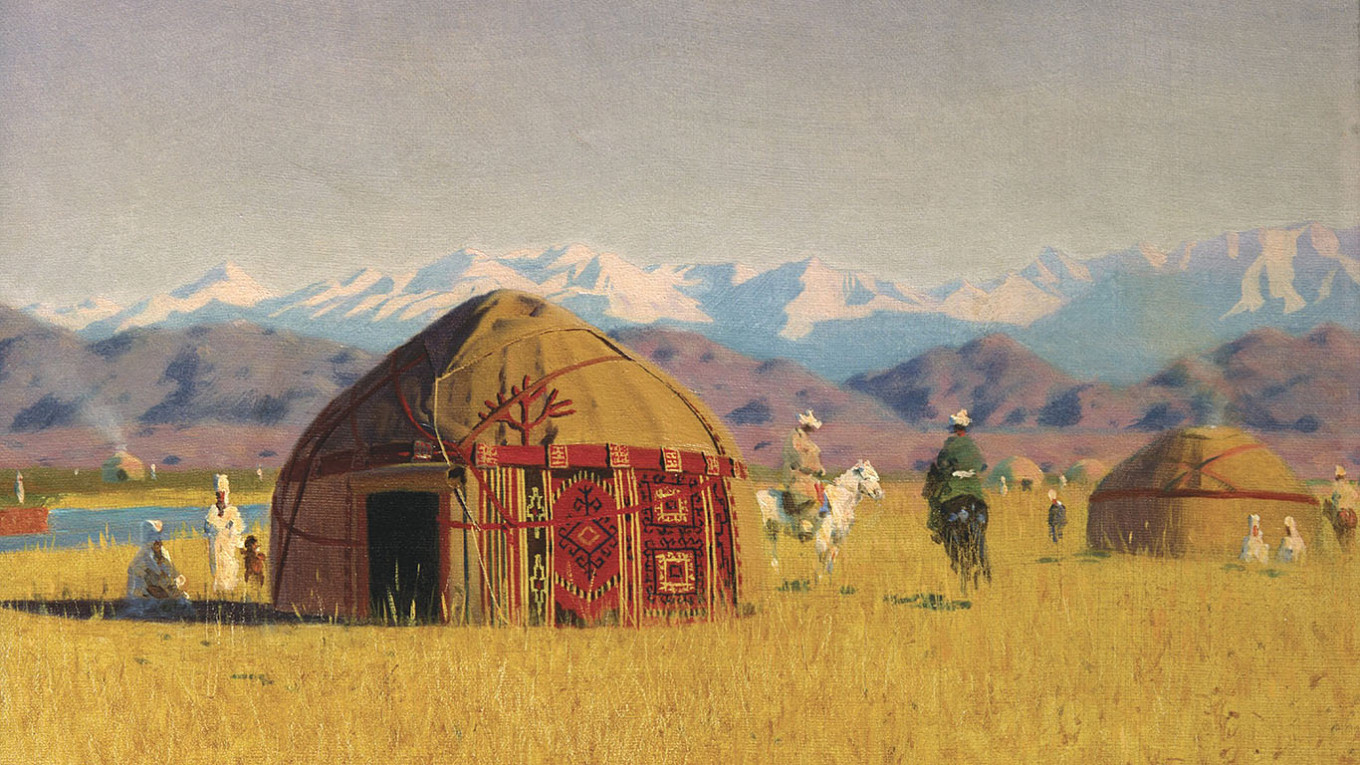
According to Bitikchi, who was unable to understand nomadic lifestyles, the Russians saw them as inherently backwards and placed them slightly above hunter-gatherers, below even feudal societies. Russian colonial officers portrayed themselves as benevolent modernizers, imposing sedentarism on nomads under the guise of benefitting the very people they sought to control.
Moscow frequently deploys orientalist tropes while positioning itself as equal to — or even victimized by – Central Asia. In 2024, TV personality Tina Kandelaki criticized Kyrgyzstan for the demolition of the Soviet Museum of Military Glory named after General Panfilov, who assisted the Soviets in occupying Central Asia and later fought in World War II. She perceived this action as an attack on the positive Soviet and Russian legacy of both modernizing Central Asia and defending it from Nazi Germany.
When a video of a teacher in Tashkent assaulting a sixth-grade student who requested that the lesson be conducted in Russian emerged in 2024, Rossotrudnichestvo head Yevgeny Primakov referred to the situation as an example of “vile Russophobia.” The teacher was immediately dismissed for abusing a student, not Russophobia.
The Russian language is still widely spoken in Bishkek and parts of Kyrgyzstan where Russians made up a majority under the U.S.S.R. Moscow’s information campaigns still find audiences in the country.
But many decolonial discussions take place in Russian as well. Central Asians were russified at the expense of their local languages more than any other Soviet republics. The loss of native languages and, by proxy, cultural identity is a common theme.
While societies in Central Asia are shedding colonial stereotypes, they remain under Russian rule through domestic loyalists. Central Asian autocratic governments allow selective decolonial narratives that reinforce their pre-existing policy priorities. Kazakhstan permits revisions of the causes of the Asharshylyq famine of 1930-33 — from a natural to manmade disaster — and recenters the Kazakh language, moving away from the Cyrillic script. Uzbekistan has expanded research into anti-U.S.S.R. Jadids and Basmachi movements as a symbol of their nation’s independence. Careful not to anger Russia, the Kyrgyz government still promotes a sterilized version of the Russian tsarist repression of 1916 that portrays the Bolsheviks as saviors.
Kyrgyz historians’ open backlash against their Russian counterparts is especially noteworthy because they are countering the official ideological narrative of their Moscow-friendly government. This is significant as it enables nations like Kyrgyzstan to better contend with how colonial propaganda continues to this day. The Kremlin weaponizes the allegations of Russophobia to suppress decolonial movements, framing efforts for linguistic and cultural independence as assaults on Russian heritage rather than assertions of sovereignty.
As scholars and activists reveal the atrocities committed under the Russian Empire and U.S.S.R., an increasing number of politicians are adopting language that characterizes Russian dominance as colonial rather than emancipatory. Behind the scenes, a struggle is emerging between nationalist elites who explore the memory of trauma and the Kremlin’s efforts to restrain such historical revisions.
A Message from The Moscow Times:
Dear readers,
We are facing unprecedented challenges. Russia's Prosecutor General's Office has designated The Moscow Times as an "undesirable" organization, criminalizing our work and putting our staff at risk of prosecution. This follows our earlier unjust labeling as a "foreign agent."
These actions are direct attempts to silence independent journalism in Russia. The authorities claim our work "discredits the decisions of the Russian leadership." We see things differently: we strive to provide accurate, unbiased reporting on Russia.
We, the journalists of The Moscow Times, refuse to be silenced. But to continue our work, we need your help.
Your support, no matter how small, makes a world of difference. If you can, please support us monthly starting from just $2. It's quick to set up, and every contribution makes a significant impact.
By supporting The Moscow Times, you're defending open, independent journalism in the face of repression. Thank you for standing with us.

Remind me later.