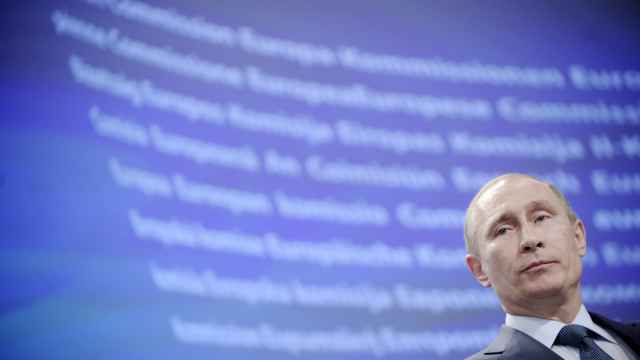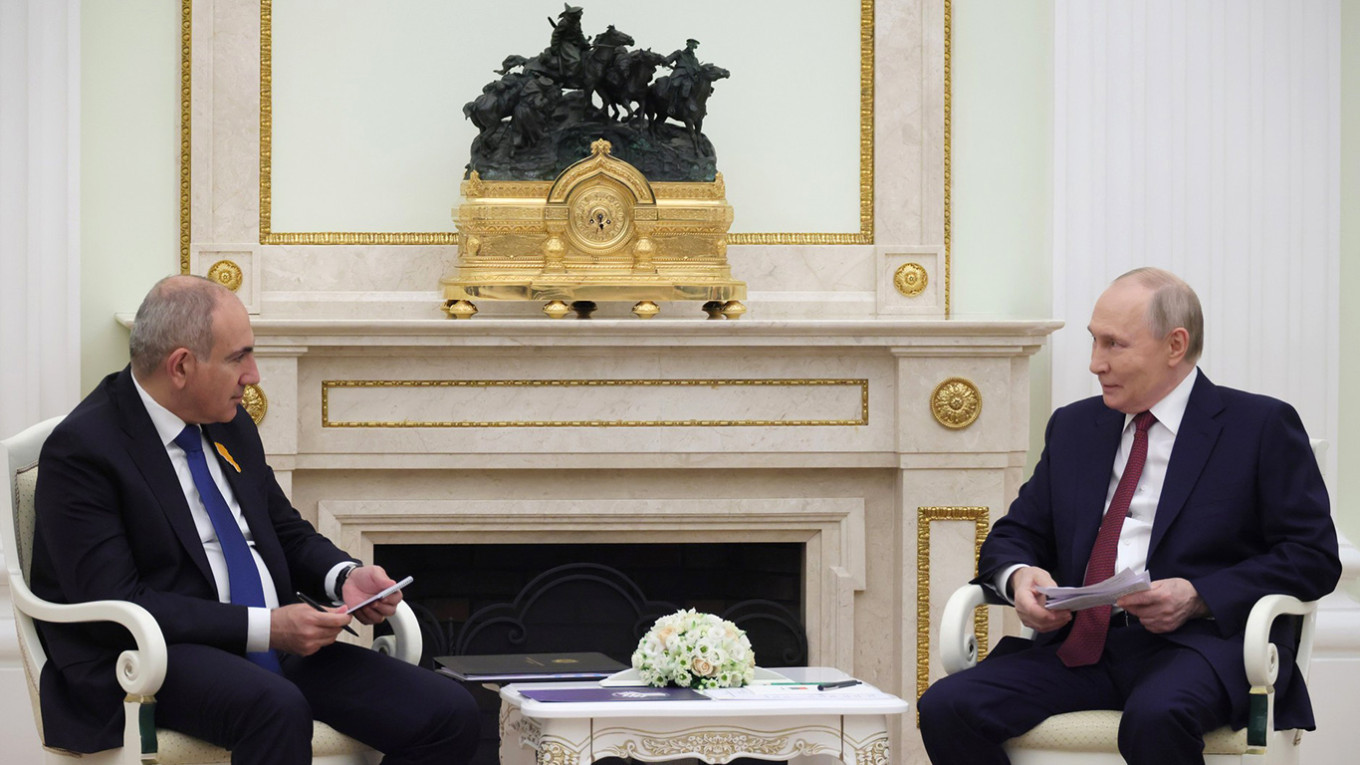
Russian President Vladimir Putin will travel to Kazakhstan on Wednesday for a three-day visit, during which he is expected to address Armenia's EU membership bid — a move Moscow has openly criticized.
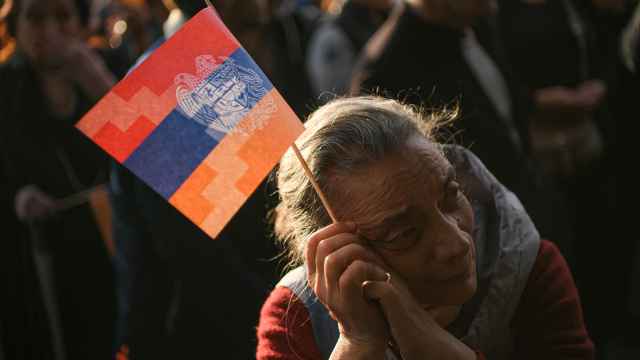
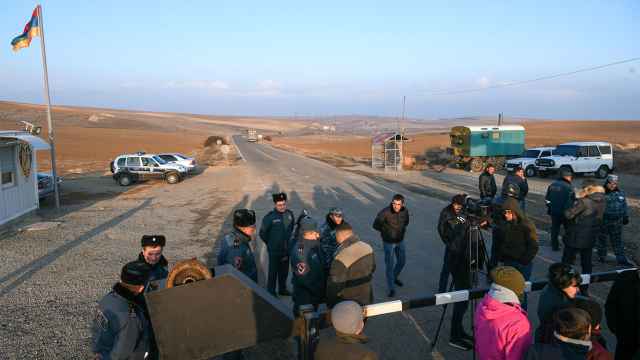
Armenia has been building ties with Brussels for years, with frustration in the country over Moscow's perceived failure to protect it during conflicts with neighboring Azerbaijan.
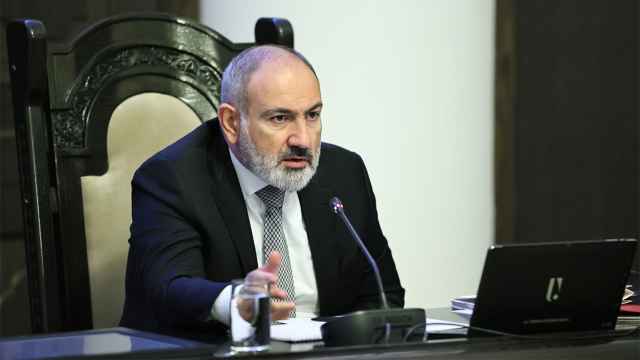
Last year, Yerevan passed a law formally declaring its intention to seek EU membership, though it has yet to submit a formal application. Armenia still hosts a Russian military base on its territory.
Speaking at a press briefing attended by AFP, Kremlin foreign policy adviser Yury Ushakov said Putin would raise Yerevan's EU aspirations at an upcoming Eurasian Economic Union summit — a Russia-led economic bloc of former Soviet states that includes Armenia.
"Putin has repeatedly stressed that it is impossible to belong to two associations simultaneously. It simply will not work," Ushakov said.
He added that it was equally "impossible" to expel a member state from the bloc, but that a country could announce it was ending its "cooperation."
The consequences and risks of such a step would need to be discussed at the summit, he added.
The Russian leader will attend the meeting alongside Kazakh President Kassym-Jomart Tokayev, Belarusian President Alexander Lukashenko, Kyrgyz President Sadyr Japarov and an Armenian deputy minister, Ushakov said.
Putin is also scheduled to speak at a forum in the Kazakh capital, Astana, on Thursday and hold bilateral talks with Kazakh officials.
He will be joined by the heads of Russia's space agency Roscosmos, which leases the Baikonur Cosmodrome from Kazakhstan, and nuclear giant Rosatom, which is currently building Kazakhstan's first nuclear power plant.
Around 15 documents covering energy, economics and tourism are expected to be signed between the two countries, Ushakov said.
A Message from The Moscow Times:
Dear readers,
We are facing unprecedented challenges. Russia's Prosecutor General's Office has designated The Moscow Times as an "undesirable" organization, criminalizing our work and putting our staff at risk of prosecution. This follows our earlier unjust labeling as a "foreign agent."
These actions are direct attempts to silence independent journalism in Russia. The authorities claim our work "discredits the decisions of the Russian leadership." We see things differently: we strive to provide accurate, unbiased reporting on Russia.
We, the journalists of The Moscow Times, refuse to be silenced. But to continue our work, we need your help.
Your support, no matter how small, makes a world of difference. If you can, please support us monthly starting from just $2. It's quick to set up, and every contribution makes a significant impact.
By supporting The Moscow Times, you're defending open, independent journalism in the face of repression. Thank you for standing with us.

Remind me later.