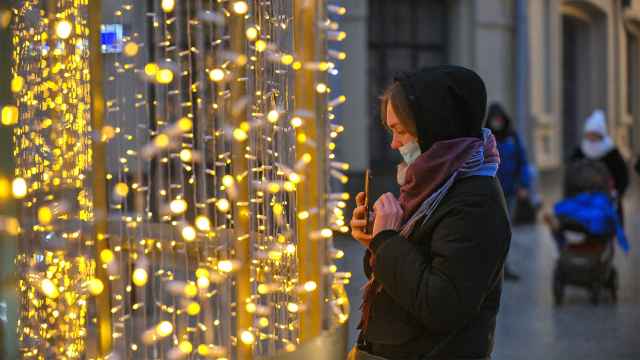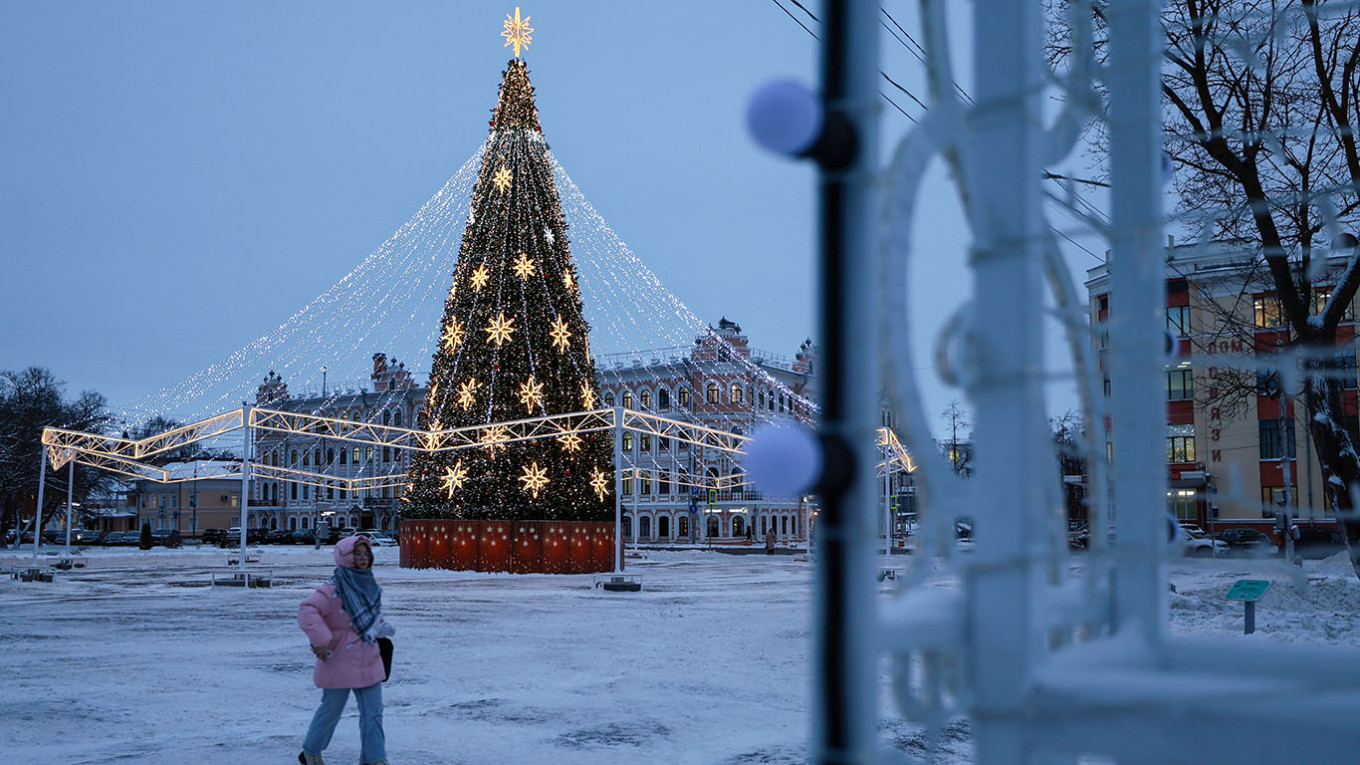
Authorities in several Russian regions have again canceled or scaled back New Year’s celebrations, citing the ongoing war in Ukraine, the Vedomosti business daily reported Monday.
With the exception of activities geared toward children, most public festivities have been canceled in the republics of Khakassia, Tyva, Bashkortostan, Buryatia and Chuvashia, as well as in the Vologda, Saratov and Leningrad regions, the Krasnodar and Stavropol regions and annexed Crimea.
“While our sons, brothers and fathers are on the front line, our main task is to be with them in our thoughts and deeds, not in noisy celebrations,” Tyva’s regional head Vladislav Khovalyg said.
He argued that large-scale New Year’s events including corporate parties and fireworks displays would be unethical while Russian troops are fighting in what Moscow calls its “special military operation” in Ukraine.
Saratov region Governor Roman Busargin urged officials to spend time collecting humanitarian aid for the front or meeting with soldiers and their families instead of organizing holiday events.
In the Siberian republic of Buryatia, authorities appealed for “solidarity with fellow countrymen defending the nation’s interests on the front line” and called for the cancellation of New Year’s corporate parties.
Bashkortostan’s head Radiy Khabirov told officials that “no one would understand” celebrations at such a time.
At least 64 of Russia’s 89 federal subjects — a number that includes annexed and occupied regions — will not hold New Year’s fireworks displays in major cities this year, the state-run TASS news agency reported.
The measures may not be welcomed by all residents, political analyst Konstantin Kalachyov told Vedomosti.
“New Year’s is sacred, a major holiday, a time of hope for a miracle,” he said. “Even in the hardest years of World War II, it remained for Soviet people a bright symbol of unity, faith in victory and a return to peaceful life.”
In regions far from the front line and largely unaffected by drone attacks, where authorities have long acted as though life is continuing as normal, the restrictions may be met with confusion, sociologist Denis Volkov said.
“But everyone knows the ‘special operation’ is still ongoing, and many will probably see this as a necessary measure,” Volkov told Vedomosti.
A Message from The Moscow Times:
Dear readers,
We are facing unprecedented challenges. Russia's Prosecutor General's Office has designated The Moscow Times as an "undesirable" organization, criminalizing our work and putting our staff at risk of prosecution. This follows our earlier unjust labeling as a "foreign agent."
These actions are direct attempts to silence independent journalism in Russia. The authorities claim our work "discredits the decisions of the Russian leadership." We see things differently: we strive to provide accurate, unbiased reporting on Russia.
We, the journalists of The Moscow Times, refuse to be silenced. But to continue our work, we need your help.
Your support, no matter how small, makes a world of difference. If you can, please support us monthly starting from just $2. It's quick to set up, and every contribution makes a significant impact.
By supporting The Moscow Times, you're defending open, independent journalism in the face of repression. Thank you for standing with us.

Remind me later.