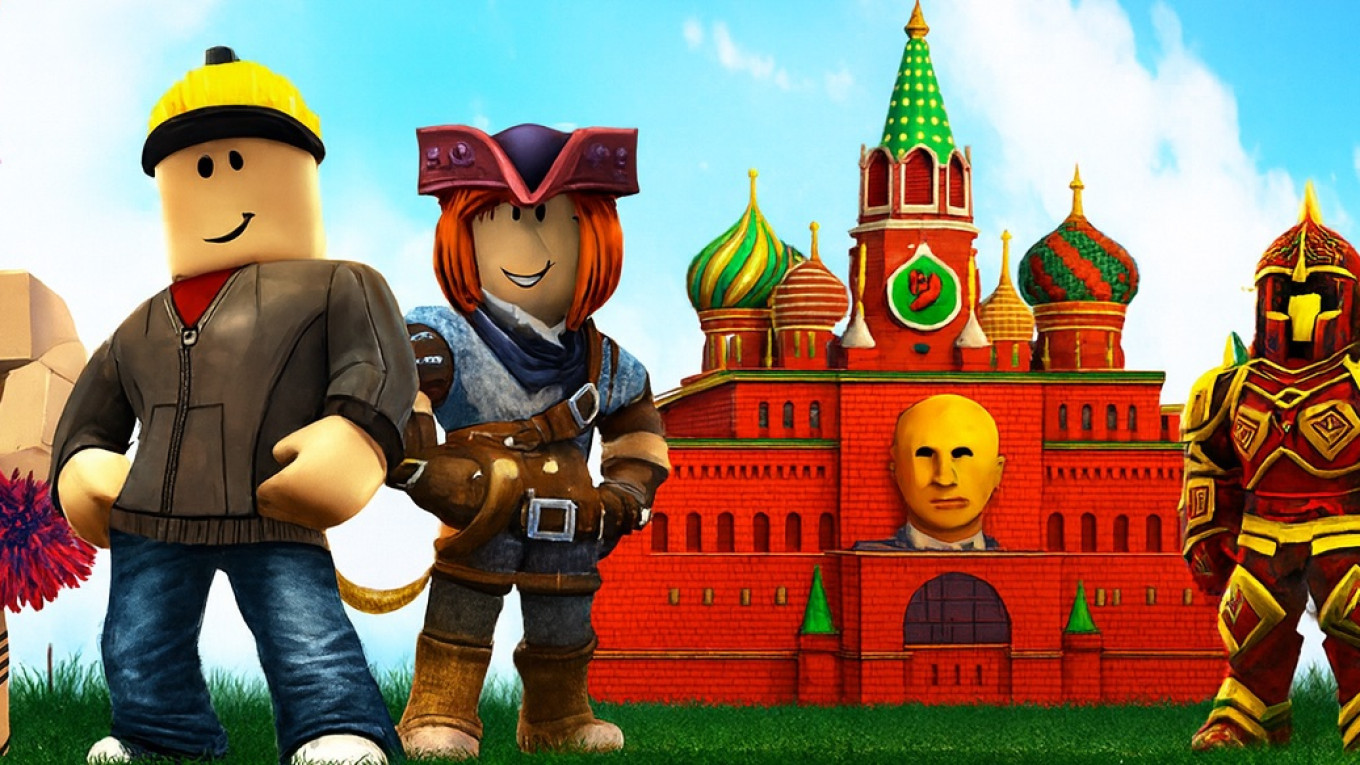
The blocking of the gaming platform Roblox once again confirmed that the Russian state is stuck in the last century. Unlike adults, who force their discontent deep inside them until better days that never come, children have no such inhibition. Kremlin spokesman Dmitry Peskov said that “many” children had written in to the president’s annual end-of-year press conference to complain about the ban.
Roblox allows users to socialize online through games they create themselves. Its risks are well known: in the eyes of many countries’ laws, this level of engagement can verge on child labor exploitation. Most importantly, these worlds are easily infiltrated by ill-intentioned adults posing as children.
The day after the ban, Yekaterina Mizulina — head of the Safe Internet League and a serial denouncer — seized the moment for self-promotion, claiming she had received tens of thousands of letters from heartbroken children. Roblox’s developer even issued a statement saying it was ready to do everything possible to improve safety and comply with local laws.
Even without Mizulina’s theatrics, children are unlikely to sigh obediently and take up bingo. The campaign to build a “sovereign internet” — purging inconvenient sites and routing everything through the state-approved Max messenger — is a bigger threat to people over 50. Many in that age group are unable or unwilling to adapt to new technology, and they pressure everyone else to accommodate them — insisting, for example, that their children abroad download Max because they refuse to learn how to use a VPN.
By contrast, children, whom Mizulina claims to protect, will manage perfectly well without her.
It is hard to imagine life in modern Russia without tools for bypassing online censorship. A constant, kafkaesque struggle unfolds: Roskomnadzor waves its blocker in all directions; VPN developers invent ever more elusive circumvention protocols; app stores remove products at the agency’s request and immediately begin selling identical new ones to fill that gap. The younger the internet user, the more likely they are to find whatever they need. The main challenge is negotiating with parents over permission to pay for the best services.
Russia started building a legislative framework for unconstitutional censorship as far back as 2008, when President Vladimir Putin’s seat-warmer Dmitry Medvedev signed a decree transforming the Federal Service for Supervision in the Sphere of Mass Communications, Communications and the Protection of Cultural Heritage (does anyone still remember that idiotic acronym — Rossvyazokhrankultura?) into a more narrowly specialized body: Roskomnadzor.
That small man, whose career has progressed from selfies in elevators to drunken tantrums on X, is still sometimes remembered today as a progressive reformer — at least in comparison with Putin. And yet it was precisely his short stint at the helm that produced the notorious 2012 Internet Restriction Bill.
In 2014, amid the annexation of Crimea and the downing of Malaysia Airlines Flight MH17, State Duma deputy Andrei Lugovoi dreamed up the blocking of websites without the need for a court decision. At that point, censorship in Russia was de facto introduced.
The former diversity of public opinion was quickly forgotten. Soviet-style doublethink returned — opinions best kept to oneself, with passive resistance to the imposed unanimity. Meanwhile, the leadership continued — and continues — to exploit the rhetoric of democracy and free speech, thereby discrediting those very concepts.
In 2018, the American NGO Freedom House ranked Russia at 53rd out of 65 countries in terms of internet freedom. That was the very year Roskomnadzor tried to block Telegram, whose success was ironically encouraged by restrictions on free speech.
First, it was Generation Z, now it is Generation Alpha, whose online lives are as real to them as their friends at school. They look at bureaucrats in cheap jackets, insisting censorship is “for their own good,” exactly as those bureaucrats deserve to be seen.
Of course, faceless bureaucrats in gray suits do real damage. They helped enable the attack on Ukraine, treating human lives like a first-person shooter. They grind everything they touch into pulp — and they do it while steadily numbing the minds of loyal citizens.
But it is precisely children — whom those bureaucrats still dismiss as clueless brats — who can, simply by the way they live, raise a giant middle finger. And that is exactly what is happening.
Russian officials have always looked foolish. But in the years of full-scale war, they have never looked more ridiculous. In peacetime, that kind of decay could provoke an easy laugh among people who still think. Now it is no laughing matter: the dusty people in charge have plans vast enough to chill the blood. Yet no matter how much havoc they wreak in their rusty world of blood, dirt and so-called traditional values, the digital world is not fully theirs to command.
A Message from The Moscow Times:
Dear readers,
We are facing unprecedented challenges. Russia's Prosecutor General's Office has designated The Moscow Times as an "undesirable" organization, criminalizing our work and putting our staff at risk of prosecution. This follows our earlier unjust labeling as a "foreign agent."
These actions are direct attempts to silence independent journalism in Russia. The authorities claim our work "discredits the decisions of the Russian leadership." We see things differently: we strive to provide accurate, unbiased reporting on Russia.
We, the journalists of The Moscow Times, refuse to be silenced. But to continue our work, we need your help.
Your support, no matter how small, makes a world of difference. If you can, please support us monthly starting from just $2. It's quick to set up, and every contribution makes a significant impact.
By supporting The Moscow Times, you're defending open, independent journalism in the face of repression. Thank you for standing with us.

Remind me later.