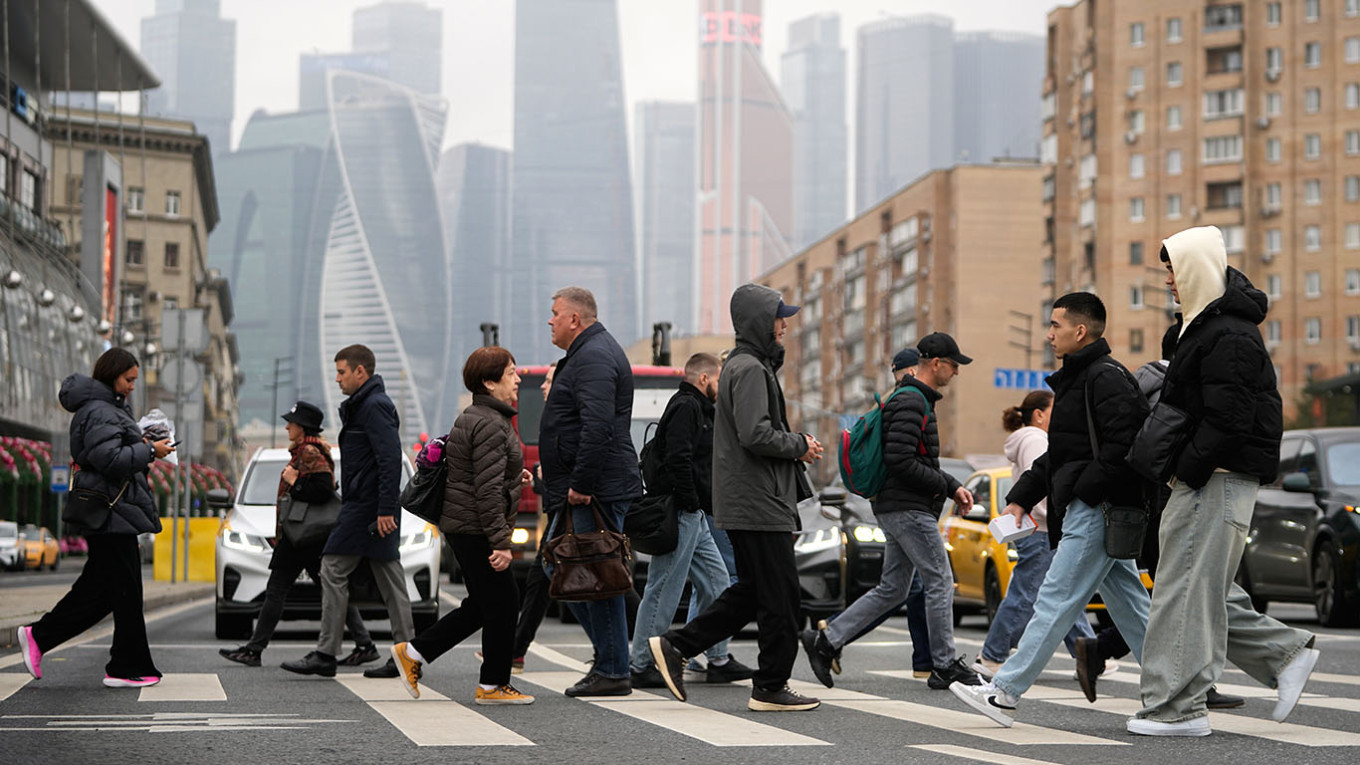
Russian households are finding it increasingly difficult to forecast their earnings despite incomes being on the rise for nearly three years, according to a new survey by the Public Opinion Foundation (FOM).
Half of respondents said they could only predict their family income for six months or less, up from 44% two years ago.
The planning horizon is shrinking across the population, FOM said.
The poll, conducted monthly for the Central Bank, tracks perceptions of inflation, saving behavior and financial wellbeing, and once a year asks how far ahead Russians can foresee their income.
Compared with November 2023, the share of those who said they could predict income for “less than a month,” one month, two-three months or four-six months increased, while longer-term answers declined or remained unchanged.
The most common response (16%) was two to three months.
Another 13% said they could predict income only a month ahead; 13% said four to six months; and 13% said seven to 12 months.
One in 12 respondents (8%) said they could not predict their income even a month in advance.
In total, nearly two-thirds (63%) said they had no idea what their income would be a year from now.
FOM said respondents in stronger financial positions were more likely to forecast earnings further ahead.
Among those who said they could afford any necessary expenses, including a car, 12% could plan income one to three years out, compared with 7% among all respondents.
Those who reported lacking money even for food or clothing were far more likely to choose one month or less, and also struggled most with the question.
Forty-four percent of people lacking money for food and 34% of those lacking money for clothing said they could not give an estimate, compared with 25% overall.
FOM said people who cannot afford food or clothing often lack stable income sources and rely on irregular work, while higher-paying jobs are typically more stable.
This uncertainty persists despite sustained growth in wages and incomes.
According to the Higher School of Economics’ Center for Business Tendencies Studies, survey respondents began reporting more positive assessments of their financial position, saving opportunities and conditions for major purchases starting in the third quarter of 2023.
Real disposable household income in January-September was 9.2% higher than a year earlier, while real wages rose 4.5%, state statistics agency Rosstat reported.
A separate Central Bank survey found the strongest income growth among Russia’s poorest households, while higher-income groups saw declines.
Analysts at the Central Bank warned that rapid income gains could distort expectations.
Optimism about future finances was at its highest and concerns about deterioration at their lowest among those whose incomes rose more than 50% between 2022 and 2024.
But FOM surveys consistently show that most Russians still struggle to make ends meet.
Only about one-third have savings that would allow them to cope for a time if they lost their income. Around 70% say they had to cut spending or abandon planned purchases over the past year due to lack of money.
Between 5% and 8% describe their situation as “not enough money even for food,” while a further 20% say they can afford food but not clothing or shoes.
In the latest poll, 28% said their financial situation had worsened over the past year, while 16% said it had improved.
A Message from The Moscow Times:
Dear readers,
We are facing unprecedented challenges. Russia's Prosecutor General's Office has designated The Moscow Times as an "undesirable" organization, criminalizing our work and putting our staff at risk of prosecution. This follows our earlier unjust labeling as a "foreign agent."
These actions are direct attempts to silence independent journalism in Russia. The authorities claim our work "discredits the decisions of the Russian leadership." We see things differently: we strive to provide accurate, unbiased reporting on Russia.
We, the journalists of The Moscow Times, refuse to be silenced. But to continue our work, we need your help.
Your support, no matter how small, makes a world of difference. If you can, please support us monthly starting from just $2. It's quick to set up, and every contribution makes a significant impact.
By supporting The Moscow Times, you're defending open, independent journalism in the face of repression. Thank you for standing with us.

Remind me later.