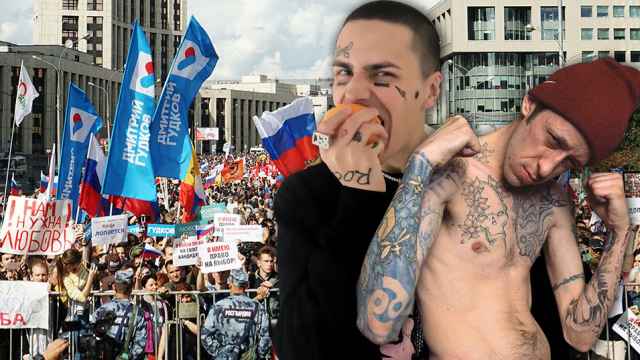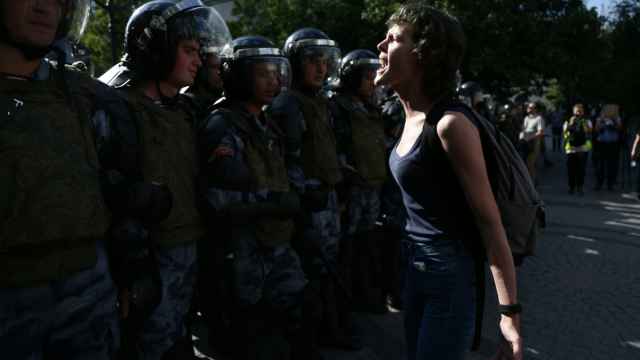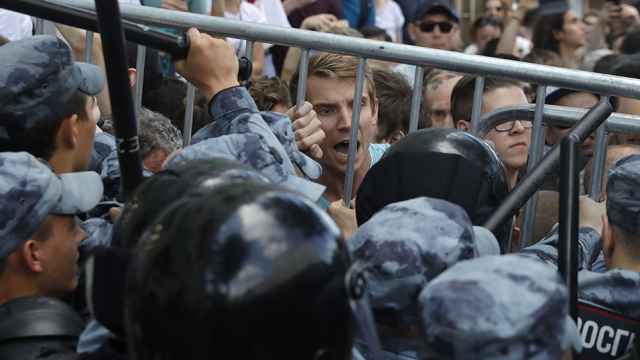

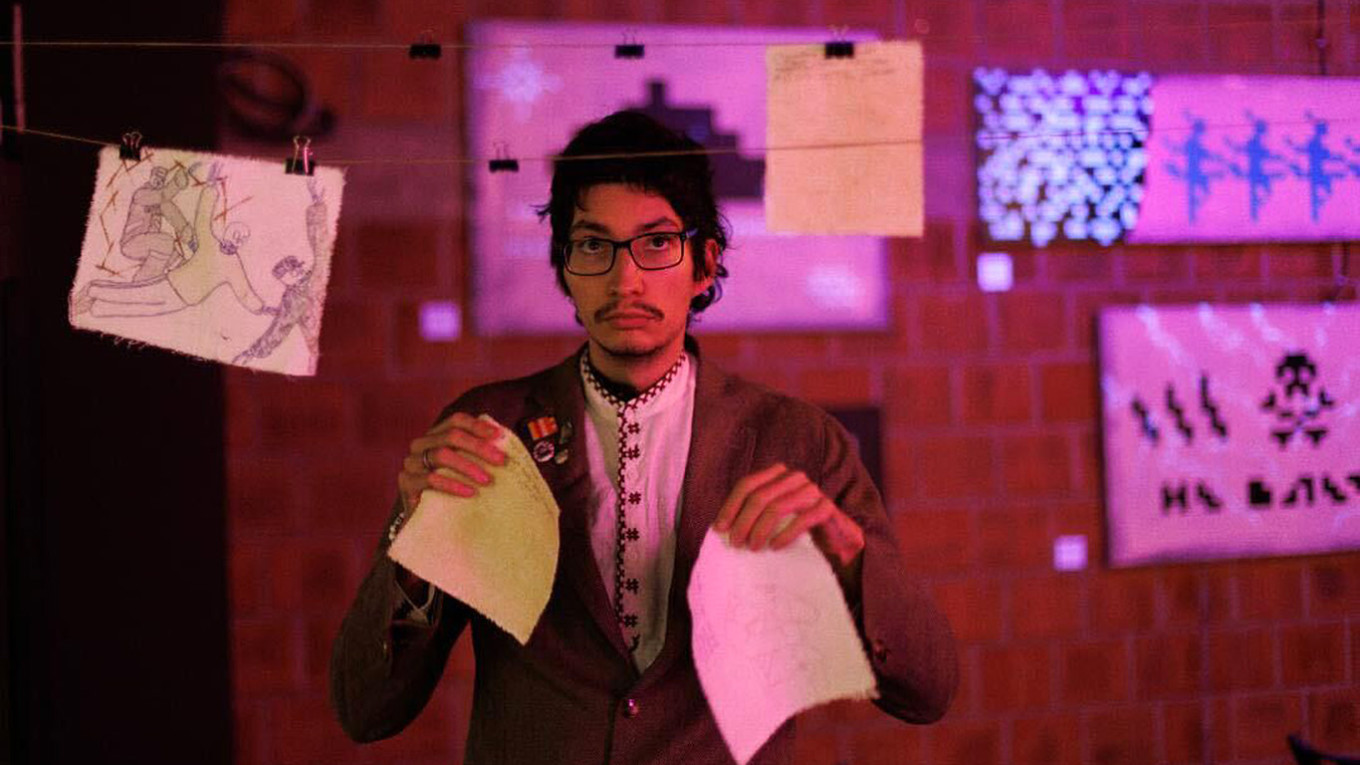
To mark the fourth anniversary of Russia's invasion of Ukraine, Pavel Krisevich stood outside the Kremlin walls and challenged the Russian leader to a duel.
“Putin, come out,” shouted Krisevich, who was decked out in boxing gear.
Yet Krisevich was not actually in Russia. The performance artist and political activist was using AI to depict himself on Red Square.
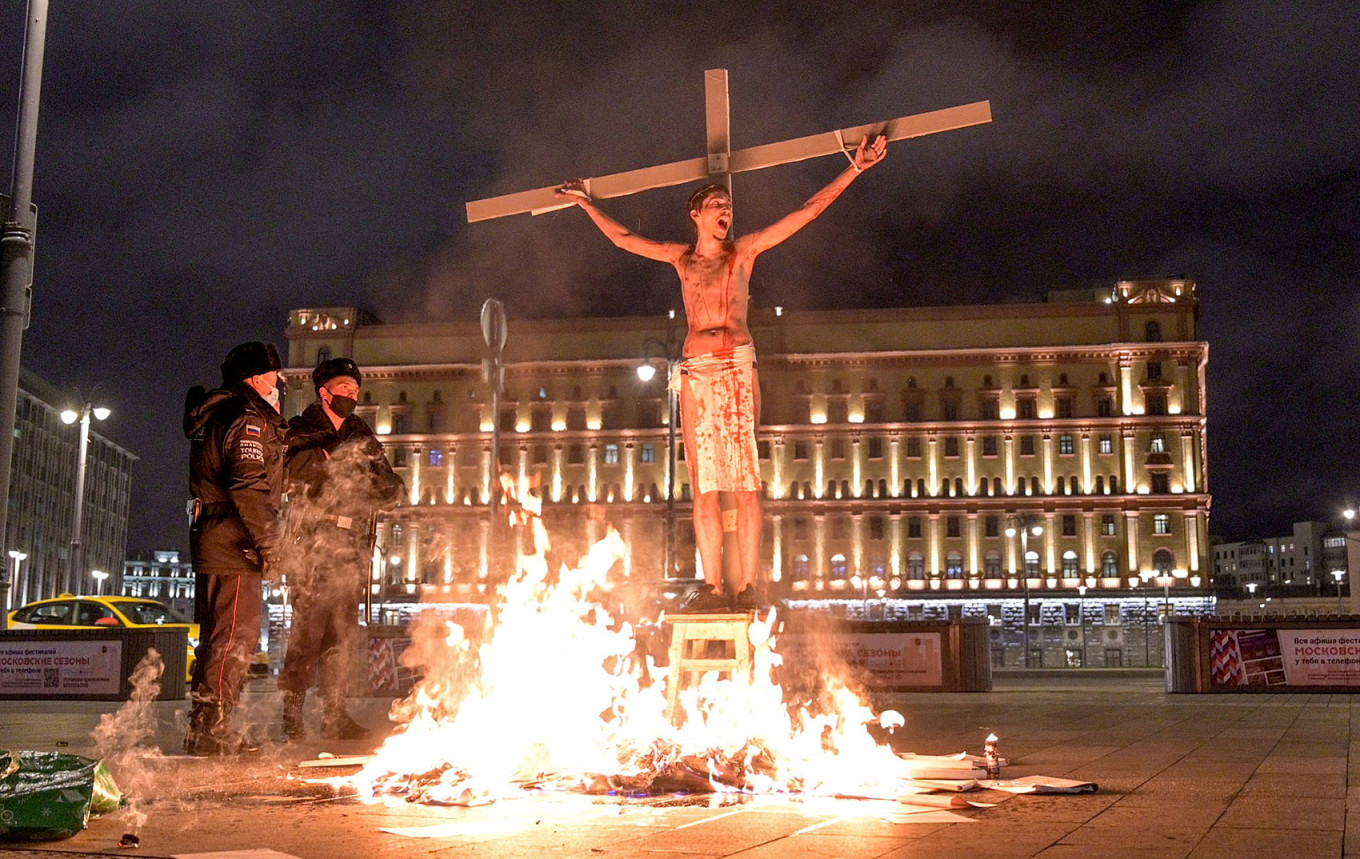
Krisevich, 25, is known for provocative public actions criticizing state repression, militarism and censorship in Russia. He has served prison time for performances like a simulated suicide on Red Square to protest restrictions on free speech and a mock crucifixion in support of political prisoners outside the Federal Security Service (FSB) headquarters.
After his release from a three-year prison term in 2025, Krisevich was arrested several more times, including during an attempt to stage a photoshoot at a rocket monument near Moscow that he said was a reference to Stanley Kubrick’s anti-war film “Dr. Strangelove.” He left Russia later that year and is now awaiting French asylum in Montenegro.
His challenge to Putin referenced a 1995 protest by artist Alexander Brener, who challenged then-President Boris Yeltsin near the Kremlin during the First Chechen War.
In an interview with The Moscow Times, he said the AI format allowed him to stay engaged with Russia’s political climate while avoiding the risks faced by activists still inside the country.
This interview has been edited for length and clarity.
MT: What were you seeking to express through the performance in which you invited Putin to a duel?
PK: I conceived this performance while I was still in Russia. After leaving, I had to rethink how to continue working as an artist in exile. The AI format allowed me to somehow overlay myself onto what is happening in Russia and finally speak out without the censorship I faced when I was there.
People usually encounter performances through photos or video anyway. Even if something is created using AI, it still exists and has a certain charm — some people will believe it, others won’t, and it will provoke discussions. I didn’t hide the fact that the performance was AI, but some people believed it actually happened. As an artist, it was important to see how this new format works. Any action you take in real life now comes with very serious responsibility. In my view, people have the right to use such forms to push the boundaries of what is permissible.
The performance reflects my attitude toward the war between Russia and Ukraine. People want peace. I want Putin not only to come out of the Kremlin to face me in this duel, but also leave for another country. It’s clear that Putin will never come out to face me. So why complicate things when you can do this performance without being present yourself?
I’ve seen comments saying that such actions diminish activists who remain in Russia. But during the year I stayed in Russia and communicated with activists there, many are just glad that at least something is being done safely. The mere fact that [this performance] happened — even if not in real life — can be a symbol of inspiration, prompting others either to decide to do their own performance or simply to be inspired.
After all, all contemporary art actions that take place in real life in Russia are precisely searching for these mimicking forms. This was the case in 2025, when Feminist Anti-War Resistance and [feminist activist] Daria Serenko staged a performance with banners advertising clothes hangers [in a campaign for abortion rights]. Some activists I know who remain in Russia also carry out small intrusions into reality with art that reveals its meaning only when viewed closely.
MT: You carry out political performances but were forced to leave the country. How do you engage with discourse and culture inside Russia?
PK: This is my biggest dilemma. This performance is one expression of the internal dilemma I had, because I want to remain within the Russian reality. Of course, this is much easier now than it was half a century or a century ago, because you have AI and the internet. Through news and social media, you can still get a rough idea of what people think and what they talk about.
People inside Russia are very skeptical toward those who have left. No one likes it when someone in Georgia or Europe decides things for them. I have no right to call on others to protest from abroad. Once you’re no longer in Russia, even after a month, you can’t imagine the pressure hanging over every Russian activist.
When I finally settle in the country where I’m applying for asylum, I’ll face a more difficult choice between building a new life and continuing to live artistically within the Russian context. Of course, I want to continue living this Russian life through my work.
MT: You stayed in Russia for a year after your release from prison. How did the situation there compare with your expectations?
PK: As my release date approached, I didn’t expect anything good. But I didn’t think there would be such paranoia in the law enforcement agencies, roughly speaking. You don’t even need to do anything to be viewed as an enemy and a potential saboteur.
A week before my release, FSB officers visited me and started lecturing me that if I did anything, they would definitely imprison me again. I realized that even the picture of Russia that leaked through state media was far lighter than reality. If you live an ordinary life, you can still avoid much of this — you might face economic pressure or see calls to sign a contract with the Defense Ministry and so on — but you can retreat into internal emigration. But if you engage in political activism, you must be prepared for them to come with a search warrant at any moment or for you to become a witness in some criminal case. Or local police officers might just come and ask if everything is okay. You can be detained ahead of important events or celebrations.
Considering that prison preserves a person in time, I was released in 2025 as a person who is emotionally in 2021. That’s obviously why I was drawn to continuing my performances. At the same time, there was even greater pressure — if I did something serious now, I’d be imprisoned again, and that would be the end. I really didn’t want to go to prison a second time.
It’s a completely different reality in Russia: the economy is struggling, there’s an increasingly paranoid search for internal enemies because security forces need to fulfill certain quotas, you can do activism relatively freely only as long as you haven’t been spotted by the security services.
For activists today, remaining underground for as long as possible is often the only way to keep doing actions that might be small, but can still influence people’s thinking.
MT: What motivated you to do performances under such pressure?
PK: The main meaning for me was to show that protest continues, to create emotional messages that could inspire others. It’s hard for everyone to watch new criminal cases being opened and life becoming harsher. By doing my performances, I want to inspire people so that no one gives up and also to show the West that such forms of protest still exist in Russia.
Now, with such repressive pressure on activists, I believe that all forms of protest matter — every form of self-expression. People should remember that they are not obliged to tie themselves to familiar forms of protest. They can seek unusual forms of self-expression that leave a mark on the face of the city, on the streets or simply on social media. That’s also good. It’s a cultural layer that shows what kind of country we live in now and the situation we’re in.
MT: While you were in prison, you continued to produce new works of art. How did you manage to do that?
PK: It all developed in a kind of experimental way. From the very beginning, when I ended up in prison, I realized it would be for a long time. I thought that since I was already there, I needed to look for forms of creativity.
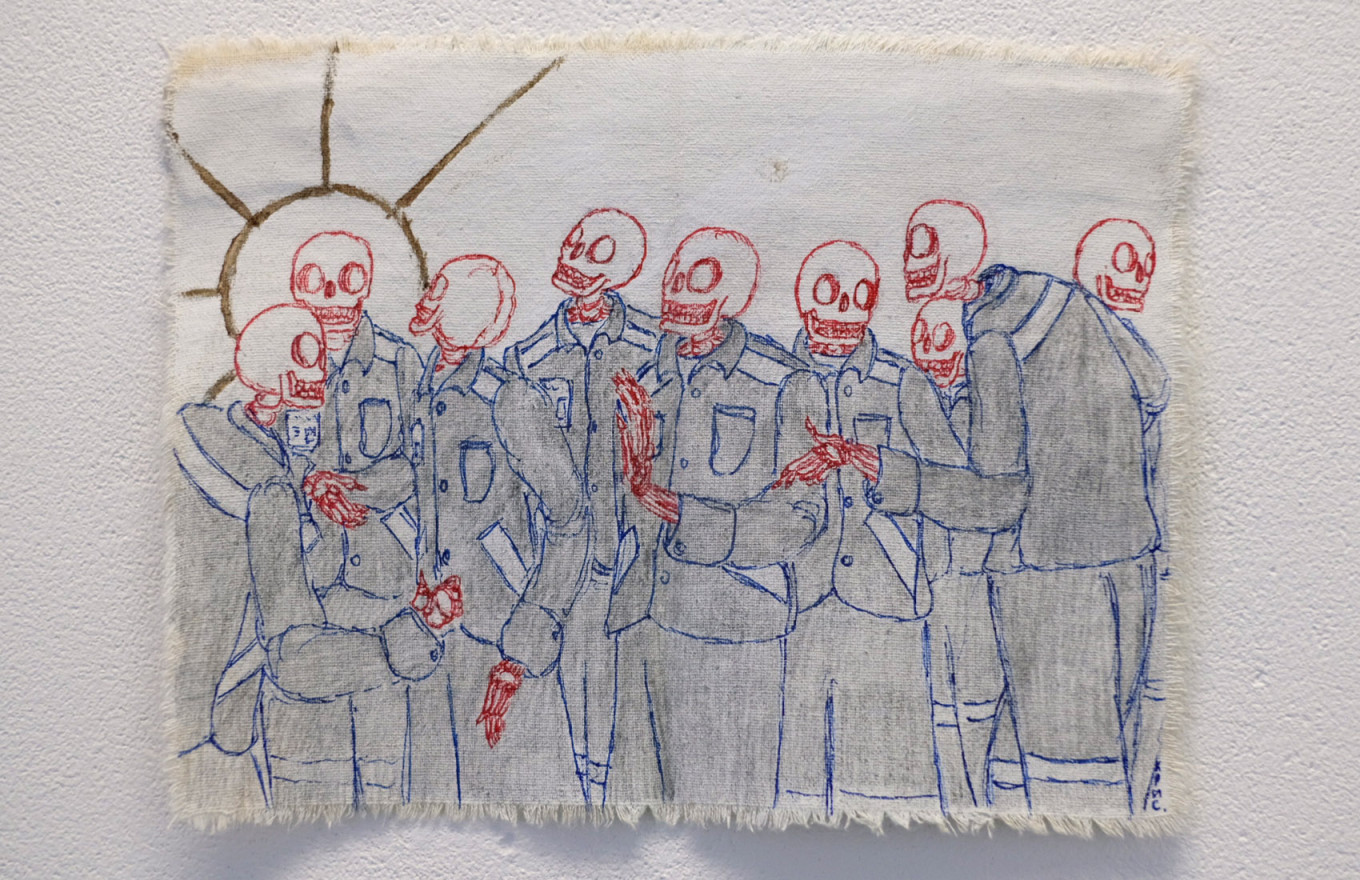
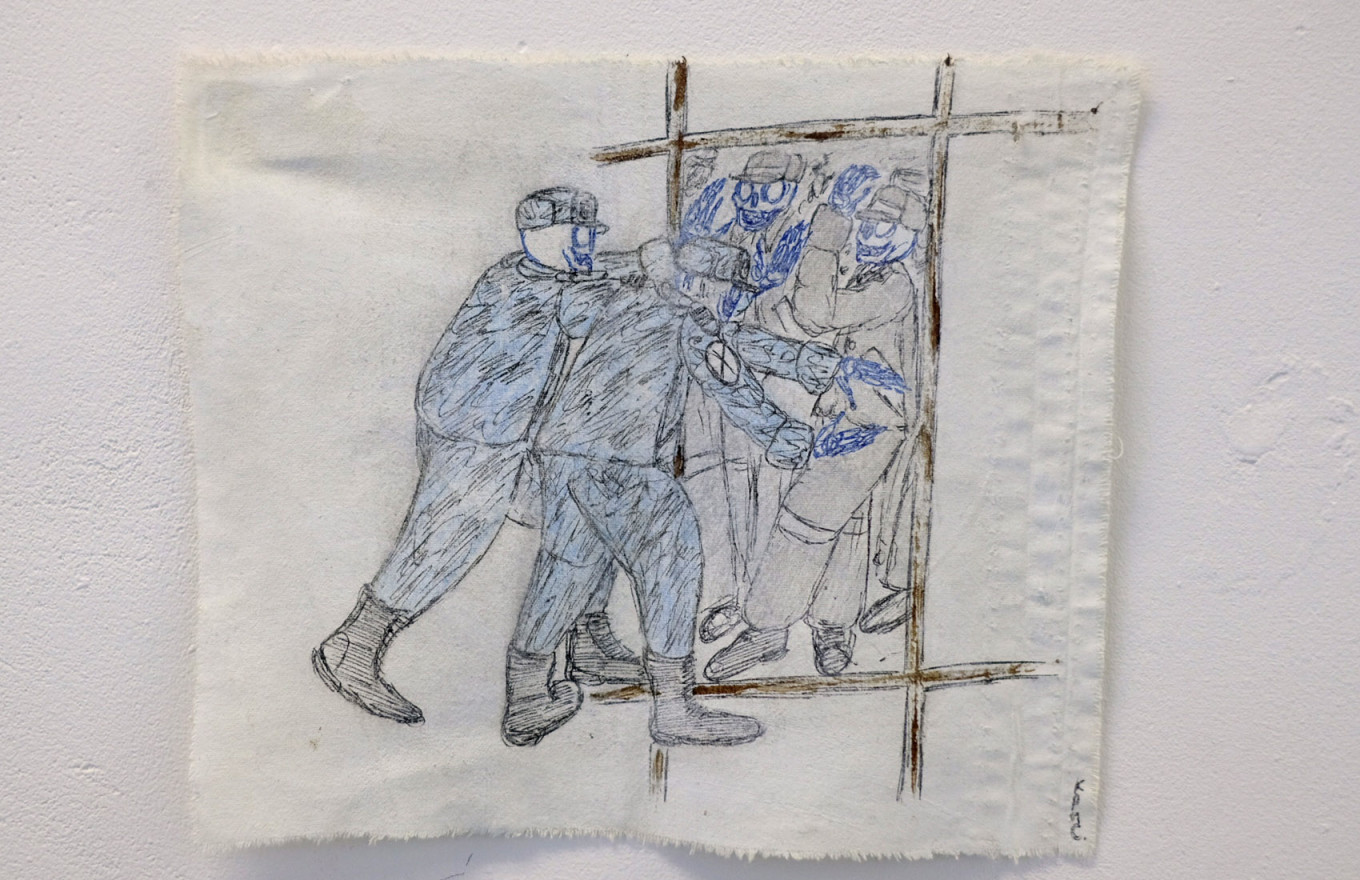
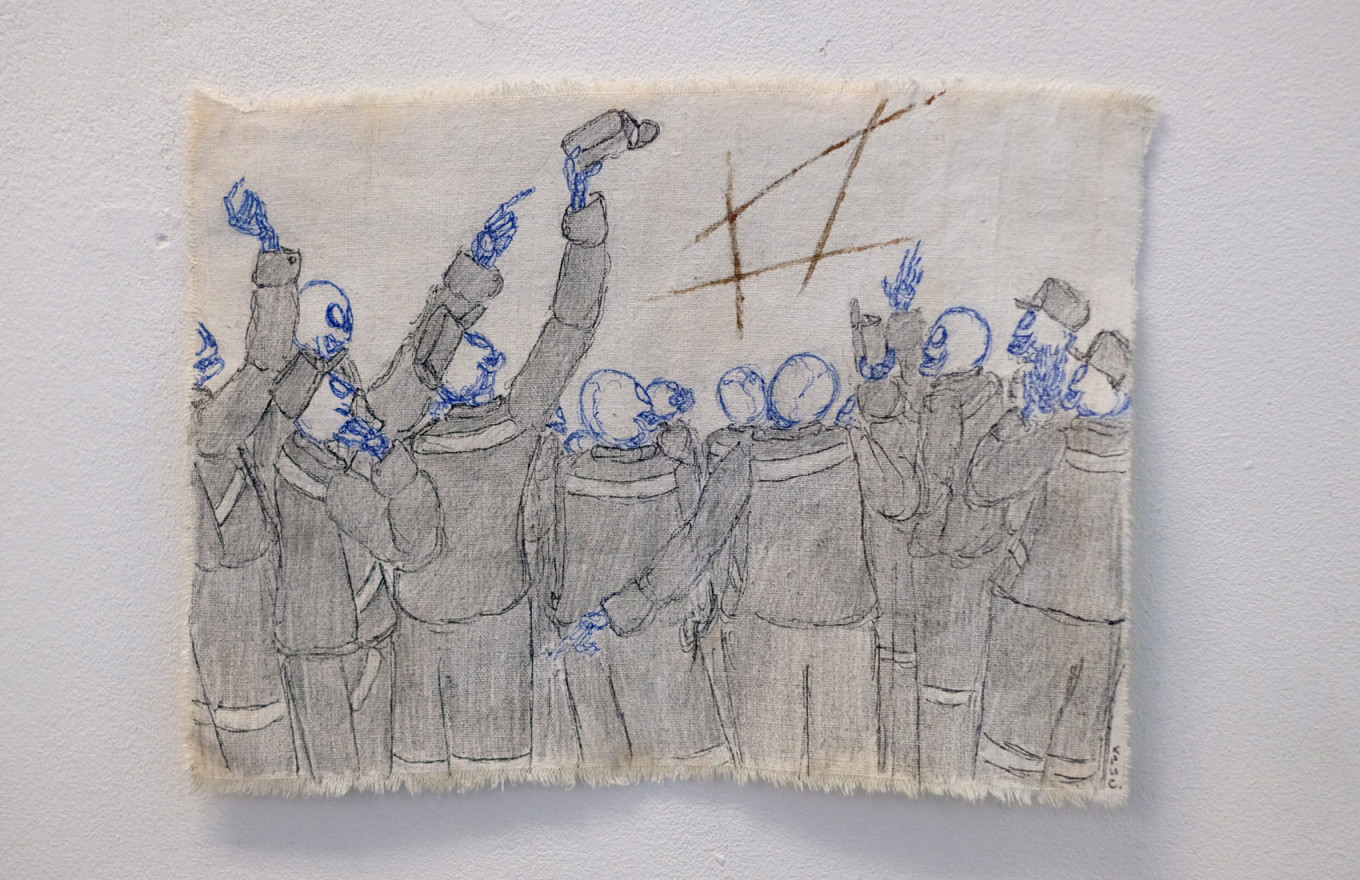
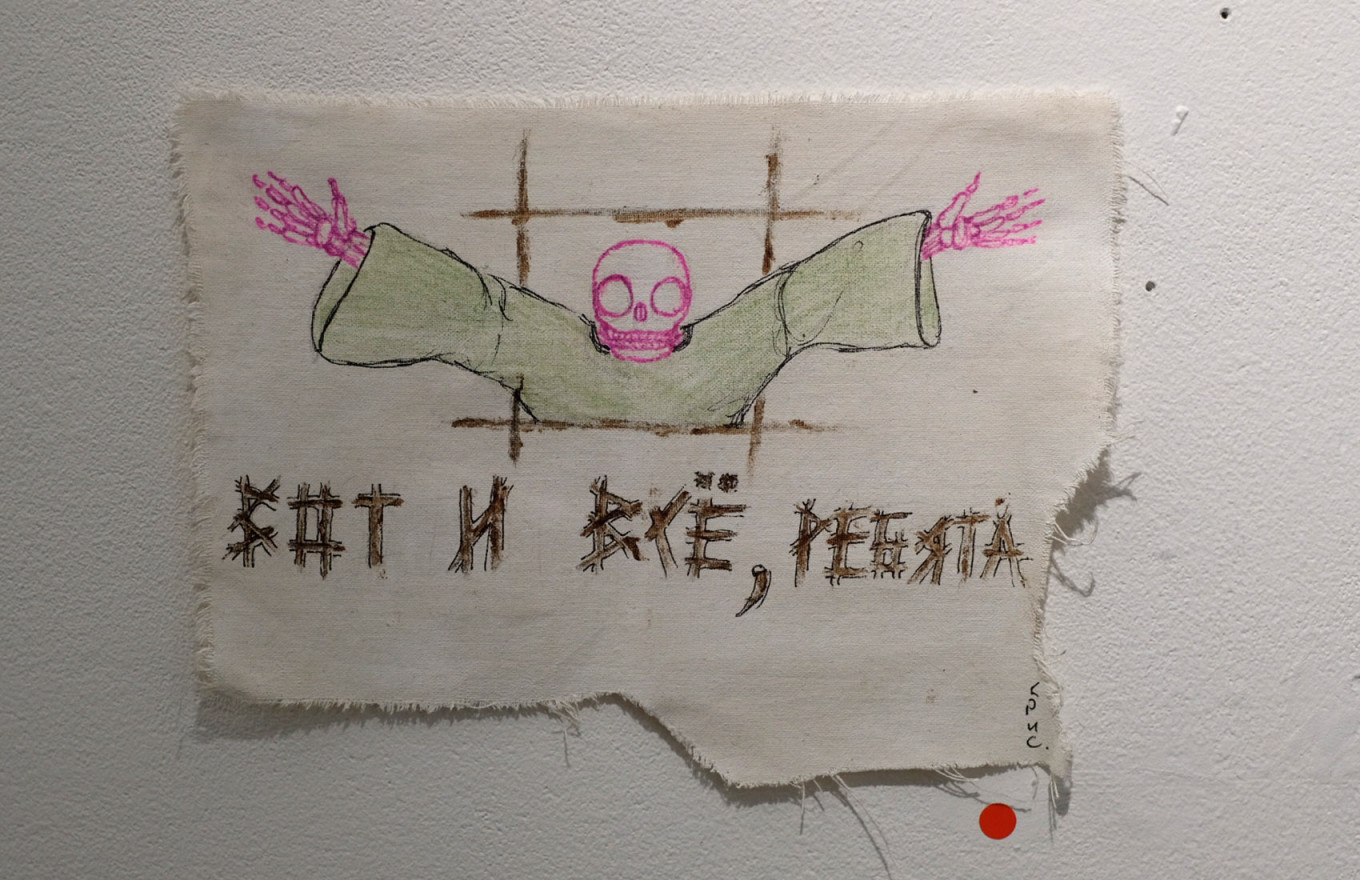
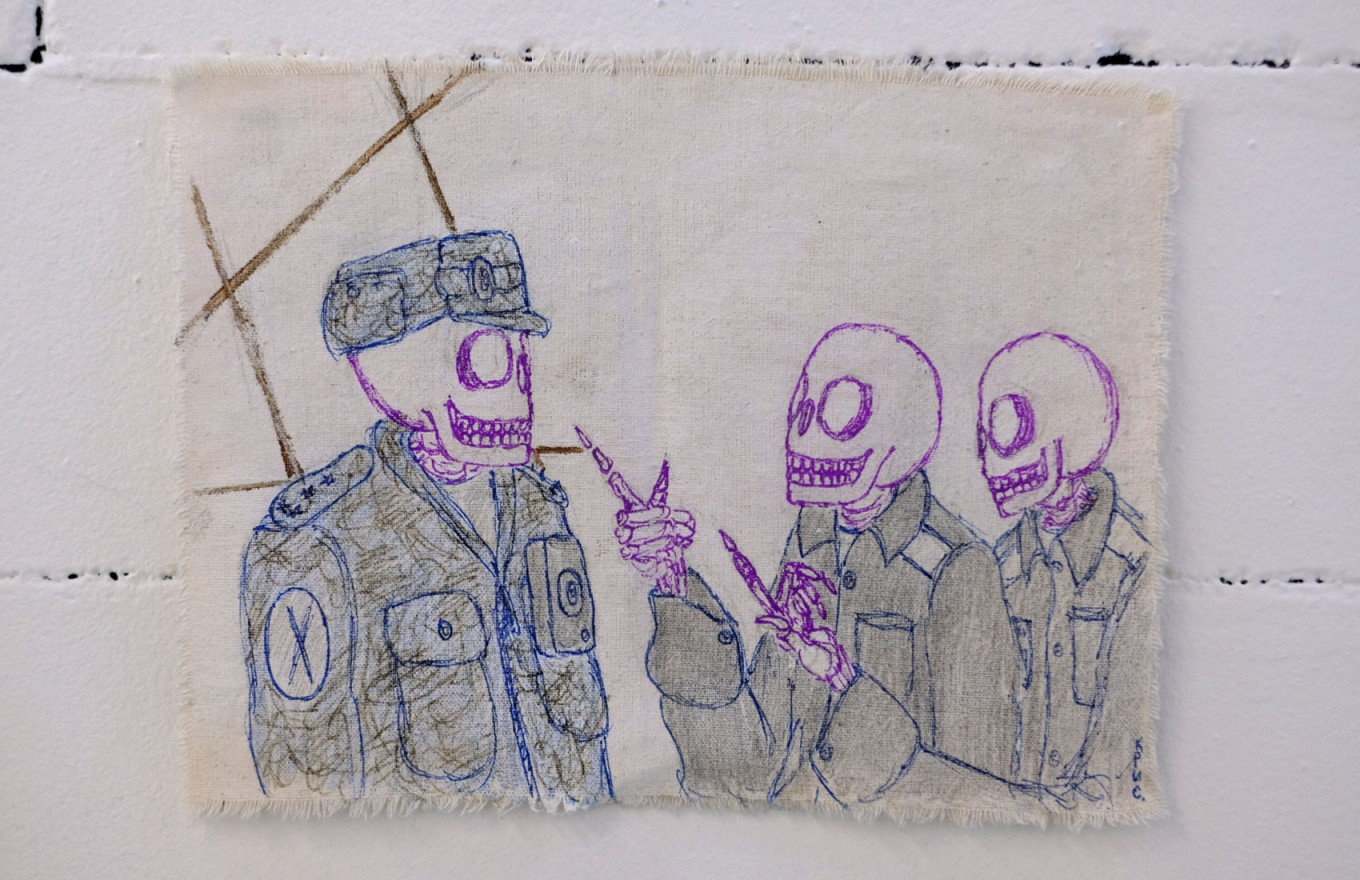
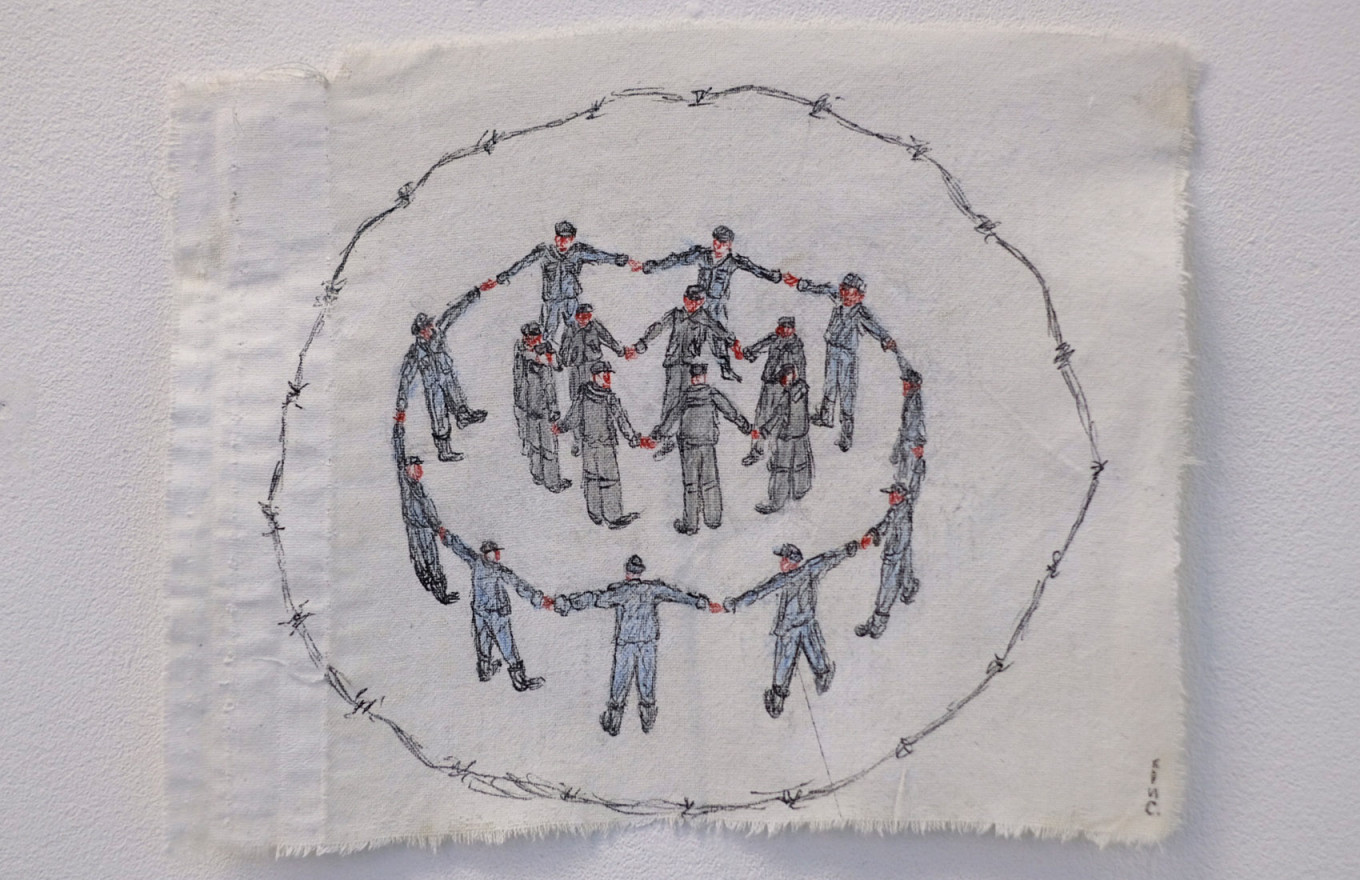
Partly through talking to cellmates who had already been in prison before, I learned that drawing on bedsheets is very common in prison. We made homemade paints using toothpaste, paint scraped from walls, coffee, dyes from bleeding shirts, pen ink and charcoal from burnt matches. I experimented with my cellmates, drawing simple works without priming. Then we realized we could coat a simple bedsheet with toothpaste, which hardens and makes the drawing look brighter.
From there, it became a process: I would open up a piece of prison bedsheet, prime it with toothpaste, prepare the paint and draw. Over time, the works developed their own creative theory. I began to use my own blood more in the drawings and now, even in freedom, I continue to draw with my blood.
MT: What are your plans for the future?
PK: We’re waiting for humanitarian asylum. Creatively, I plan to continue holding exhibitions of what I’ve been creating after prison — like window bars that I redraw in blood, or embroidery on clothing. We’ll continue to push all this forward, integrating into salons, exhibitions and so on. But I still don’t look as far ahead as I used to when I was in Russia — no more than a week — because everything changes very quickly.
A Message from The Moscow Times:
Dear readers,
We are facing unprecedented challenges. Russia's Prosecutor General's Office has designated The Moscow Times as an "undesirable" organization, criminalizing our work and putting our staff at risk of prosecution. This follows our earlier unjust labeling as a "foreign agent."
These actions are direct attempts to silence independent journalism in Russia. The authorities claim our work "discredits the decisions of the Russian leadership." We see things differently: we strive to provide accurate, unbiased reporting on Russia.
We, the journalists of The Moscow Times, refuse to be silenced. But to continue our work, we need your help.
Your support, no matter how small, makes a world of difference. If you can, please support us monthly starting from just $2. It's quick to set up, and every contribution makes a significant impact.
By supporting The Moscow Times, you're defending open, independent journalism in the face of repression. Thank you for standing with us.

Remind me later.