
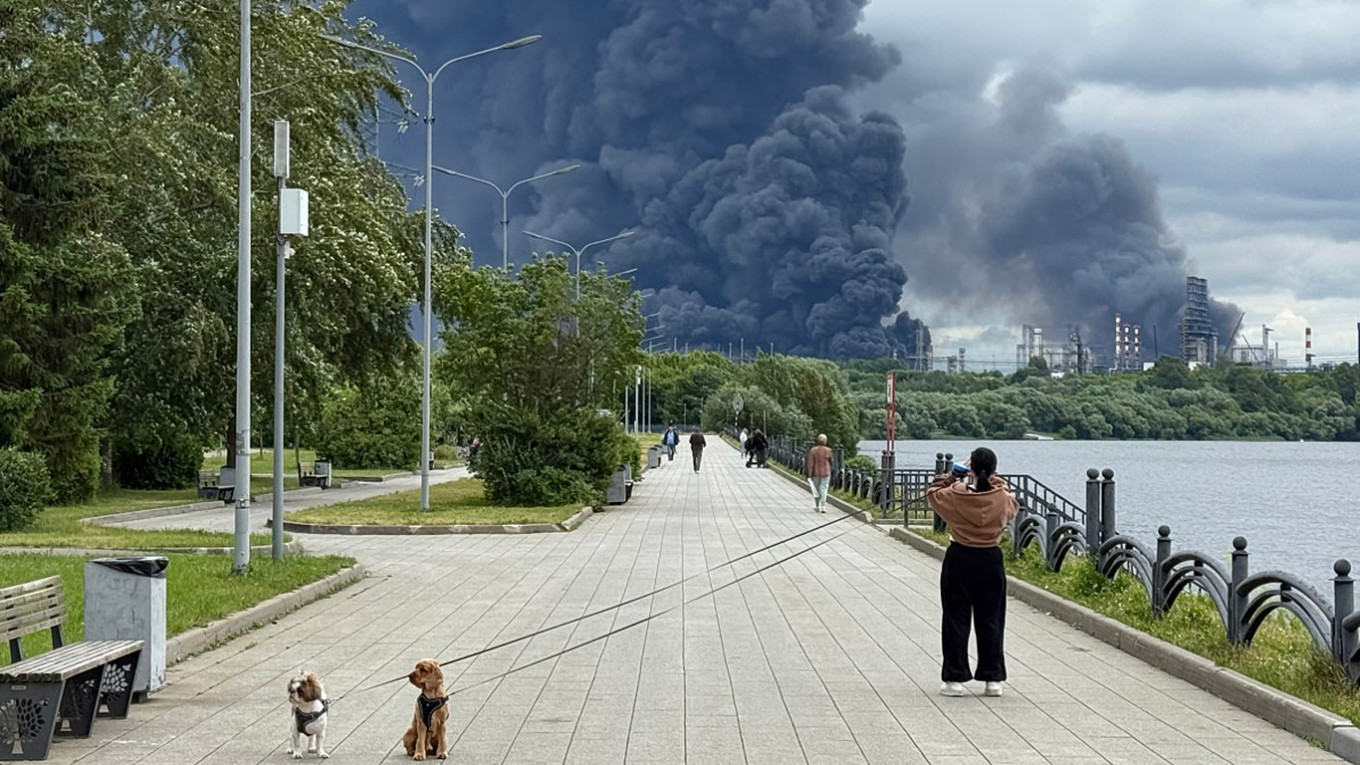
When Ukrainian drones struck targets in Moscow on June 16, 18 and 22, the attacks were notable not only because of the dramatic footage that they generated. Along with the attack on an oil terminal near St. Petersburg, they repeatedly exposed the Russian capital’s air defense as faulty, even as the Defense Ministry made the questionable claim that air defense systems shot down a thousand drones and the Kremlin’s spokesperson praised the response.
Military experts pointed out that defending against drones arriving from multiple directions requires extensive coordination across Russia's integrated air defense network, which was “not happening properly." Beyond the very likely military shortcomings, however (which this article will not to go into), the political response to the drone attacks also exposed the underlying contradictions in how Russian authorities are supposed to handle such crises.
In a remarkable parallel to the Ukrainian army’s 2024 incursion into the Kursk region, President Vladimir Putin stayed away from the bad news as long as possible, not visiting the region for months. On the day of the attack on the Kapotnya refinery, he was in Kazan, attending the Russia-ASEAN summit and avoided the topic for days afterward. When he did talk about it, it was in broad terms in which he blamed Europe for helping Ukraine with drone launches, threatening consequences and pushing responsibility outwards to an external enemy.
After the drone attacks on Moscow, Russia's main television channels did not cover the attack in their daytime broadcasts. Instead, state-adjacent media pivoted to warnings about the criminality of filming drones, suppressing footage of events that Muscovites were able to see from their own windows.
The underlying logic is clear: allow the bureaucratic machine to manage the public framing while security services handle suppression. Do not admit mistakes at the top, as that is dangerous in a personalist autocracy.
Russia's system of governance is not, as it is sometimes portrayed in Western commentary, a rigid and simple top-down hierarchy in which the Kremlin issues instructions and underlings obey. Rather, it is a system of deliberately overlapping responsibilities and managed conflicts in which ambiguity is a feature, not a bug.
In peacetime, this produces corruption and inefficiency but also a kind of stability, especially from the point of view of the Presidential Administration, which can act as an arbiter and decider of last resort, prevent the emergence of potential strong challengers and get useful information on the problems of the day. In real crises, however, this means that accountability can always be deflected elsewhere and the course of action is unclear, save from some standing principles of the system.
To civilian officials, the personal risk of owning a problem but failing to solve it is great. That is in spite of the fact that one of the core features of Russia's domestic governance is centralized decision-making and decentralized crisis management, and that subnational administrators often lack the funds and the incentives to prepare for crises proactively. Civilian administrators who step forward in a crisis situation expose themselves to potential criminal liability, often instead of the security elite who are shielded from such responsibility.
Meanwhile, the system of incentives that has traditionally underpinned and oiled regional political machinery that administrators could rely on — the so-called adminresurs — are shakier.
Take some recent examples: leading officials in the Kursk, Belgorod and Bryansk regions faced criminal responsibility for corruption linked to the construction of their defensive fortifications, even though it is likely that none of them thought the military would be so unprepared to make them necessary. Belgorod’s governor, Vyacheslav Gladkov, while he stayed out of prison, saw his career arc broken, likely due to his vocal opposition to internet restrictions, in spite of his successful crisis management credentials.
Regional officials and economic elites with seizable assets have faced increasing pressure from the security services and the investigative authorities over the past two years, amid an ongoing crackdown on deputy governors and regional ministers in various corruption cases. Russia’s nationalization drive has transferred 6.5 trillion rubles ($86.8 billion) worth of assets to state ownership, often based on charges that had previously been understood as fair game.
The repressive reflex and the avoidance of responsibility for bad news were also on display during the Moscow attacks. Mayor Sergei Sobyanin's Telegram channel provided real-time intercept counts while the Defense Ministry issued impressive-sounding figures of drones being neutralized. But there was little, if any, visible civilian emergency management that wasn't filtered through the military-security lens. Residents of Kapotnya in south-east Moscow were not told how to stay safe and no reliable information was provided to drivers to avert queues at gas stations as news of a fuel shortage spread.
Prioritizing security services over civilian administrators, suppressing uncontrolled information instead of crisis communication and deflecting accountability are not the failures of individual officials. They are the product of a system designed to do exactly this in order to stabilize the position of those at the top. In most cases, the system works as it is intended to — regardless of the cost borne by the civilian population.
As crises multiply, budgets get tighter and the rules of the game underpinning the distribution of responsibility become less easy to read, expect fewer officials willing to stand up, act and risk taking the blame.

A Message from The Moscow Times:
Dear readers,
We are facing unprecedented challenges. Russia's Prosecutor General's Office has designated The Moscow Times as an "undesirable" organization, criminalizing our work and putting our staff at risk of prosecution. This follows our earlier unjust labeling as a "foreign agent."
These actions are direct attempts to silence independent journalism in Russia. The authorities claim our work "discredits the decisions of the Russian leadership." We see things differently: we strive to provide accurate, unbiased reporting on Russia.
We, the journalists of The Moscow Times, refuse to be silenced. But to continue our work, we need your help.
Your support, no matter how small, makes a world of difference. If you can, please support us monthly starting from just $2. It's quick to set up, and every contribution makes a significant impact.
By supporting The Moscow Times, you're defending open, independent journalism in the face of repression. Thank you for standing with us.

Remind me later.