
The war triggered by the U.S.-Israeli attack on Iran is driving sharp swings in global oil markets, potentially handing Russia an unexpected revenue boost despite Western sanctions over its war in Ukraine.
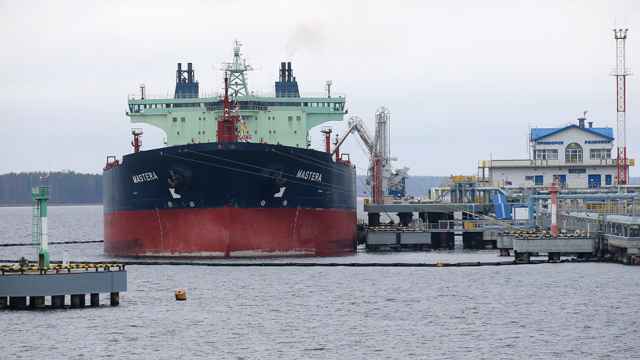
Prices for Russian crude surged above $70 a barrel this week as the Middle East conflict effectively shut down traffic through the Strait of Hormuz, a critical maritime chokepoint through which roughly 20% of global oil supply passes daily.
Sustained higher prices could bring billions of dollars in additional revenue to the Kremlin’s coffers, easing pressure on the federal budget and helping fund military spending for the four-year war in Ukraine.
But analysts caution that this boost to revenue may prove short-lived and is unlikely to fully reverse Russia’s economic woes.
As recently as late February, Russia was struggling to sell its oil at steep discounts amid weak global demand and sanctions targeting the country’s major energy companies. The price of Russia’s flagship Urals crude blend had fallen to about $40 per barrel, roughly $30 below the global Brent benchmark.
Meanwhile, the federal budget was reeling after oil and gas revenues totaled 8.5 trillion rubles ($107.5 billion) in 2025, their lowest level since 2020 and down 24% from the previous year.
But the Middle East conflict and the near-closure of the Strait of Hormuz has lifted prices for oil that does not pass through the strait, benefiting exporters like Russia whose crude can reach buyers through alternative routes.
But how big of a windfall could this be for the Russian economy?
On the surface, a considerable one.
Russia’s 2026 budget is based on an assumed Urals oil price of $59 per barrel. Before the Iran conflict, many analysts warned this assumption was overly optimistic and that weaker oil and gas revenues could push the country into a much larger deficit than the government’s planned 3.8 trillion rubles.
SberCIB, the research arm of Russia’s largest lender Sberbank, estimated the deficit could reach as much as 7.3 trillion rubles ($95.1 billion) this year under those conditions.
If oil prices were to stay elevated at $70-90 for an entire year, however, the picture would look very different.
Russia exported an average of about 4.8 million barrels of crude per day in 2025. If prices average $70 instead of $59 in 2026, that could bring roughly $20 billion in additional revenue compared with the government’s forecast. At an average price of $90 per barrel, this extra revenue boost could rise to about $55 billion.
Russian Deputy Prime Minister Alexander Novak has already said Moscow is ready to increase supplies to major buyers such as India and China.
The U.S. has also granted India a 30-day waiver allowing additional purchases of Russian oil amid uncertainty over Middle Eastern supplies.
The energy bonanza could be further boosted by higher natural gas revenues from exports to China and Europe, as many long-term gas contracts are partially linked to oil prices.
All of these factors combined could provide Moscow with additional financing for its war effort in Ukraine, which official estimates say consumes about 5% of GDP, or about 11 trillion rubles (over $130 billion) per year.
While significant, a revenue boost of this kind would not be unprecedented. Russia previously benefited when oil prices averaged $70 per barrel in 2022 as markets adapted to sanctions imposed over the invasion of Ukraine.
Nor is it certain that the current oil price surge will last the entire year.
Prolonged high energy prices tend to slow the global economy, reducing demand for oil and eventually pushing prices back down.
At the same time, the U.S. has not committed to deploying ground forces in Iran, with President Donald Trump suggesting the conflict could end “pretty quickly.”
Other major powers also have strong incentives to prevent a prolonged shutdown of the Strait of Hormuz. More than 80% of the oil shipped through the passage goes to Asian markets, with China, India, Japan and South Korea among the largest buyers. That raises the likelihood that diplomatic or security arrangements will eventually restore shipping through the strait.
Markets continue to show volatility, with Brent crude futures climbing back above $90 a barrel on Wednesday after plunging the previous day.
And Russian oil was trading at around $62 per barrel on Wednesday following news that the International Energy Agency planned to release 400 million barrels of oil to bring down prices and stave off supply disruptions.
The bottom line is that Russia is coming out as a clear economic winner from the Iran conflict, with potential additional revenues in the tens of billions of dollars.
But even if this windfall does materialize, the extra cash would only be enough to help stabilize Russia's economy rather than transform it or enable a massive scaling up of its war economy.
Even some Moscow-based analysts are striking a cautious note.
The discount on Russian oil may shrink temporarily, but it is too early to speak about lasting benefits for Moscow, said Alexei Gromov of the Moscow-based Institute for Energy and Finance Foundation.
"No further fundamental steps related to easing sanctions pressure on Russia or expanding the circle of buyers of Russian oil are currently in sight," he added.
Kirill Rodionov, another energy analyst, said the current disruption could ultimately accelerate new oil transportation projects and efforts by major consumers, particularly China, to secure long-term guarantees for transit through the Strait of Hormuz.
"Alongside a possible U.S.-Iran deal, including the lifting of the embargo on Iranian oil, the current crisis will contribute to tougher competition in the oil market and the stabilization of Brent prices at relatively low levels — $60 per barrel or below in 2026 prices," he noted.
A Message from The Moscow Times:
Dear readers,
We are facing unprecedented challenges. Russia's Prosecutor General's Office has designated The Moscow Times as an "undesirable" organization, criminalizing our work and putting our staff at risk of prosecution. This follows our earlier unjust labeling as a "foreign agent."
These actions are direct attempts to silence independent journalism in Russia. The authorities claim our work "discredits the decisions of the Russian leadership." We see things differently: we strive to provide accurate, unbiased reporting on Russia.
We, the journalists of The Moscow Times, refuse to be silenced. But to continue our work, we need your help.
Your support, no matter how small, makes a world of difference. If you can, please support us monthly starting from just $2. It's quick to set up, and every contribution makes a significant impact.
By supporting The Moscow Times, you're defending open, independent journalism in the face of repression. Thank you for standing with us.

Remind me later.