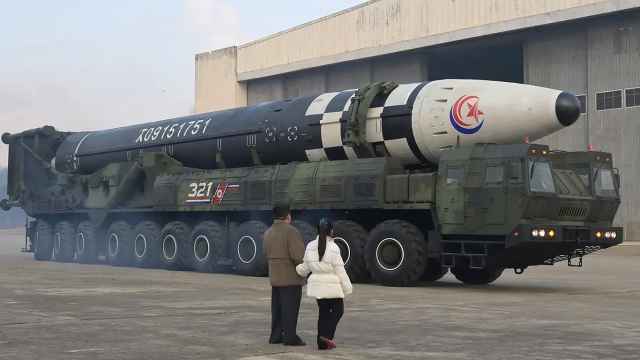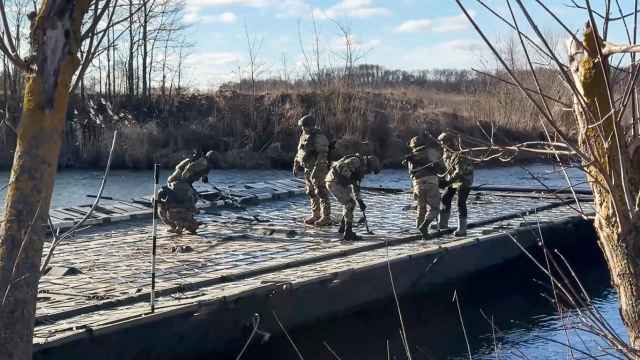

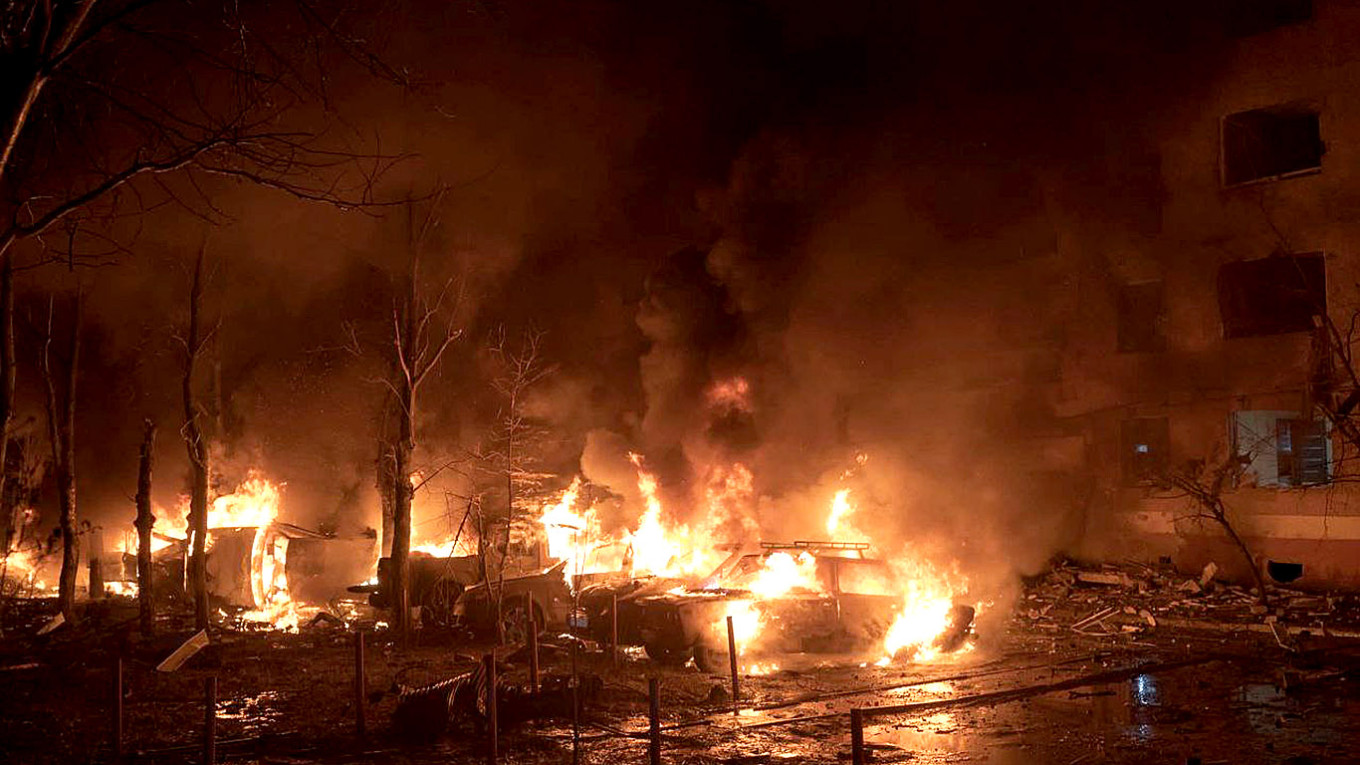
On the fourth grim anniversary of Russia’s full-scale invasion, it is impossible to deny the mark the war has left on Ukrainians. In our eyes, Ukraine is turning into Europe’s 21st-century Guernica while global attention shifts to competition for resources, the AI revolution and the spectacle of robot martial artists.
If one were to sum up these four years, it would not be a story in which courage and righteousness guarantee a happy ending. This war has been strikingly black and white, but the reaction to it was anything but.
Ukrainians, from the very beginning, drew parallels with Tolkien’s world. The orcs invaded, but in our version, the elves never truly arrived. Weapons come, but unevenly, delayed by endless debates about how not to provoke the orcs.
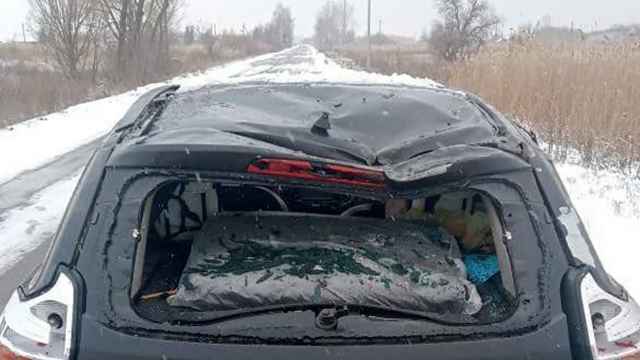
The eagles have not come either. The Sky Shield initiative still hasn’t taken shape, leaving the Ukrainian sky dangerously open and, as a result, millions without water, electricity, or heat after repeated missile and drone strikes on civilian infrastructure.
Nor did a true Fellowship of the Ring emerge. Ukraine remains outside Europe’s formal security architecture, effectively shielding the continent while lacking NATO membership, acredible alternative alliance or the prospects of one. Hybrid formats — cooperation with NATO, enhanced partnership in frameworks such as the Joint Expeditionary Force — are better than nothing, but far from adequate.
Worse still, undeniable tensions in Transatlantic cooperation and within the European Union — alliances supposedly grounded in humanist values — are diverting attention. Now, some demand that Ukrainians contribute to their own destruction, pressing Kyiv toward concessions framed as “realism” and even turning to open blackmail.
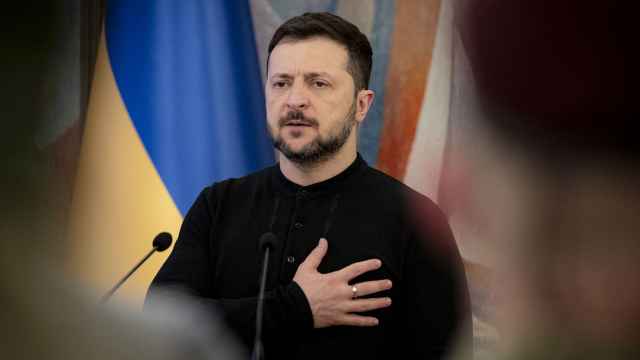
Ukraine’s President Volodymyr Zelensky, along with those engaged in international advocacy, is exhausted from explaining that Ukraine is not losing the war. Russia’s advances are bigger in the fight for Western minds than on the battlefield. In 2025, Moscow captured roughly 1% of Ukrainian territory at the cost of over $100 billion and monthly casualty numbers above 30,000. Meanwhile, Slovakia and Hungary demanded that Kyiv resume allowing Russian oil to flow through its territory, threatening to cut emergency electricity and fuel supplies to Ukraine and block sanctions or final assistance if they refused.
At the same time, Ukrainians’ daily routine includes exposure to news about casualties. Alleys of Glory commemorating fallen soldiers stand in every city as an attempt to process this abnormal new normality. It is no longer a surprise to learn of stories like leaked messages in which a Russian major general casually discusses the torture and mutilation of Ukrainian POWs with his wife, sending photos of severed ears strung on a rope and jokingly comparing them to pigs’ ears snacked on with a glass of beer. Meanwhile, some European audiences still recoil even at drone footage of Ukrainian operations that comply with the Geneva Conventions. But war has not become fancier since Remarque’s “All Quiet on the Western Front.” It remains, at its core, brutal.
What this war feels like in cafés and boardrooms in Paris or Berlin is not what it feels like in homes that have become dark and frozen caves, in bomb shelters, in underground metro stations and especially in trenches. Even the most shocking tragedy cannot sustain emotional engagement indefinitely for those living far from its epicenter. That, too, is human nature.
Ukraine’s suffering and courage are becoming old news. Weekly combined missile-and-drone attacks and atrocities in occupied territories and missing children have become routine. Yet one cannot grow accustomed to the sound of explosions at night, even in the fifth year of war.
Still, people can endure deprivation and the absence of normal life for a greater cause. What’s harder is watching a second diplomatic front open against you and finding it increasingly difficult to distinguish friends from adversaries. Some call it realpolitik; others see proof that the West cannot stand up for the values it professes.
In 2022, Ukrainian advocates worked day and night to explain where the West had misjudged Ukraine, Russia, and the risks to Europe’s security order. Those arguments once felt urgent. Today, they often seem irrelevant — not because they were wrong, but because the gap in threat perception between Ukraine and its partners remains the size of the Grand Canyon.
In the early months of the invasion, Ukrainians were sometimes excluded from international panels because they were seen as too aggressive, too traumatized, too unpredictable — liable to disrupt polished conferences with accounts of bloodshed and devastation amid the hope of rebooting relations with Russia. Now, inviting a Ukrainian speaker can feel as expected as serving canapes or — in some cases — entertainment to spice things up.
We are constantly asked for new ideas, new strategies and new narratives to put forward. Yet in many cases, what is needed is simply the proper implementation of decisions that have already been taken: tightening sanctions enforcement against Russia’s shadow fleet, delivering existing air-defense commitments, or moving forward on long-discussed security guarantees. But Ukraine, whose resistance made it possible for millions west of its borders to continue living normal lives, remains outside the core of Europe’s security system and may remain there even after active hostilities subside.
We are like gladiators who cannot leave the arena. The battle has lasted so long that sympathy risks becoming ceremonial. At this point, it is more interesting for observers to discuss tactics, weapons systems, or political intrigue than daily suffering. But how many can name the number of Ukrainians killed last week?
There is nothing entirely new in this. It was only recently that humanity tried, collectively, to see the human being in everyone. What happened to that ideal?
A Message from The Moscow Times:
Dear readers,
We are facing unprecedented challenges. Russia's Prosecutor General's Office has designated The Moscow Times as an "undesirable" organization, criminalizing our work and putting our staff at risk of prosecution. This follows our earlier unjust labeling as a "foreign agent."
These actions are direct attempts to silence independent journalism in Russia. The authorities claim our work "discredits the decisions of the Russian leadership." We see things differently: we strive to provide accurate, unbiased reporting on Russia.
We, the journalists of The Moscow Times, refuse to be silenced. But to continue our work, we need your help.
Your support, no matter how small, makes a world of difference. If you can, please support us monthly starting from just $2. It's quick to set up, and every contribution makes a significant impact.
By supporting The Moscow Times, you're defending open, independent journalism in the face of repression. Thank you for standing with us.

Remind me later.