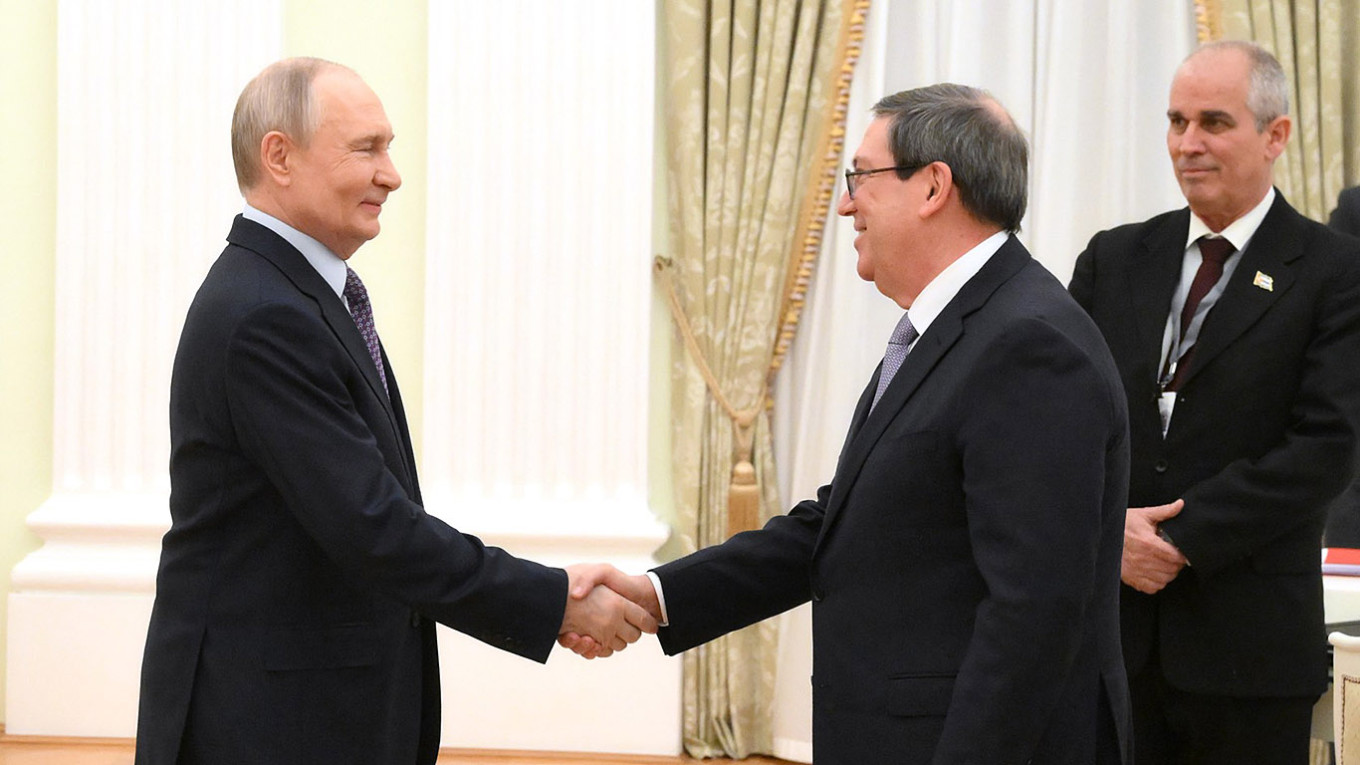
President Vladimir Putin and other top Kremlin officials met with Cuban Foreign Minister Bruno Rodríguez in Moscow on Wednesday, coming as the communist-ruled island nation faces severe fuel shortages and blackouts due to an oil embargo imposed by the United States.
Putin told Rodríguez that Russia has “always stood by Cuba in its struggle for independence, for the right to develop along its own path and has always supported the Cuban people.”
“Now we’re in a special period, with new sanctions. You know how we feel about this. We won’t tolerate anything like that,” the Russian leader added.
Cuba is grappling with its worst energy crisis in years after U.S. President Donald Trump threatened to impose tariffs on any country that sells oil to it, ramping up his pressure campaign on the communist leadership to implement political and economic reforms.
Cuba, which imports around 60% of its energy supply, previously relied on oil sold by Venezuela. Those shipments ended after then-President Nicolás Maduro was captured in a U.S. military raid.
Russian Foreign Minister Sergei Lavrov, who met with Rodríguez in a separate meeting before Putin, called on the United States to “show common sense” and end its blockade.
Russia’s Embassy in Havana said last week that Moscow planned to send oil and other petroleum products to Cuba as humanitarian aid.
Kremlin spokesman Dmitry Peskov earlier on Wednesday said the meeting between Putin and Rodríguez “holds special significance given the difficult period that friendly and brotherly Cuba is currently experiencing.”
Asked whether Russian oil shipments to the struggling island could harm Ukraine peace negotiations brokered by the United States, Peskov said he does not “believe these issues are interrelated.”
“Russia has consistently opposed the blockade of the island,” he told reporters. “We value our relationship with Cuba, and we intend to develop it further, certainly by providing the appropriate assistance to our friends during these difficult times.”
Cuba has been allied with Russia since its 1960s socialist revolution, relying on the Soviet Union for economic and political support for decades. The Kremlin has maintained close relations with the Caribbean island after the U.S.S.R. collapsed.
A Message from The Moscow Times:
Dear readers,
We are facing unprecedented challenges. Russia's Prosecutor General's Office has designated The Moscow Times as an "undesirable" organization, criminalizing our work and putting our staff at risk of prosecution. This follows our earlier unjust labeling as a "foreign agent."
These actions are direct attempts to silence independent journalism in Russia. The authorities claim our work "discredits the decisions of the Russian leadership." We see things differently: we strive to provide accurate, unbiased reporting on Russia.
We, the journalists of The Moscow Times, refuse to be silenced. But to continue our work, we need your help.
Your support, no matter how small, makes a world of difference. If you can, please support us monthly starting from just $2. It's quick to set up, and every contribution makes a significant impact.
By supporting The Moscow Times, you're defending open, independent journalism in the face of repression. Thank you for standing with us.

Remind me later.