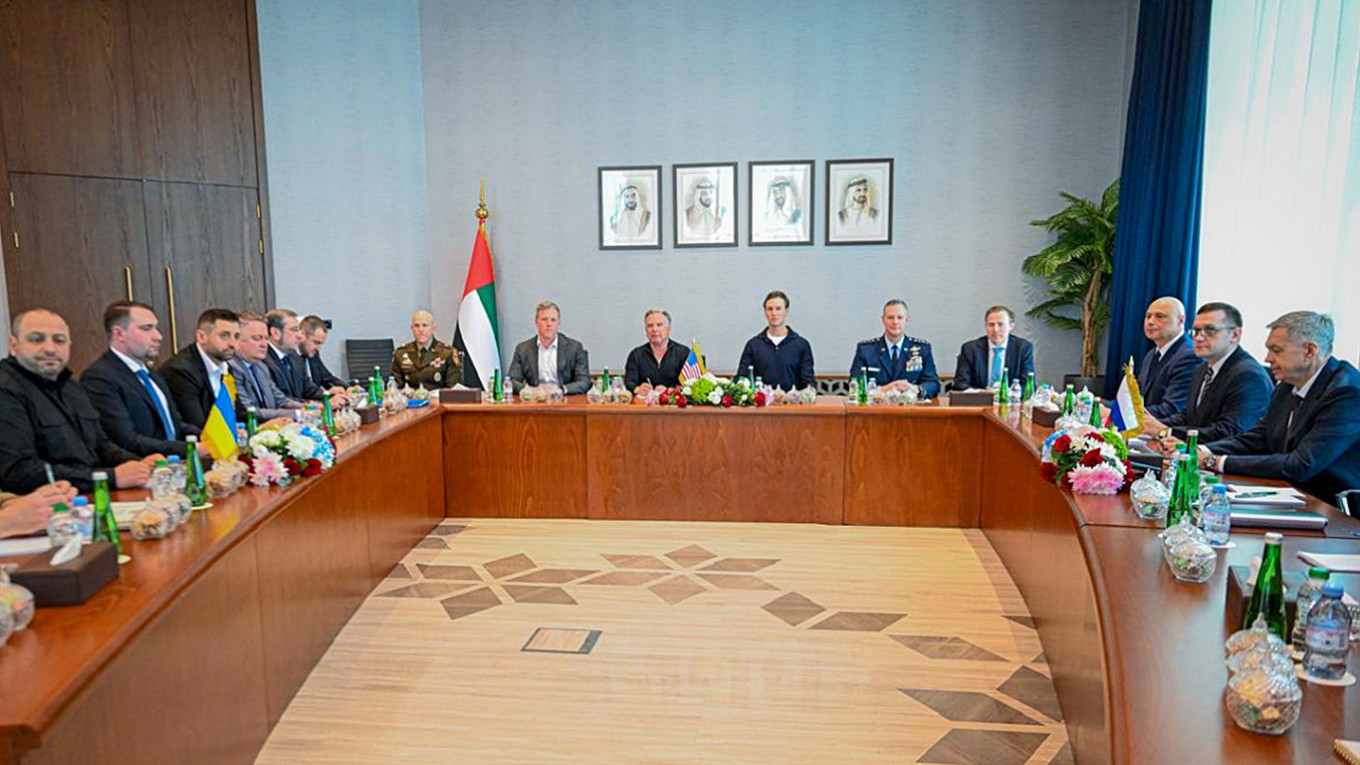
A second round of talks between Russia, Ukraine and the United States in Abu Dhabi finished Thursday with the two warring countries agreeing to a new prisoner exchange, though it was not immediately clear whether the sides made any progress toward a peace deal.
White House special envoy Steve Witkoff, who led the U.S. delegation at the two-day talks, said Ukraine and Russia would release 314 prisoners. He said it would be the first such exchange between the countries in five months.
“This outcome was achieved from peace talks that have been detailed and productive,” Witkoff wrote in a post on X. “While significant work remains, steps like this demonstrate that sustained diplomatic engagement is delivering tangible results and advancing efforts to end the war in Ukraine.”
He said “additional progress” was expected in the coming weeks.
Shortly after Witkoff published that post, Russia’s Defense Ministry announced that the prisoner exchange had taken place earlier on Thursday, with each side releasing 157 prisoners of war. The ministry said three Russian civilians from the Kursk region were also returned.
Ukraine’s headquarters for the treatment of prisoners of war said only 150 of the Ukrainians released in the exchange were military personnel, while the remaining seven were civilians who had been held in Russian captivity.
Despite renewed diplomatic efforts by the White House, prospects for a peace agreement between Russia and Ukraine remain just as uncertain today as when President Donald Trump took office over a year ago, having earlier promised to end the war by day one of his presidency.
Rustem Umerov, Ukraine’s chief negotiator and the head of its national security and defense council, said Wednesday that the work of negotiators had so far been “focused on concrete steps and practical solutions” to ending the war, which is nearing its fourth anniversary.
The Russian side was again represented by military intelligence chief Igor Kostyukov, who has been sanctioned in the West over his role in the invasion, along with other senior intelligence officials.
Kremlin envoy and Russian Direct Investment Fund CEO Kirill Dmitriev, who did not appear to be directly involved in military discussions as part of peace negotiations, told state media on Thursday that separate meetings were taking place with U.S. officials in Abu Dhabi in parallel with Ukraine talks.
“We are actively working with the Trump administration to restore Russia-U.S. economic relations, including through the Russian-American Economic Cooperation Group. We met today, and the meetings are going well,” Dmitriev said.
Ahead of the talks in Abu Dhabi, Kremlin spokesperson Dmitry Peskov told reporters that the “doors for a peaceful resolution” to the conflict, which has killed tens of thousands of people on both sides, “remain open.”
“Our position is crystal clear,” Peskov said during a daily press briefing on Wednesday. “So long as the Kyiv regime does not take the appropriate steps, the special military operation will continue.”
President Vladimir Putin has insisted that Ukraine hand over the eastern Donbas region despite not controlling all of the territory. Ukrainian leader Volodymyr Zelensky has rejected the idea outright despite coming under pressure from Trump to make a quick deal.
In Abu Dhabi, Witkoff was joined by Trump’s son-in-law Jared Kushner, both of whom have become fixtures in the Trump administration’s diplomatic efforts to end the war in Ukraine.
U.S. Secretary of the Army Daniel Driscoll and NATO Supreme Allied Commander Alex Grynkewich are also part of the American delegation.
Later on Friday, the United States European Command said Moscow and Washington had agreed during the talks in Abu Dhabi to reestablish high-level military-to-military dialogue, which was suspended just months before the full-scale invasion of Ukraine in February 2022.
“Maintaining dialogue between militaries is an important factor in global stability and peace, which can only be achieved through strength, and provides a means for increased transparency and de-escalation,” the command said in a statement.
The second round of trilateral talks began a day after Russia launched a missile and drone barrage against Ukraine’s energy infrastructure, cutting power and heating as temperatures plunged well below freezing.
Zelensky said the attack cast doubt on Russia’s commitment to diplomacy.
Meanwhile, thousands of people in the Belgorod region were also without power and heating on Wednesday following a Ukrainian air attack there the night before, local officials said.
This week’s peace negotiations were postponed from the weekend due to what the Kremlin described as scheduling issues among the three sides.
A Message from The Moscow Times:
Dear readers,
We are facing unprecedented challenges. Russia's Prosecutor General's Office has designated The Moscow Times as an "undesirable" organization, criminalizing our work and putting our staff at risk of prosecution. This follows our earlier unjust labeling as a "foreign agent."
These actions are direct attempts to silence independent journalism in Russia. The authorities claim our work "discredits the decisions of the Russian leadership." We see things differently: we strive to provide accurate, unbiased reporting on Russia.
We, the journalists of The Moscow Times, refuse to be silenced. But to continue our work, we need your help.
Your support, no matter how small, makes a world of difference. If you can, please support us monthly starting from just $2. It's quick to set up, and every contribution makes a significant impact.
By supporting The Moscow Times, you're defending open, independent journalism in the face of repression. Thank you for standing with us.

Remind me later.