
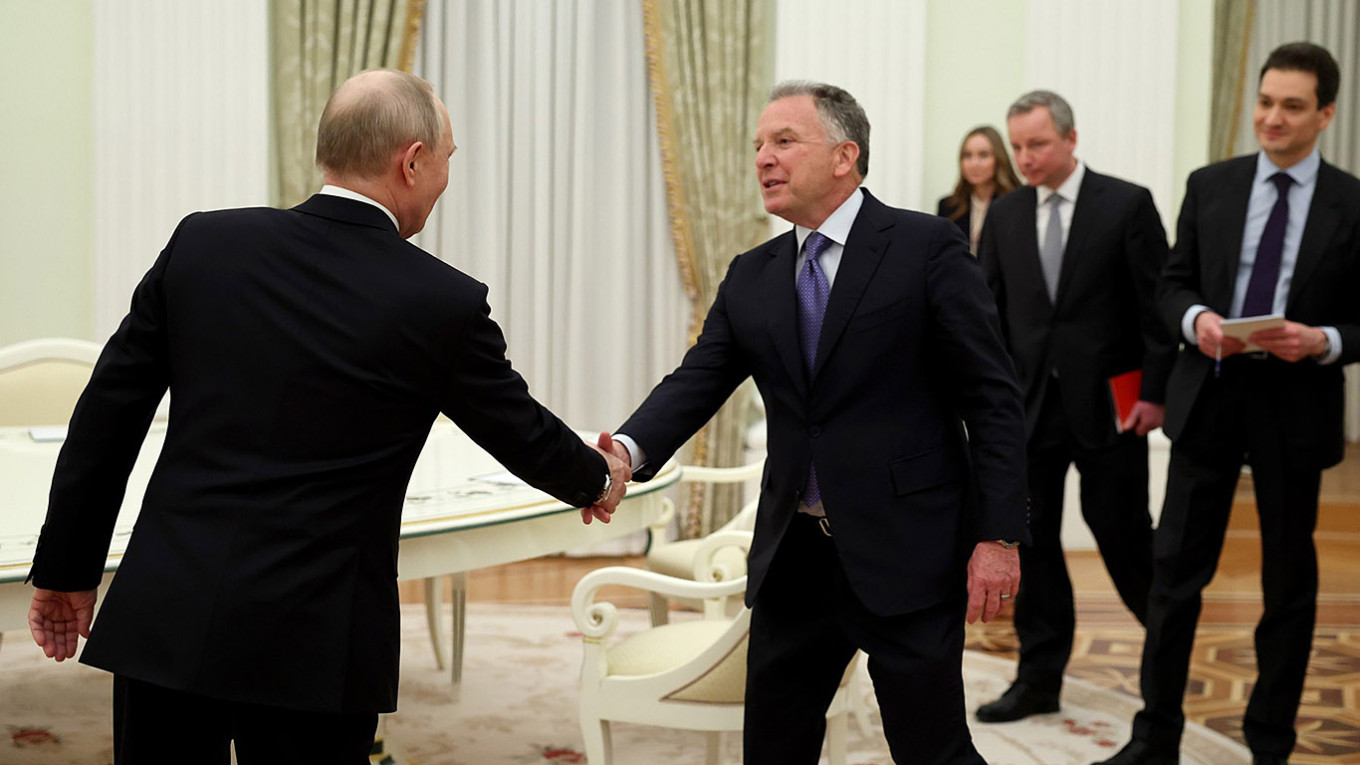
As negotiations continue to drag on between Washington, Kyiv and Moscow, the Kremlin’s narrative about the war has centered on one potential solution: evicting Ukrainian forces from the Donbas.
Not by force, of course. After nearly four years of continuous, devastating war, Russian troops are still bogged down in eastern Ukraine, gaining minuscule amounts of territory at terrifyingly high costs. Instead, the Kremlin is banking on convincing the United States to strong-arm Ukraine into unilaterally ceding the territory. As envoy Kirill Dmitriev, who has led negotiations from the Russian side, posted on Tuesday, “Donbas withdrawal is the path to peace for Ukraine.”
But for those who’ve followed the narratives Russia has spun over the past few years, the idea that simply swapping slices of territory in the Donbas could end the fighting belies what this war is really about. As we approach twelve years since Russian troops first swarmed into Ukraine, claiming Crimea and shedding blood across eastern Ukraine, it’s worth re-examining the Kremlin’s rationale for why it launched the war in the first place. In messaging for audiences both domestic and foreign, it’s easy to see how and why this war was never about the status of the Donbas – and how and why the war has always been about far, far more.
The claims hinge on a simple idea: that the origins of this war, and the solution toward ending it, are largely about sovereignty over Donbas. These claims have, by all appearances, found a receptive audience in negotiating partners like Steve Witkoff, who apparently believes control of the Donbas is the key to ending the war. They might even find receptivity among audiences who are exhausted by war, or who have forgotten about all the reasons the Kremlin laid out for its invasion in early 2022.
There are two primary prongs that emerge from the Kremlin’s narratives about the war from day one. Firstly, Moscow claimed that the reasons for the war focused specifically on Ukraine and especially its status as an independent nation. Ukraine was supposedly overseen by a “junta” that had launched a “coup” in 2014. A regime that was, as Russian President Vladimir Putin infamously claimed, run by Nazis.
As such, the war itself was about rescuing ethnic Russians and Russian speakers from Ukraine’s “fascist” regime. As Putin said himself in his address announcing the full-scale invasion, “The purpose of this operation is to protect people who, for eight years now, have been facing humiliation and genocide perpetrated by the Kiev [sic] regime” and that it was Moscow’s mission to “demilitarize and denazify Ukraine.”
Much of this messaging was aimed at internal audiences in Russia. Years later, the idea that Kyiv is a Nazi regime is just as ludicrous for international audiences as it was then.
But Putin’s selling of the war didn’t stop there. As he further claimed, Russia and Ukraine were brotherly nations, part of a supposedly “triune state” linked with Belarus. As such, the war was about restoring Ukraine to its constituent, subaltern relationship with Moscow — and about preventing Kyiv from joining the West.
Ukraine and Russia were, as Putin memorably claimed, “one people,” meaning that any sense of Ukrainian identity separate from Russia had to be extinguished. This sentiment was captured most infamously in a since-deleted post from the state-run RIA Novosti outlet, which said that the war was about returning Ukraine “to its natural state as part of the Russian world.”
For domestic audiences, the two arguments — that Ukraine was controlled by “fascists,” and belonged firmly within the Russian bosom — were of a piece. Taken together, the goal of the invasion was clear: regime change, with the toppling of President Volodymyr Zelensky’s government and implementation of a pro-Russian regime in its stead. Even Putin’s further claims that Ukraine was, in reality, a Soviet-era fabrication on historic Russian land augmented this argument. Thus, Ukraine couldn’t be allowed to exist as an independent sovereign entity in any form whatsoever. Any Ukrainian sovereignty must be obliterated by whatever means necessary, including outright war.
Yet the Kremlin didn’t stop there. Moscow also argued to audiences both domestic and foreign that this war was not just about Ukraine alone, but about Russia’s ascendancy, a global reordering and a return to a world in which supposedly great powers can do as they wish. For instance, there was the claim that the war was actually about beating back an expansive NATO. (Little matter that, following the invasion, both Sweden and Finland joined NATO – and Russia didn’t bother to invade either.) So, too, that this war was necessary because the West apparently “sought to destroy our traditional values.” Patriarch Kirill echoed Putin’s framing, claiming that the 2022 invasion rested on the fact that residents of eastern Ukraine “refused to accept” things like “the gay parade.”
Most obliquely, Putin and his allies have claimed that this war — and the broader righteousness of Russia’s cause — rests on the fact that Russia is a “country-civilization” and a “great millennial power” that will chart its own path, a “unique state-civilization” that is following its “historically unique mission.” The war is simply the first step in Putin’s dreams of a “new Yalta,” as journalist Mikhail Zygar has written, a “new world order” in which spheres of influence and self-proclaimed great powers reign.
Taken together, the entire swath of Russian narratives explaining and defending the war is a confused, muddled mess. It’s a buffet of rationales: some predicated on the status of ethnic Russians, some based on Russia’s historic standing and some aimed at upending the broader global order directly. Some of these narratives and excuses are even in direct contradiction with one another, such as when Putin claims with one breath Ukraine is a supposedly brotherly nation that must be returned and, with another, that Ukraine is actually a Leninist fabrication that must be obliterated.
But even within that cluttered, contradictory morass, a clear picture emerges. This war is not, and never has been, about the status of provinces in eastern Ukraine. Thinking it will be solved, or that peace will reign, should the status of those provinces change is a fool’s errand, completely ignoring all of the broader reasons and rationales Putin and his inner circle have laid out for what this war is truly about: dominating all of Ukraine, confirming Russia’s right to lord over nearly all of its neighbors and much of Europe while restoring Russia’s supposed status as a global power.
A Message from The Moscow Times:
Dear readers,
We are facing unprecedented challenges. Russia's Prosecutor General's Office has designated The Moscow Times as an "undesirable" organization, criminalizing our work and putting our staff at risk of prosecution. This follows our earlier unjust labeling as a "foreign agent."
These actions are direct attempts to silence independent journalism in Russia. The authorities claim our work "discredits the decisions of the Russian leadership." We see things differently: we strive to provide accurate, unbiased reporting on Russia.
We, the journalists of The Moscow Times, refuse to be silenced. But to continue our work, we need your help.
Your support, no matter how small, makes a world of difference. If you can, please support us monthly starting from just $2. It's quick to set up, and every contribution makes a significant impact.
By supporting The Moscow Times, you're defending open, independent journalism in the face of repression. Thank you for standing with us.

Remind me later.