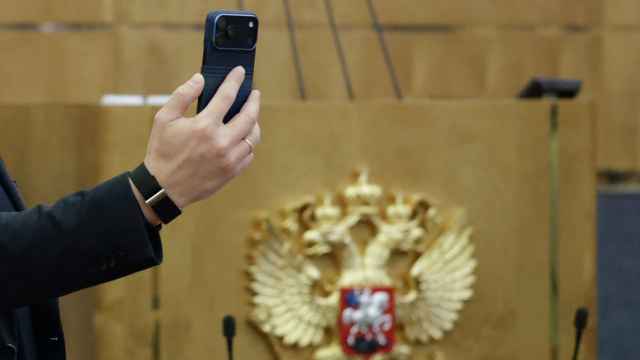
A senior lawmaker in Russia’s lower-house State Duma has criticized his colleagues for amplifying threats in the media about alleged plans to block Telegram and WhatsApp, saying Tuesday that only state media regulators have the authority to issue statements about internet restrictions.
“Speculating about blocks is pointless and using such a sensitive topic just to boost one’s media citations is dubious,” said Sergei Boyarsky, who chairs the State Duma’s Information Policy, Technology and Communications Committee.
“Only Roskomnadzor, the regulator that holds the necessary authority, can announce actual plans,” Boyarsky, a member of the ruling United Russia party, told the state-run TASS news agency.
Boyarsky made his comments after Mikhail Delyagin, a lawmaker from the social conservative party A Just Russia, said he expects Russian authorities to fully block Telegram by September 2026, coming amid reports of slowed download speeds on the app.
Two weeks earlier, Roskomnadzor was forced to deny claims by State Duma lawmaker Andrei Svintsov, a member of the nationalist Liberal Democratic Party (LDPR), that it was throttling Telegram’s download speeds. Svintsov also alleged authorities would outright ban WhatsApp this year.
In August, Roskomnadzor began restricting voice and video calls on WhatsApp and Telegram as part of what it described as an anti-fraud initiative, a move both companies criticized.
The Kremlin itself has said that blocking foreign messengers to combat fraud makes little sense since scammers use a variety of tools available to them.
Russian security services, meanwhile, say Ukraine employs both messaging apps to recruit people for carrying out acts of sabotage and assassinations inside Russia.
Roskomnadzor’s restrictions on WhatsApp and Telegram calls also come as authorities pressure Russians to download and use the government-backed messaging app Max, where a number of pro-Kremlin channels have slowly been migrating since the summer.
Max reached 70 million monthly users in December, making it the third-most used app in Russia. But it remains behind WhatsApp and Telegram, which, in December, had 94.5 million and 93.6 million monthly users, respectively.
A Message from The Moscow Times:
Dear readers,
We are facing unprecedented challenges. Russia's Prosecutor General's Office has designated The Moscow Times as an "undesirable" organization, criminalizing our work and putting our staff at risk of prosecution. This follows our earlier unjust labeling as a "foreign agent."
These actions are direct attempts to silence independent journalism in Russia. The authorities claim our work "discredits the decisions of the Russian leadership." We see things differently: we strive to provide accurate, unbiased reporting on Russia.
We, the journalists of The Moscow Times, refuse to be silenced. But to continue our work, we need your help.
Your support, no matter how small, makes a world of difference. If you can, please support us monthly starting from just $2. It's quick to set up, and every contribution makes a significant impact.
By supporting The Moscow Times, you're defending open, independent journalism in the face of repression. Thank you for standing with us.

Remind me later.