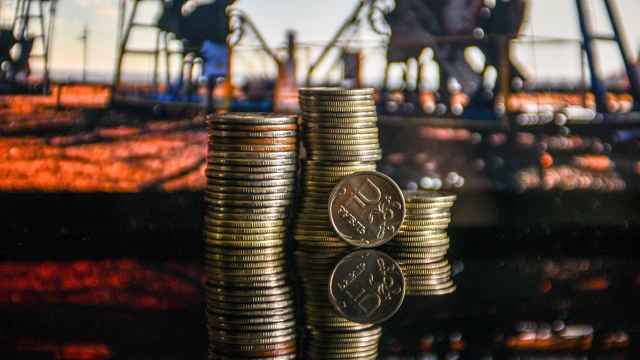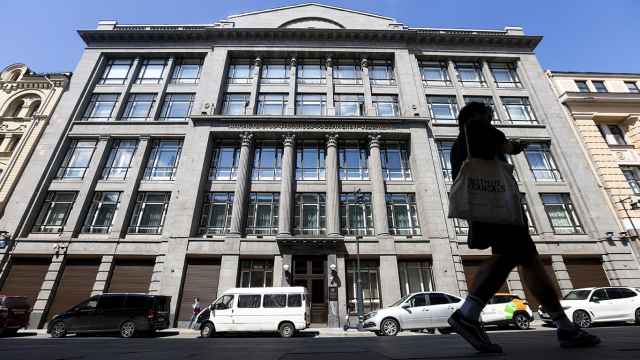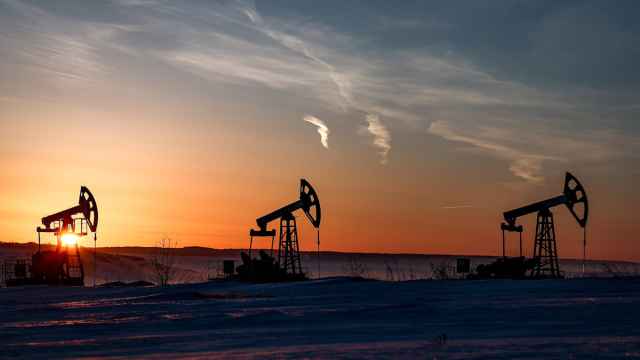
Russia’s federal budget is set to start the year with a sharp deficit, a deputy finance minister has warned, as front-loaded spending collides with weak oil prices and falling energy revenues.
Government spending will be elevated in January and February due to advance payments on state procurement contracts, while oil prices remain low, Deputy Finance Minister Vladimir Kolychev said.
Russia will fall short of its planned oil and gas revenues as a result, he added.
Spending pressures are expected to ease later in the year, Kolychev said, predicting that budget dynamics in 2026 will broadly mirror last year’s pattern, “but in a more acute form” because energy revenues are even lower.
The Finance Ministry had spent 8 trillion rubles ($103.2 billion) in the first two months of 2025, more than 18% of total annual expenditures, resulting in a deficit of 2.4 trillion rubles ($31.0 billion).
While spending later normalized, revenue shortfalls pushed the deficit to nearly 5 trillion rubles ($64.5 billion) by July, before ending the year at a record 5.65 trillion rubles ($72.9 billion).
Total spending for this year is planned at 44 trillion rubles ($567.6 billion).
Based on last year’s schedule, around 8 trillion rubles ($103.2 billion) are again expected to be spent in January and February.
Economist Yegor Susin estimates oil and gas revenues in the first two months at 0.9-1.0 trillion rubles ($11.6-12.9 billion), down from 1.56 trillion rubles ($20.1 billion) a year earlier, with non-oil revenues at 4.1-4.3 trillion rubles ($52.9-55.5 billion).
That would imply a budget deficit of 2.7-3.0 trillion rubles ($34.8-38.7 billion) over the period, he said.
The Finance Ministry says it intends to stick to its annual spending plan, which would keep the full-year deficit below last year’s level. The deficit is currently budgeted at 3.8 trillion rubles ($49.0 billion).
Analysts at Gazprombank expect a wider deficit of 5.0-5.5 trillion rubles ($64.5-71.0 billion), or 2-2.5% of GDP, citing faster spending growth than the finance ministry projects.
Alfa Bank’s chief economist Natalia Orlova has described the planned 4% increase in spending as “very ambitious,” noting that most budget obligations — including social payments, ongoing infrastructure projects and military spending — are difficult to cut.
Last year, analysts similarly doubted the ministry could avoid a traditional year-end spending surge.
While December spending did spike, it was far smaller than usual, prompting former Deputy Finance Minister Sergei Aleksashenko to say the ministry had “worked a miracle.”
Budget revenues this year are forecast at 40.3 trillion rubles ($519.9 billion), including 8.9 trillion rubles ($114.8 billion) from oil and gas.
However, analysts at MMI calculated that the budget could miss at least 3 trillion rubles ($38.7 billion) in energy revenues at current oil prices and exchange rates.
Under Russia’s fiscal rule, such shortfalls are covered by selling foreign currency and gold from the National Wealth Fund (NWF).
An additional 0.7 trillion rubles ($9.0 billion) will be sold this year to offset the fund’s prior investments, MMI analysts said, warning that liquid assets in the fund could be exhausted as early as this year.
The NWF held just over 4 trillion rubles ($51.6 billion) in liquid assets at the start of the year.
The Finance Ministry believes the fund has sufficient resources to manage “significant risks,” Kolychev said.
He said the ministry focuses on average oil prices over a longer period rather than short-term fluctuations, and does not view the current decline as permanent.
However, if officials conclude that the long-term equilibrium oil price has fallen well below the budget’s assumed level of $55 per barrel, changes to the fiscal framework would need to be discussed, he said.
That would likely involve lowering the so-called cutoff price used in the fiscal rule to calculate baseline oil and gas revenues. The cutoff price stood at $60 last year, $59 this year, and is scheduled to fall by $1 annually to $55 by 2030.
Russia’s average export price for crude oil was $39.2 per barrel in December, according to the Economic Development Ministry.
Central Bank officials have previously said that the cutoff price would need to be reduced if prices fail to recover.
MMI analysts argue it should be cut sharply to around $40 per barrel, and expect such a decision to be taken in the autumn.
Read this article in Russian at The Moscow Times' Russian service.
A Message from The Moscow Times:
Dear readers,
We are facing unprecedented challenges. Russia's Prosecutor General's Office has designated The Moscow Times as an "undesirable" organization, criminalizing our work and putting our staff at risk of prosecution. This follows our earlier unjust labeling as a "foreign agent."
These actions are direct attempts to silence independent journalism in Russia. The authorities claim our work "discredits the decisions of the Russian leadership." We see things differently: we strive to provide accurate, unbiased reporting on Russia.
We, the journalists of The Moscow Times, refuse to be silenced. But to continue our work, we need your help.
Your support, no matter how small, makes a world of difference. If you can, please support us monthly starting from just $2. It's quick to set up, and every contribution makes a significant impact.
By supporting The Moscow Times, you're defending open, independent journalism in the face of repression. Thank you for standing with us.

Remind me later.