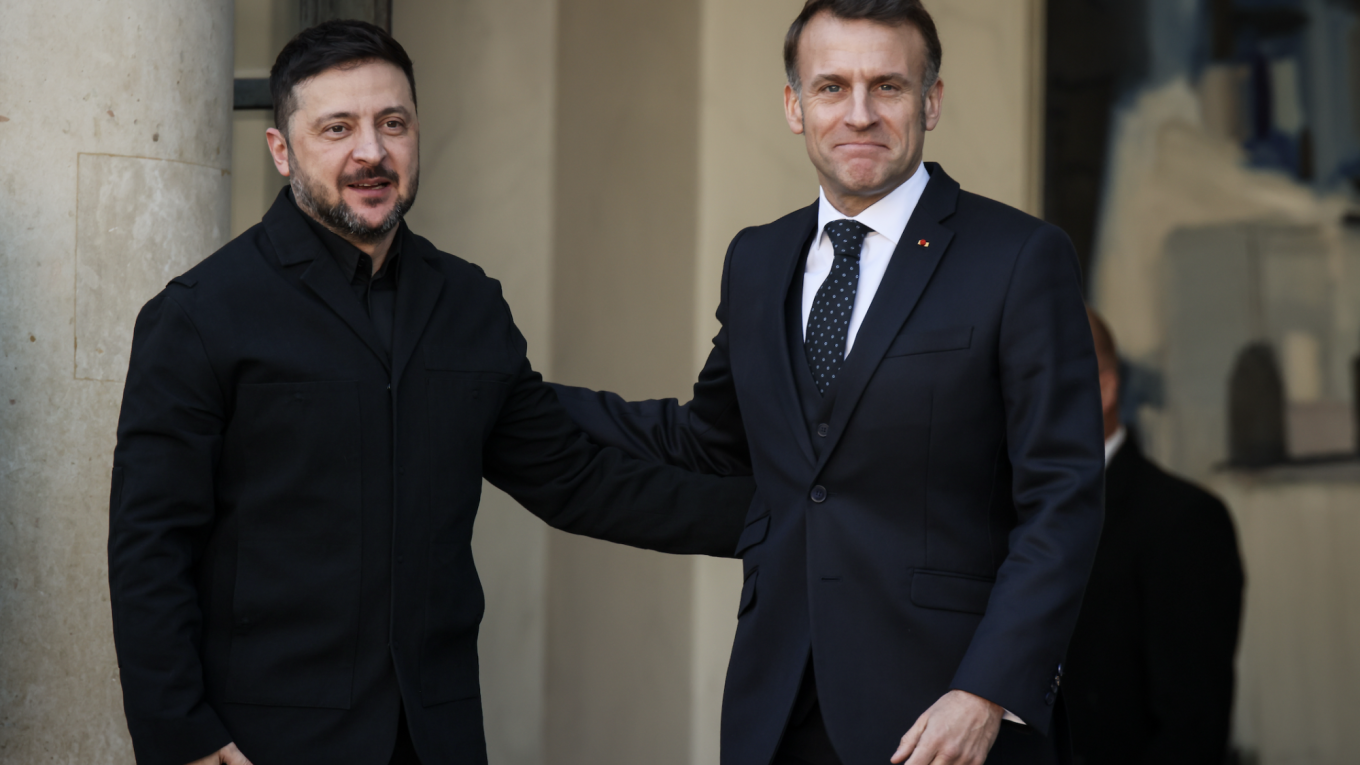
Following the largest yet meeting of the so-called Coalition of the Willing in Paris, both European leaders and U.S. envoys hailed progress that hid tensions in recent days over assertive U.S. foreign policy in the Western hemisphere under President Donald Trump.
But the security guarantees for Ukraine would only come into force once a ceasefire is agreed to end the almost four-year war sparked by Russia's 2022 full-scale invasion. Russian leader Vladimir Putin's intentions remain unclear.
The "robust" guarantees would see the United States lead a truce monitoring mechanism with European participation, French President Emmanuel Macron said after the meeting which gathered representatives of 35 countries, including 27 heads of state or government.
Macron, British Prime Minister Keir Starmer and Ukrainian leader Volodymyr Zelensky signed a declaration of intent that foresees Britain, France and other European allies deploying troops on Ukrainian territory after a ceasefire.
The allies also agreed to establish a U.S.-Ukraine-Coalition coordination cell in Paris.
But a promise that Washington would commit to "support" the European-led multinational force "in case of a new attack" by Russia that was present in the draft statement was not in the communique released on Tuesday evening.
Macron said that Paris could deploy "several thousand" French troops to Ukraine after the war.
'Critical issue'
Macron said after the meeting that the moves represented "robust security guarantees for a solid and lasting peace," hailing an "operational convergence" among allies including the United States.
The security guarantees are "the key to ensuring that a peace agreement can never mean a Ukrainian surrender and that a peace agreement can never mean a new threat to Ukraine" from Russia, Macron said.
Against the background of tensions between Europe and the U.S. on Greenland and Venezuela, U.S. special envoy Steve Witkoff, who was present at the talks in Paris, said "a lot of progress" had been made.
Allies have "largely finished" agreeing security guarantees for Ukraine "so that the people of Ukraine know that when this ends, it ends forever," he said, flanked by President Trump's son-in-law Jared Kushner.
Witkoff said that "land options" will be the most "critical issue" and "hopefully we will be able to come up with certain compromises with regard to that."
Trump believes "this carnage has to stop," added Witkoff.
Kushner added: "This does not mean that we will make peace, but peace would not be possible without the progress that was made here today."
Zelensky expressed satisfaction over the outcome.
"These are not just words. There is concrete content: a joint declaration by all the coalition countries and a trilateral declaration by France, Britain, and Ukraine," Zelensky said in.
Echoing Witkoff's comments, Zelensky added the most significant issue still to be resolved was "the territorial question," referring to Russian demands that Kyiv give up the eastern Donbas region of Ukraine.
Russia, which occupies around 20% of Ukraine, has also repeatedly opposed any NATO boots on the ground in Ukraine to monitor a halt in hostilities.
'Hardens our resolve'
Starmer said for his part that following a ceasefire the U.K. and France will establish "military hubs" across Ukraine and "build protected facilities for weapons and military equipment to support Ukraine's defensive needs."
But he warned: "We can only get to a peace deal if Putin is ready to make compromises. And so we have to be frank, for all Russia's words, Putin is not showing he is ready for peace. Over the last few weeks, we've seen the opposite," he said.
"This only hardens our resolve," he added.
Meanwhile top diplomats from the G7 nations during a phone call "welcomed progress on security guarantees for Ukraine," a French Foreign Ministry spokesperson said.
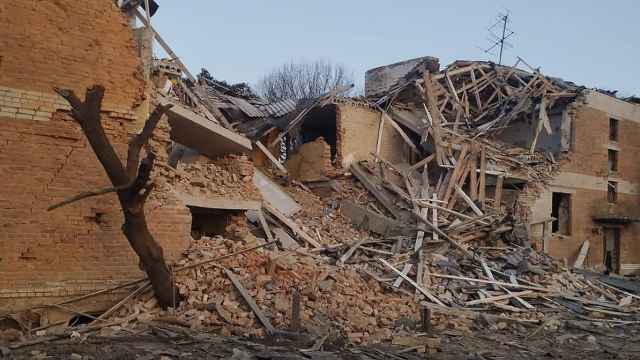
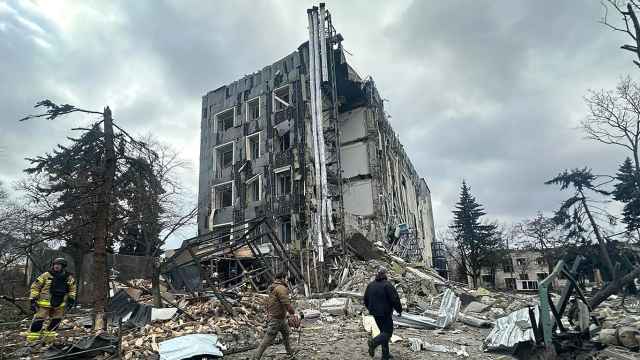
There has been no recent let-up in fighting in what has been Europe's deadliest conflict since World War II.
German Chancellor Friedrich Merz, whose nation has been wary of contributing troops to a multinational force, said German forces could join to monitor a ceasefire, but based in a neighboring country.
"We will certainly have to make compromises," he said in Paris, adding that "we will not achieve textbook diplomatic solutions."
The capture by U.S. forces of Venezuelan president Nicolas Maduro, a Putin ally, as well as claims by Trump that the self-governing Danish territory of Greenland should become part of the U.S. had unsettled some European countries ahead of the meeting.
Macron told French TV: "I cannot imagine a scenario in which the United States of America would be placed in a position to violate Danish sovereignty."
A Message from The Moscow Times:
Dear readers,
We are facing unprecedented challenges. Russia's Prosecutor General's Office has designated The Moscow Times as an "undesirable" organization, criminalizing our work and putting our staff at risk of prosecution. This follows our earlier unjust labeling as a "foreign agent."
These actions are direct attempts to silence independent journalism in Russia. The authorities claim our work "discredits the decisions of the Russian leadership." We see things differently: we strive to provide accurate, unbiased reporting on Russia.
We, the journalists of The Moscow Times, refuse to be silenced. But to continue our work, we need your help.
Your support, no matter how small, makes a world of difference. If you can, please support us monthly starting from just $2. It's quick to set up, and every contribution makes a significant impact.
By supporting The Moscow Times, you're defending open, independent journalism in the face of repression. Thank you for standing with us.

Remind me later.