
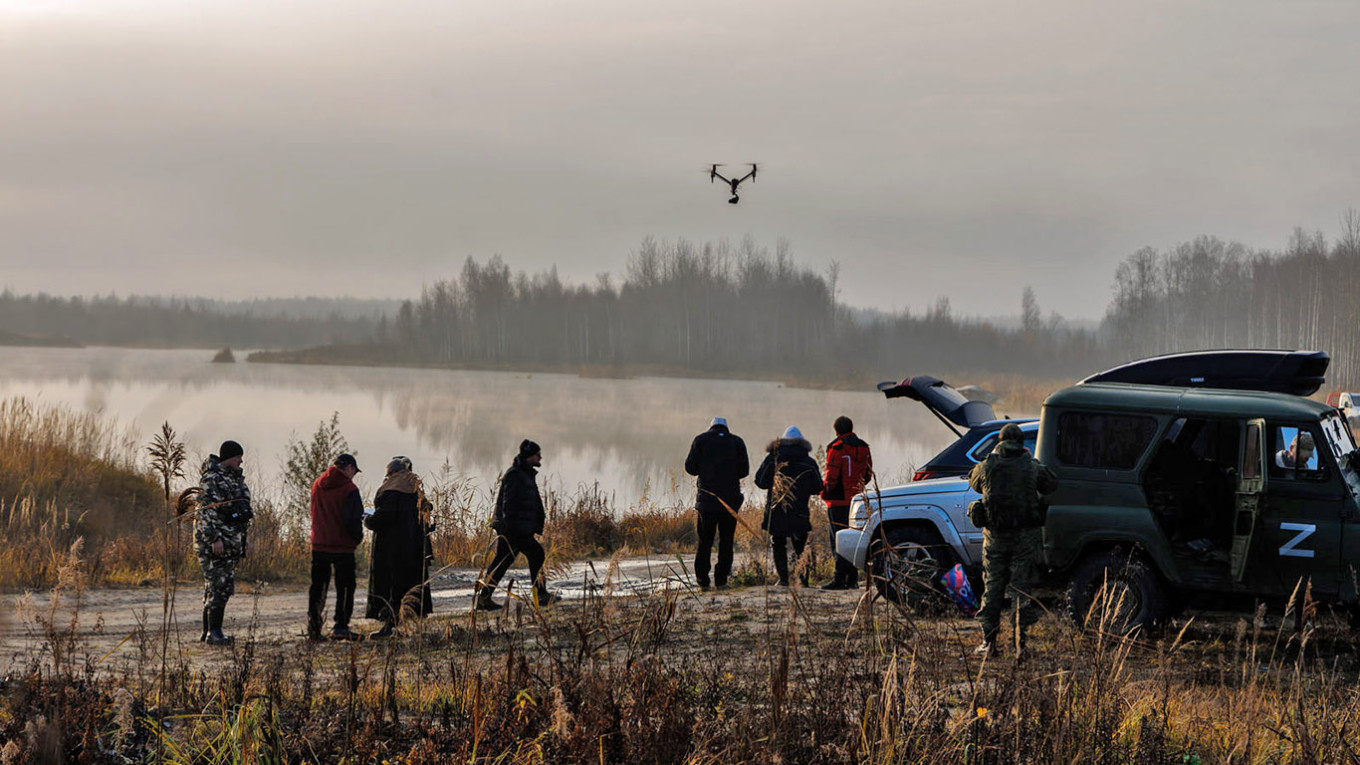
President Vladimir Putin and his propagandists have tried to portray the aggression in Ukraine as a people’s war since the beginning. It didn’t work. The country has grown tired, even as so-called heroes — people who killed, raped and maimed with impunity — returned from the front.
It seems Kremlin ideologues decided it was time to inject the population with an antidote: “The Other Side of the Coin,” a comedy series following Russian soldiers fighting in Ukraine.
A comedy about war, backed by an organization that receives billions of rubles from the Kremlin, is a new genre for Russian propaganda. No comedies about the war in Chechnya were made with state funding (or private funding, for that matter). The devastation of the two Chechen wars looks very similar to what we see in Ukraine today: residential neighborhoods leveled by artillery, mass killings of civilians in “cleansing operations,” looting, and filtration camps that are sites of torture, rape and extortion.
But there is a fundamental difference between the Chechen wars and today’s war in Ukraine. In 1994-1996, atrocities committed by Russian troops and the realities of the war could be reported with relative freedom, at least for a time. Fewer members of the public knew people who were fighting or were affected by sanctions than today. Beyond journalists and human rights defenders, what happened in Chechnya mostly concerned the military and their families. For most Russians, it was a local story on the empire’s periphery.
There was no mobilization then. Coffins came back from Chechnya, as they once did from Afghanistan, but far fewer than from Ukraine. People with broken psyches returned too, but in smaller numbers who mostly went unnoticed rather than becoming a “new elite.”
The war in Ukraine has become a far greater problem for the Kremlin than the Chechen campaigns. Not only in media terms — atrocities by Russian soldiers instantly spread on social media to multimillion-strong audiences — but socially as well. This war, like a slow-acting poison, has soaked into all of today’s Russian reality.
The logic behind making a comedy is simple: laughter helps manage fear. Removing the war from public consciousness is impossible, so propaganda’s task is to turn it from a tragedy into a comedy.
The plot is simple: “A group of volunteers arrives in the combat zone. The newcomers are placed under the command of an experienced fighter with the call sign ‘Cuba,’ who doesn’t want to babysit recruits but follows his commander’s orders. Their first task is to set up a temporary base in a ruined house. Thus begins the everyday lives of young fighters under the supervision of experienced commanders.”
Right. It’s a story of everyday life filled with smiles, soaked in camaraderie and the guidance of wise leaders … Not exactly the experience of Russian soldiers we know about.
The cast list is baffling. One has to feel sorry for Alexander Mikhailov who, for some reason, decided to tarnish his filmography late in life. Another actor, Vladimir Epifantsev, was even once reported to the police in 2023 for “Russophobia” for saying that “we live in a fascist military state.”
The idea of turning the war into a comedy didn’t go over well with high-profile pro-war figures, either. Mikhail Ivanov, deputy chair of the World Russian People’s Council and a United Russia deputy in the Bryansk Regional Duma, called the idea “deeply flawed and immoral,” noting that mocking how mothers and wives lose and mourn sons and husbands is unacceptable.
With his outrage, “council” deputy Ivanov should address the already-mentioned Putin administration. There he’ll be quickly told that this series is just what people need — and that he’d better keep quiet before an article on “discrediting the army” sticks to his tongue.
Still, there are signs that many people agree with Ivanov. For example, an angry post from VKontakte asked:
“Has the director ever been to the front? Does he understand what it’s like to see your comrades torn to pieces? Or to hold a mortally wounded friend as he dies? Funny, is it? The perfect time to be ironic?
“Categorical rejection of this outrage by the masses can influence what’s happening. Mockery of living and dead SVO veterans will not pass!”
It’s not hard to guess what will come of this. The show will be no “Good Soldier Švejk” — perhaps the classic example of a war comedy — even if some techniques seem similar. Švejk is an anti-war satire; “The Other Side of the Coin” is military propaganda sweetened with jokes.
Russians will be shown cheap, formulaic fare about good, kind, sincere and funny Russian soldiers — something like the series “Soldiers,” which fed an undiscerning audience for a decade. The new show will have all the obligatory ideological markers of the war: Ukronazis, defending Russians, traditional values, the rest of the world against us. Ukrainians defending their country will, without a doubt, be portrayed as the embodiment of global evil.
The target audience for such content is sitcom viewers on TNT who the war has not directly touched. The Kremlin likely has more ambitious goals for the agitprop. Still, the mission of combining a “holy war” with light entertainment is doomed to fail.
You can’t make people watching the war from couches laugh without provoking the fury of those who buried a husband or son. Ironically, the show’s very name — “The Other Side of the Coin” — means that there is a hidden downside to everything. You cannot have it both ways.
Young people will inevitably tear the series into memes and gags, which will pop up daily before the eyes of relatives of the dead — people whose lives Putin has permanently crippled. During the war, he disposed of at least 150,000 Russian men. That is only the number of deaths that could be confirmed; other sources cite higher numbers, as high as 250,000.
According to the Kremlin, it’s time to sit down with a bowl of dumplings and a beer and have a good laugh at military everyday life. But the bodies torn apart and rotting in trenches, the blood, filth, meanness, theft, drunkenness, drugs, vomit, execution, torture, teeth being ripped out and meat-grinder assaults enriching commanders — all that will surely stay off-screen.
A Message from The Moscow Times:
Dear readers,
We are facing unprecedented challenges. Russia's Prosecutor General's Office has designated The Moscow Times as an "undesirable" organization, criminalizing our work and putting our staff at risk of prosecution. This follows our earlier unjust labeling as a "foreign agent."
These actions are direct attempts to silence independent journalism in Russia. The authorities claim our work "discredits the decisions of the Russian leadership." We see things differently: we strive to provide accurate, unbiased reporting on Russia.
We, the journalists of The Moscow Times, refuse to be silenced. But to continue our work, we need your help.
Your support, no matter how small, makes a world of difference. If you can, please support us monthly starting from just $2. It's quick to set up, and every contribution makes a significant impact.
By supporting The Moscow Times, you're defending open, independent journalism in the face of repression. Thank you for standing with us.

Remind me later.