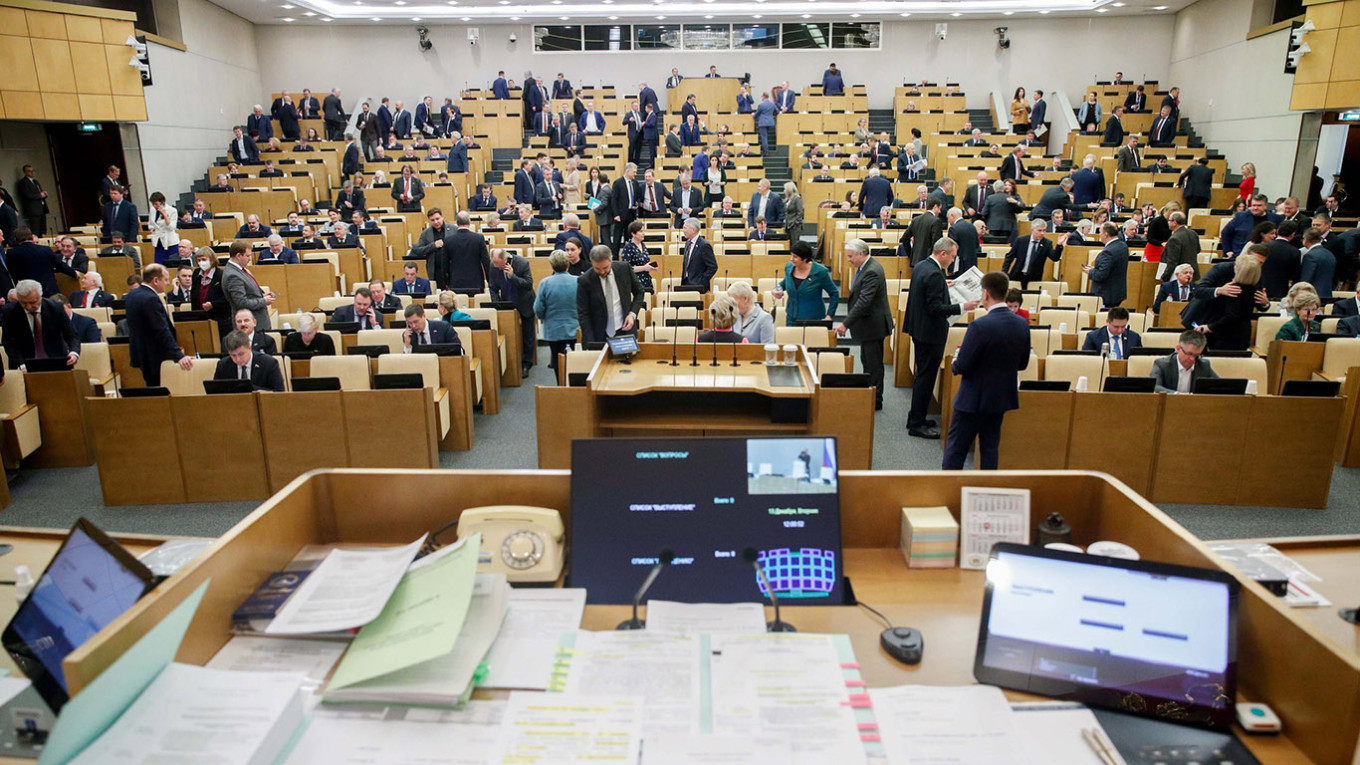
Russia’s lower-house State Duma on Thursday passed a package of bills exempting government officials from filing annual public financial declarations, a move lawmakers said would modernize oversight.
Under the legislation, financial monitoring of officials and their close relatives would instead be carried out through a closed state information system known as Poseidon, which tracks income, assets and property in real time. The system is integrated with other government databases, including those of the Federal Tax Service and the financial watchdog Rosfinmonitoring.
“This will... also facilitate prompt responses to corruption-related offenses,” said Vasily Piskaryov, a lawmaker from the ruling United Russia party, describing the shift as a move away from an “outdated system.”
Direct access to Poseidon would be limited to authorized government bodies such as the Presidential Administration and the Federal Protective Service.
Officials would still be required to submit financial declarations when taking up a new post, transferring between agencies or making purchases that exceed their family’s combined income over the previous three years, according to the bill’s text.
The changes are set to take effect on Jan. 1 if approved by the upper-house Federation Council and signed by President Vladimir Putin.
The legislation was introduced by deputies from all State Duma factions just 10 days before Thursday’s vote, though members of the Communist Party criticized the proposal during debate.
In December 2022, Putin suspended the mandatory publication of officials’ financial declarations for the duration of the war in Ukraine. Soon afterward, disclosures, including those filed before Russia’s full-scale invasion in February 2022, began disappearing from official websites.
Before that decree, Russian law had required civil servants to publicly disclose their income and assets, as well as those of immediate family members, under an anti-corruption framework introduced in 2008.
A Message from The Moscow Times:
Dear readers,
We are facing unprecedented challenges. Russia's Prosecutor General's Office has designated The Moscow Times as an "undesirable" organization, criminalizing our work and putting our staff at risk of prosecution. This follows our earlier unjust labeling as a "foreign agent."
These actions are direct attempts to silence independent journalism in Russia. The authorities claim our work "discredits the decisions of the Russian leadership." We see things differently: we strive to provide accurate, unbiased reporting on Russia.
We, the journalists of The Moscow Times, refuse to be silenced. But to continue our work, we need your help.
Your support, no matter how small, makes a world of difference. If you can, please support us monthly starting from just $2. It's quick to set up, and every contribution makes a significant impact.
By supporting The Moscow Times, you're defending open, independent journalism in the face of repression. Thank you for standing with us.

Remind me later.