
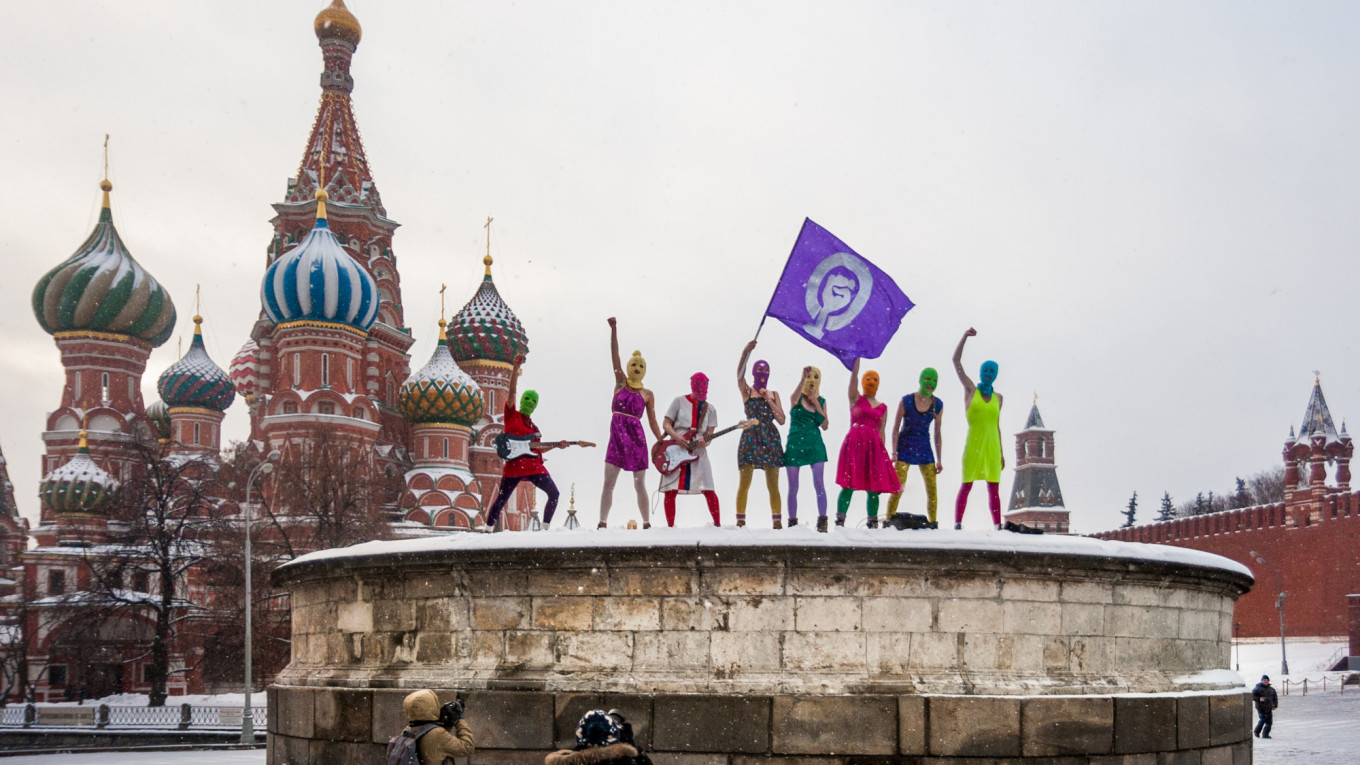
A Russian court has declared Pussy Riot an extremist organization.
What does this mean in practice? To begin with, it means that if you now write the word “Riot” next to the word “Pussy” in Russia, you could be sentenced for up to five years in prison for “justifying extremism.” The same applies if you like or share those words on social media.
Or, if you cut holes for the eyes and mouth in an ordinary knitted hat, it can now be considered an extremist balaclava. Same sentence.
While writing this, I realized that a police officer wears hats with cutouts for the eyes and mouth. Sure, they’re not colorful — but why is black worse than any other color?
You can make almost any piece of news funny by pointing out those inconsistencies. Almost.
But now I am relearning how to laugh.
As a member of Pussy Riot, I have been through a lot. I spent two years in a penal colony in the Urals — a modern-day gulag. I was beaten with whips, had my head smashed open and was banned from leaving the country. I spent nights detained in police stations. I was regularly followed and wiretapped. I endured a year and a half under house arrest, and six stints of 15 days each in special detention centers. I faced threats to take my child away; threats to imprison my child. Not a bad résumé to fill my new book with.
And yet I did not want to leave. I desperately did not want to. Leaving Russia meant tearing my heart out. If not for my loved ones, I would never have gotten into that car that simply drove west with an electronic ankle monitor and without a passport.
I have been living for three and a half years without a home, having moved between hundreds of hotels and dozens of apartments.
There are several million people like this — people deprived of a home and, in essence, of a country. And each of us has our own story of how we became an “extremist” or “terrorist.” A story about the moment when it became impossible to remain silent.
Each of us — or almost each of us — has relatives left inside the country: hostages. Elderly parents who do not want to leave, or brothers and sisters who have decided that the ground under their feet is more valuable than crying out the truth about the crimes of Putin, the army and the regime’s propagandists.
Criminal cases opened in Russia mean only one thing: the road back is only a road to prison. Another member of Pussy Riot, Taso, recently said that he thinks more and more about what the word “never” means. It’s frightening to think about, isn’t it? The prospect of “never returning home.”
This summer, in July, my father died. It happened a month and a half after a search related to our latest criminal case, for spreading “fake news about the Russian army.” The case was opened over the 2022 anti-war video “Mama, Don’t Watch TV” and the 2024 anti-war performance “You Are Sponsoring the War” at the Pinakothek museum in Germany. Five members of Pussy Riot — Olga Borisova, Taso Pletner, Alina Petrova, Diana Burkot and I — received jail sentences in absentia ranging from eight to 13 years in prison.
My last conversation with my father was very short. I was late for the stage, for our concert. He said, “I immediately understood why they came. I immediately understood that it was you, Masha. Well done — you managed to get to them even from there.”
I never thought I would watch a funeral by video on Telegram, or take part in a memorial service over Zoom. But I did.
Is that what the word “never” means?
While the Kremlin is terrorizing Ukrainians, all human rights activists, opposition figures and even the LGBT movement are considered extremists in Russia. Feminism is next in line.
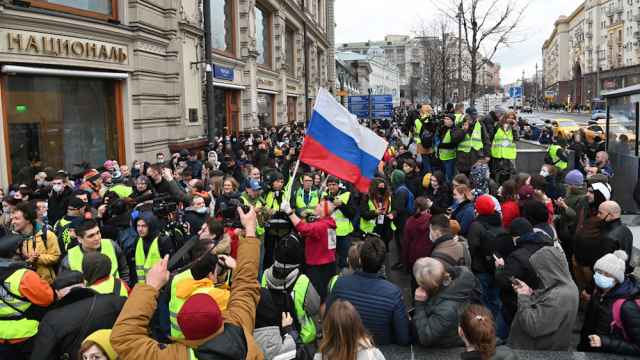
Participating in anti-war protests is a criminal offense.
Calling for sanctions against Russia is a criminal offense.
Spreading information that differs from the Kremlin's opinion is a criminal offense.
Another member of Pussy Riot, Sasha Sofeev, said: “Terrorists call us extremists. Isn't that absurd?” But this whole business about declaring the opposition to be “extremists” arose for one reason only: we did not remain silent. And we do not plan to remain silent.
No one taught us in school what to do if your country's army attacks a neighboring country, a country that you also love. We are holding concerts in support of Ukraine. Ukraine must be able to live, not become part of Putin's gulag.
I would very much like the Western world, which is leaning toward the far-right, to understand that this is not a local conflict in eastern Europe. This is a hybrid war. You may or may not like Ukraine. But if Putin doesn't like something about it today and you allow the country to be taken over, tomorrow he may not like something about you and your home.
I wrote this on Catholic Christmas Eve. Russian propagandists are calling for you to be bombed every day, with conventional and nuclear weapons. The irony is that even in a globalized world with the internet and airplanes, you don't hear this. Everyone wants to live, so they often pretend that everything is fine, that war will not come to their home.
A Message from The Moscow Times:
Dear readers,
We are facing unprecedented challenges. Russia's Prosecutor General's Office has designated The Moscow Times as an "undesirable" organization, criminalizing our work and putting our staff at risk of prosecution. This follows our earlier unjust labeling as a "foreign agent."
These actions are direct attempts to silence independent journalism in Russia. The authorities claim our work "discredits the decisions of the Russian leadership." We see things differently: we strive to provide accurate, unbiased reporting on Russia.
We, the journalists of The Moscow Times, refuse to be silenced. But to continue our work, we need your help.
Your support, no matter how small, makes a world of difference. If you can, please support us monthly starting from just $2. It's quick to set up, and every contribution makes a significant impact.
By supporting The Moscow Times, you're defending open, independent journalism in the face of repression. Thank you for standing with us.

Remind me later.