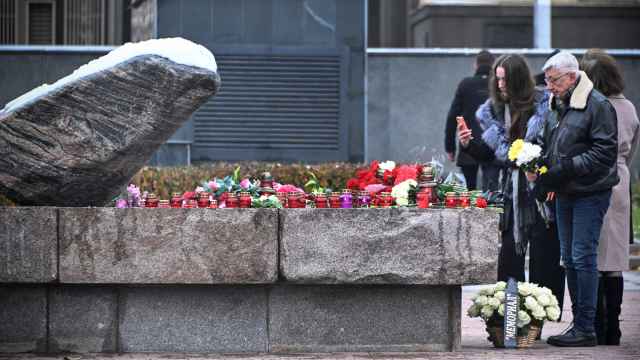
For nearly half a century, Oct. 30 has marked the annual remembrance day for victims of political repression in Russia. In the run-up to this year’s commemorations, however, librarians and schoolteachers in the Far East city of Magadan received instructions through online meetings not to hold events about Soviet repressions. If events were already scheduled, they should not be publicized.
This unprecedented interference is particularly striking because Magadan was the capital of one of the largest and deadliest gulag settlements: Kolyma. If repressions cannot be mentioned there, where tens of thousands died in brutal conditions and human and material remains of the camps are still strewn across the landscape, it appears to mark a new low in Russia’s ongoing failure to confront its Stalinist past.
Concerns about the silencing of gulag and terror memory in Russia are nothing new: they have erupted periodically since Stalin’s death.
They have mounted sharply in recent years, though, especially since the 2021 closure of Memorial, Russia’s principal NGO devoted to commemoration of Soviet atrocities. Continued attempts to commemorate terror now face relentless threats of interference, attacks, lawsuits and arrests. The Last Address project — which commemorates addresses connected to victims of Stalinist terror — is engaged in a constant battle against the removal and vandalism of its plaques. This is typical of a shadowy but now unmistakable hostility towards investigation and commemoration of Soviet terror nationwide.
Even so, there is something especially ominous about the apparent prohibition on “publicizing” these memories in Kolyma. During and after the Stalin era, the gulag needed no publicizing there. Its identity and history remain inextricably bound up with the camps. Many residents to this day have family connections to the camps, and its legacies are ubiquitous across the region.
The gulag came to Kolyma very soon after its formal founding in the late 1920s: the vast Dalstroy camp network was established in 1931. The construction of Magadan city using forced labor began soon afterwards. Though the Stalinist press mostly silenced any mention of the camps, it celebrated the huge influx of personnel that had arrived to exploit the region’s untapped natural resources (especially gold reserves in the Kolyma River) and to build a showcase Stalinist civilization on the edge of the Soviet empire. This propaganda that celebrated the region’s colonization concealed the fact that it was prisoner labor that mined the region’s gold and developed its infrastructure, and even provided most of the talent for Magadan’s most celebrated theatre. The work took a deadly toll. Over a quarter century, close to 1 million prisoners were sent to Kolyma and at least 125,000 died there.
Survivors of these brutal conditions — including Varlam Shalamov, Evgenia Ginzburg and Simeon Vilensky — were among the most important contributors to Russian gulag literature. They returned from Kolyma determined to reveal the suffering and death caused by the camps’ extreme cold, hunger and violence. Typical was Kolyma returnee, Georgy Demidov, whose prose about the camps has been rediscovered in recent years through a 2020s book series published by the Moscow State Gulag Museum and Ukrainian director Sergei Loznitsa’s film “The Two Prosecutors,” which premiered at Cannes earlier this year. Demidov’s most famous short story collection, “A Wondrous Planet,” took its name from a prisoner song which sardonically summed up Kolyma’s death and destruction: “Curse you, Kolyma/For being called a wondrous planet/If you descend the gangway there/From there, there’s no return.”
Kolyma, therefore, represented the extreme of the gulag archipelago: Solzhenitsyn himself admitted that inmates such as Shalamov had suffered in ways that non-Kolyma prisoners like himself could barely imagine. Yet local commemoration of this tragic past has been anything but extreme. As elsewhere in Russia, gulag and Great Terror memory sites are few and far between, and most operate with scant support from regional or federal authorities.
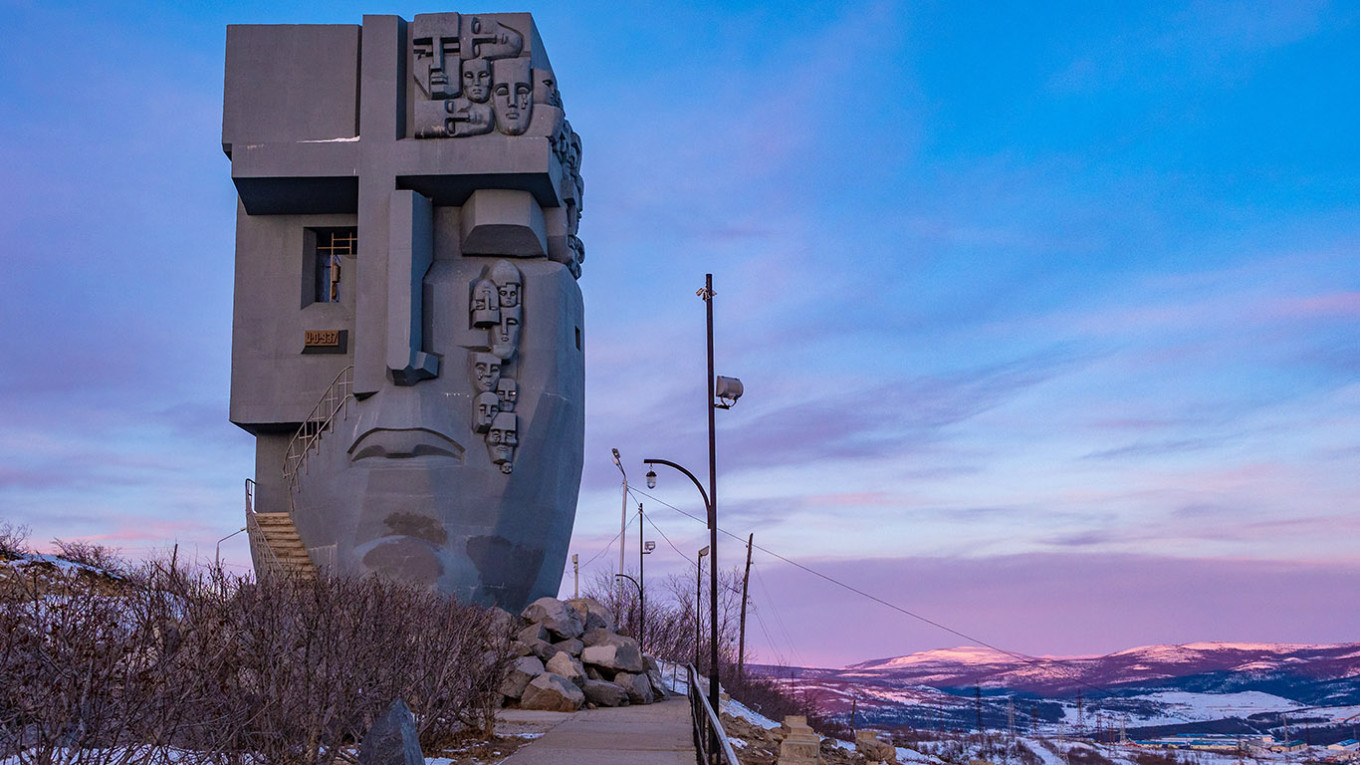
Magadan city boasts a smattering of gulag memory sites. Among its monuments, mostly dating to the de-Stalinization of the Gorbachev and early Yeltsin years, are tributes to individual prisoners (the gay musician Vadim Kozin), bosses who became prisoners (Eduard Berzin, the first boss of Dalstroy) and the area’s broader camp history, through the enormous Mask of Sorrow monument, designed by sculptor Ernst Neizvestny, and opened in 1996. The state-funded local history museum has two sections devoted to Kolyma and Dalstroy. But as in other such museums in areas deeply marked by the camps, most of its displays and events celebrate the region’s industrialization, economic might, and wartime heroism. The same is true of the city’s flagship library, whose employees were among those warned about undue publicity last month.
Museums with a more serious commitment to exploring the region’s gulag past are all grassroots initiatives, scattered across the broader region and at growing risk of closure. The largest, the Memory of Kolyma museum in Yagodnoye, was the brainchild of local enthusiast Ivan Panikarov. Having collected several thousand exhibits, Panikarov often has to display them in private apartments due to a lack of support from local authorities.
A museum in the village of Debin dedicated to Kolyma’s most famous survivor, Varlam Shalamov, was shut down for alleged violations of safety regulations in 2023, around the same time that Shalamov’s “Kolyma Tales” disappeared from Russian school syllabi. Now, Magadan’s teachers — also at last month’s meeting — can only use Solzhenitsyn’s “Ivan Denisovich” and parts of “The Gulag Archipelago” to cover the vast topic of the camps.
Despite the gulag’s deep imprint on the region’s history, then, local authorities’ commitment to keeping its memory alive is weak at best. And there have been ominous moves in the opposite direction too, such as recent moves by regional authorities to review the rehabilitation certificates of thousands of victims of Stalinist terror. October’s local warnings against memory activism therefore come as no surprise. They also fit within a broader national picture of narrowing constraints on gulag and terror memorialization, and growing attempts at more overt rehabilitation of Stalin.
Nonetheless, there is an apparent reluctance to make this new stance on the Stalinist past official, instead maintaining ambiguity, or at least plausible deniability. As recently as 2024, President Vladimir Putin himself backed the development of an ambitious open-air memory park in the Magadan region, releasing federal funding and setting a 2030 deadline to coincide with celebrations of the anniversary of the region’s founding. The glossy website of the flagship open-air museum planned for Dalstroy’s Dneprovsky camp, some 300 kilometers from Magadan, remains live and shows no obvious sign of the project being shut down. However, one of the project’s main collaborators, Roman Romanov of the State Gulag museum (itself closed in November 2024 for alleged fire regulation violations), has been fired and the Kolyma projects are rumored to have been shelved.
Meanwhile, in Magadan itself, the ceremony at the Mask of Sorrow went ahead on Oct. 30. It featured the usual rituals, including flowers being placed at the memorial and the reading out of names of local terror victims (part of the ‘Returning the Names’ that happens across Russia on the same day). However, the mayor and governor declined to attend, instead sending out statements that criticized Stalinist repressions but counseled against the politicization or distortion of their memory. Ironically, such appeals for neutrality are now a key strategy of local and national politicians seeking to marginalize or even criminalize the historical investigations of Memorial and similar NGOs.
Local officials have still issued no guidelines since the oral instructions of a few weeks ago. This means that teachers and librarians, as well as the smaller number of locals actively involved in gulag commemoration, have been plunged into further uncertainty about what can and cannot be said about the Stalinist past. As ever more organizations and individuals around the country are punished for exceeding these unclear limits, it may seem safer to say nothing at all. This silence could erase gulag memory without the authorities having to say much more about it themselves. As Magadan’s camp remains continue to decay, so too does Russia’s willingness to confront the full truth about Soviet atrocities. This is not only a failure of public memory; it also continues to enable state violence in the present.
A Message from The Moscow Times:
Dear readers,
We are facing unprecedented challenges. Russia's Prosecutor General's Office has designated The Moscow Times as an "undesirable" organization, criminalizing our work and putting our staff at risk of prosecution. This follows our earlier unjust labeling as a "foreign agent."
These actions are direct attempts to silence independent journalism in Russia. The authorities claim our work "discredits the decisions of the Russian leadership." We see things differently: we strive to provide accurate, unbiased reporting on Russia.
We, the journalists of The Moscow Times, refuse to be silenced. But to continue our work, we need your help.
Your support, no matter how small, makes a world of difference. If you can, please support us monthly starting from just $2. It's quick to set up, and every contribution makes a significant impact.
By supporting The Moscow Times, you're defending open, independent journalism in the face of repression. Thank you for standing with us.

Remind me later.