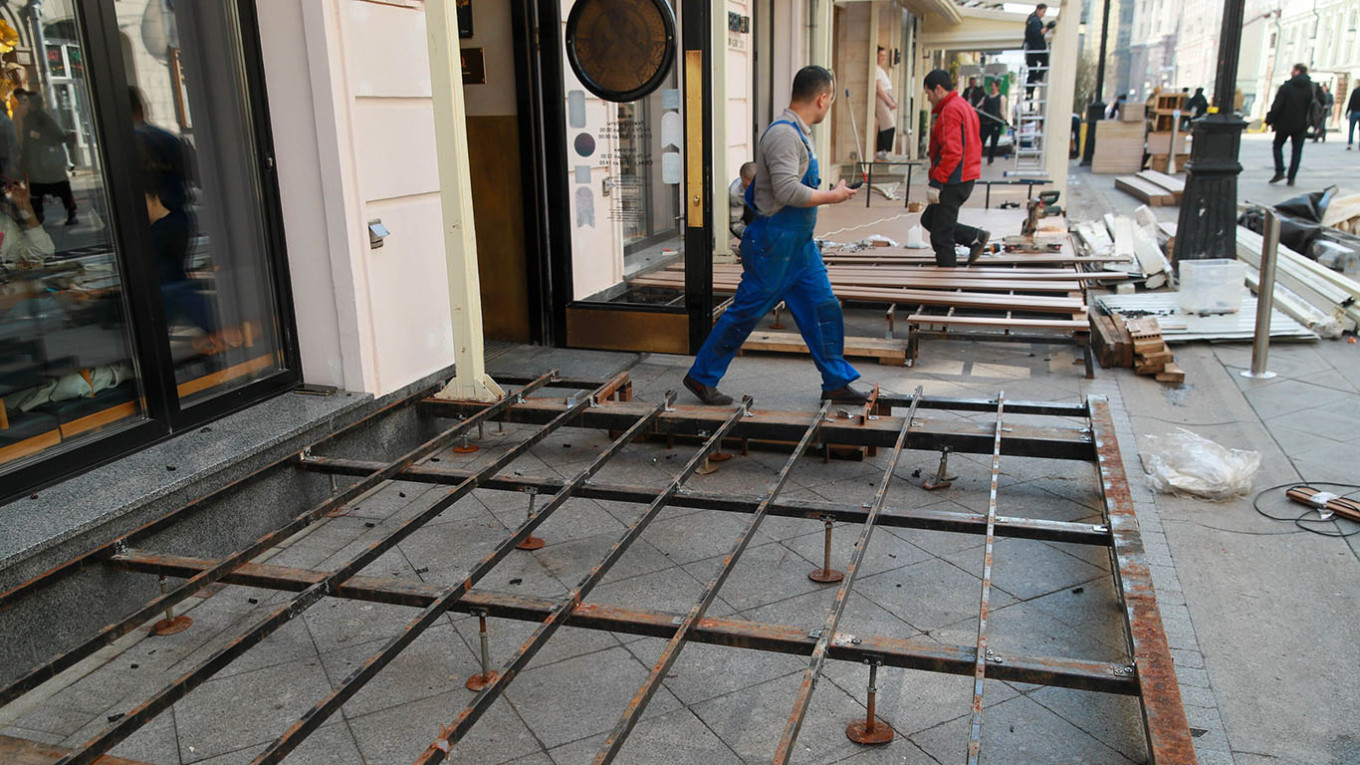
Russia’s small and medium-sized businesses (SMBs) are shutting down at an accelerating pace as higher taxes, weak consumer demand and Russia’s first economic contraction since 2023 squeeze companies already struggling with high borrowing costs and slowing spending.
Some 209,000 SMBs were liquidated in the first quarter, up 9% from the same period a year earlier, Forbes Russia reported, citing data from business analytics platform Kontur.Focus.
The closures are hitting sectors including retail, beauty salons and food services especially hard, according to Tatyana Pushkova, director of business and asset valuation at consulting firm Neo, who said many businesses are struggling to cope with high interest rates, falling demand and rising tax burdens.
Russia’s domestic economy is under mounting pressure as inflation remains elevated and households increasingly cut back discretionary spending despite years of wartime stimulus. Small businesses, long considered one of the weaker links in Russia’s economy, are facing higher operating costs while government support has been scaled back.
Since Jan. 1, entrepreneurs with annual revenue of 20 million-60 million rubles ($274,000-$822,000) have become subject to value-added tax (VAT) requirements, and Russia’s VAT rate itself increased to 22%.
Some businesses have also lost access to fixed patent-based tax payments and are being pushed onto simplified tax regimes requiring payments of either 6% of turnover or 15% of profits.
“Many private companies no longer have any financial cushion left. Small businesses are hanging on by their last reserves,” economist Dmitry Polevoy said. Higher taxes would only worsen conditions and could push some firms into bankruptcy, he added.
Restaurants and cafes appear particularly vulnerable. A March survey by Aktion Accounting found that 94% of cafes, bars and restaurants were either operating at the edge of profitability or already at a loss.
The number of food-service closures rose 29% year-on-year in January-February to 7,300 outlets. Coffeehouse chain Shokoladnitsa, for example, closed around 40 locations.
Restaurant traffic has fallen by an average of 10%-15% this year and in some cases by as much as 40%, said Alexei Komkov, a consultant at Adizes Business Consulting.
Business owners are also grappling with labor shortages, staff cost increases of 15%-20%, high taxes and declining demand, he said.
“Customers have shifted to treating restaurant visits as special occasions. Eating out is no longer part of everyday life,” Komkov said.
The retail clothing sector also faces a difficult outlook. Up to 40% of apparel stores could shut down by year-end, according to economist and Goldman Agency managing partner Olga Popkova.
Large chains have also begun scaling back operations. Zenden, O’Stin and Concept Group are among those cutting their footprint. Gloria Jeans plans to close 150 stores this year, while Finn Flare has decided to keep stores only in Moscow and St. Petersburg. Modis has filed for bankruptcy and Orby plans to do the same.
Analysts including Pushkova and Komkov said the wave of SMB closures is likely to continue as inflation remains high and Russians’ purchasing power weakens.
Meanwhile, government support for small businesses is shrinking. In the first quarter, 6% fewer companies received state aid compared with a year earlier, while grants, subsidies and capital investment support nearly halved to 5.5 billion rubles ($75.4 million) from 9.6 billion rubles ($131.5 million).
Budget spending on the federal Small and Medium Entrepreneurship program for 2025-2030 was also cut by 21% to 329.5 billion rubles ($4.51 billion).
Read this article in Russian at The Moscow Times' Russian service.
A Message from The Moscow Times:
Dear readers,
We are facing unprecedented challenges. Russia's Prosecutor General's Office has designated The Moscow Times as an "undesirable" organization, criminalizing our work and putting our staff at risk of prosecution. This follows our earlier unjust labeling as a "foreign agent."
These actions are direct attempts to silence independent journalism in Russia. The authorities claim our work "discredits the decisions of the Russian leadership." We see things differently: we strive to provide accurate, unbiased reporting on Russia.
We, the journalists of The Moscow Times, refuse to be silenced. But to continue our work, we need your help.
Your support, no matter how small, makes a world of difference. If you can, please support us monthly starting from just $2. It's quick to set up, and every contribution makes a significant impact.
By supporting The Moscow Times, you're defending open, independent journalism in the face of repression. Thank you for standing with us.

Remind me later.