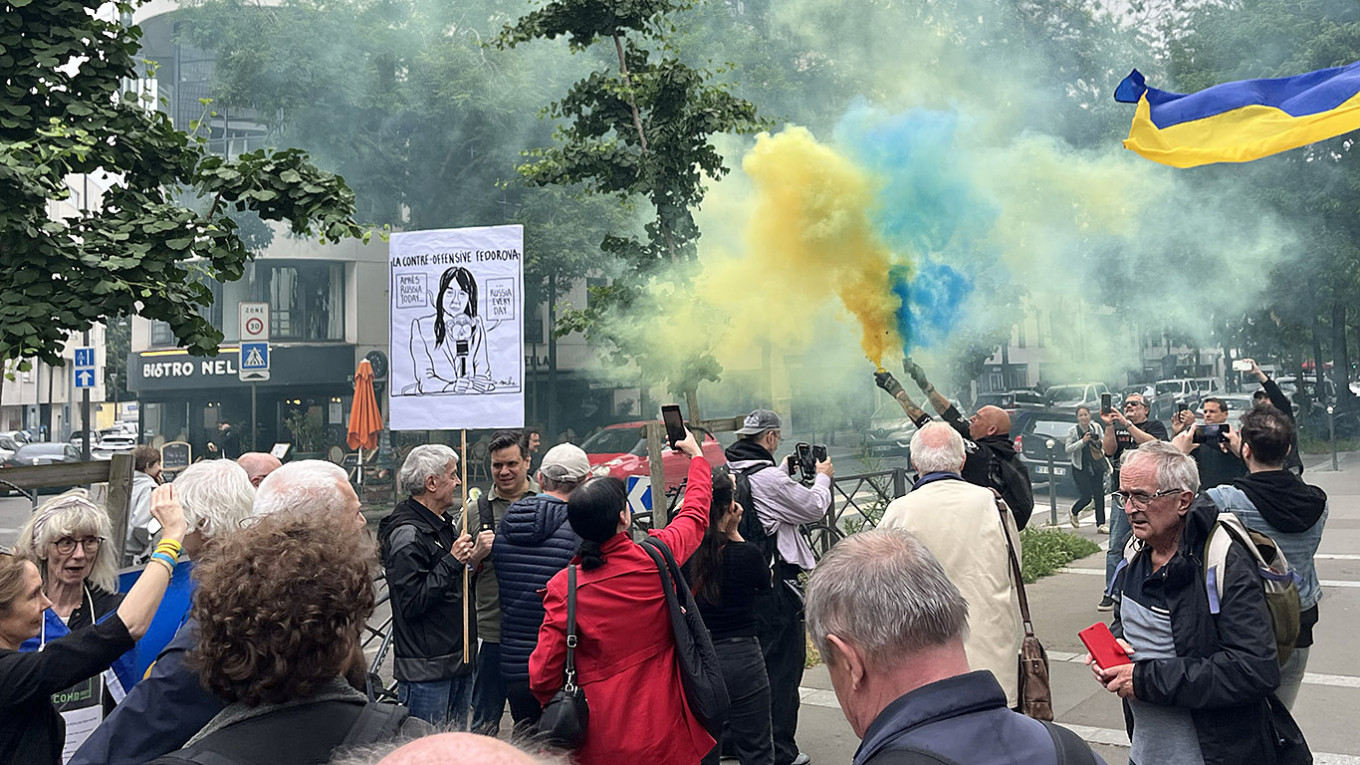
PARIS — “No, no, no to war propaganda!” the crowd chants, waving Ukrainian and French flags outside the offices of conservative broadcaster CNews in one of the French capital’s most affluent districts.
Dozens of people speaking Ukrainian, French and Russian have gathered here with a shared goal: to push for sanctions against Ksenia Fedorova, the former director of RT’s French-language satellite RT France.
The demonstration came a day after members of the European Parliament called on the European Union to impose sanctions on Fedorova, who has re-emerged as a familiar face in French media since RT France was sanctioned and shut down in 2023 — but who is now coming under increased scrutiny.
Critics argue that Fedorova continues to promote the Kremlin’s version of events through her regular appearances on outlets owned by French billionaire Vincent Bolloré.
Fedorova denies acting as a Kremlin propagandist and has described criticism of her work as politically motivated. Executives at French media conglomerate Canal+, whose channels regularly feature Fedorova, have defended her role on air.
‘The leader of our French media revolution’
According to her LinkedIn profile, Fedorova, 45, spent more than 17 years at the Russian state-funded broadcaster RT, joining the network at its founding in 2005.
Margarita Simonyan, RT's editor-in-chief, has described Fedorova as “my beautiful deputy” and “the leader of our French media revolution.”
RT France stopped operating in 2023 after French authorities froze its bank accounts following European sanctions imposed on Russian state media after the invasion.
Since last fall, Fedorova has regularly appeared as a commentator on Bolloré-owned media outlets including CNews, Europe 1 and JDNews.
“It should be stated that this person is a propagandist, not a journalist,” Antoine Bernard, director of advocacy at Reporters Without Borders, told The Moscow Times.
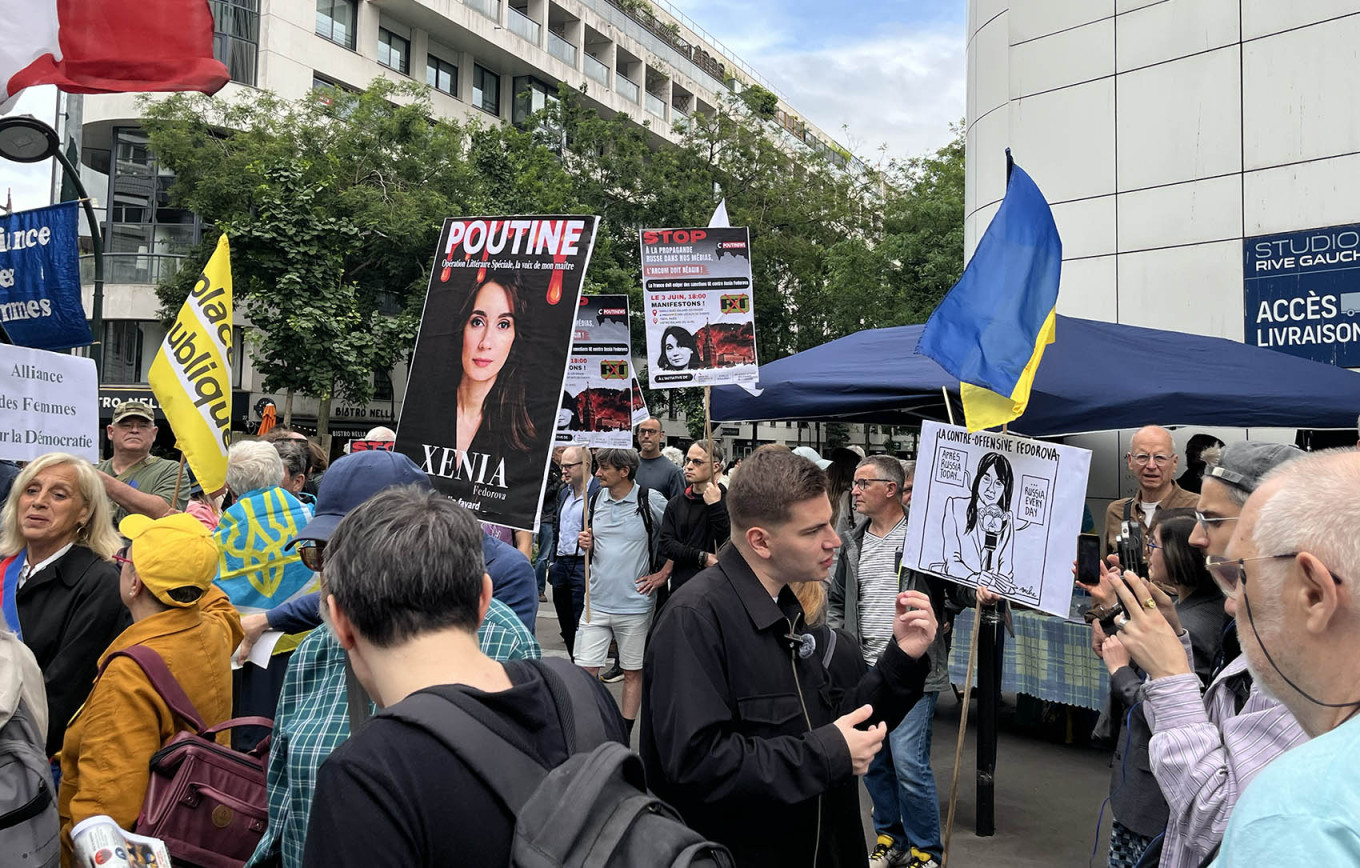
According to Le Monde, Fedorova has referred to Russia’s invasion of Ukraine as a “special military operation,” adopted Moscow’s characterization of Ukraine’s 2014 Maidan revolution as a “coup d’état” and described Russia’s annexation of Crimea as a “reunification” with Russia.
She has also argued that Russia wants peace while Western countries are responsible for prolonging the conflict by providing support to Ukraine.
Fedorova continued to appear on programs hosted by Russian state television host Vladimir Solovyov in 2022 and 2023, while Solovyov has regularly cited updates from her Telegram channel.
‘Exiled’
Wednesday’s demonstration was not the first time that Fedorova’s presence in France had sparked protests.
In April 2025, pro-Ukrainian activists interrupted the launch of Fedorova’s book “Bannie” (“Exiled”) at Paris’ Grand Palais, distributing leaflets featuring images of Ukrainian children deported to Russia and displaying a blood-stained toy alongside Fedorova’s portrait.
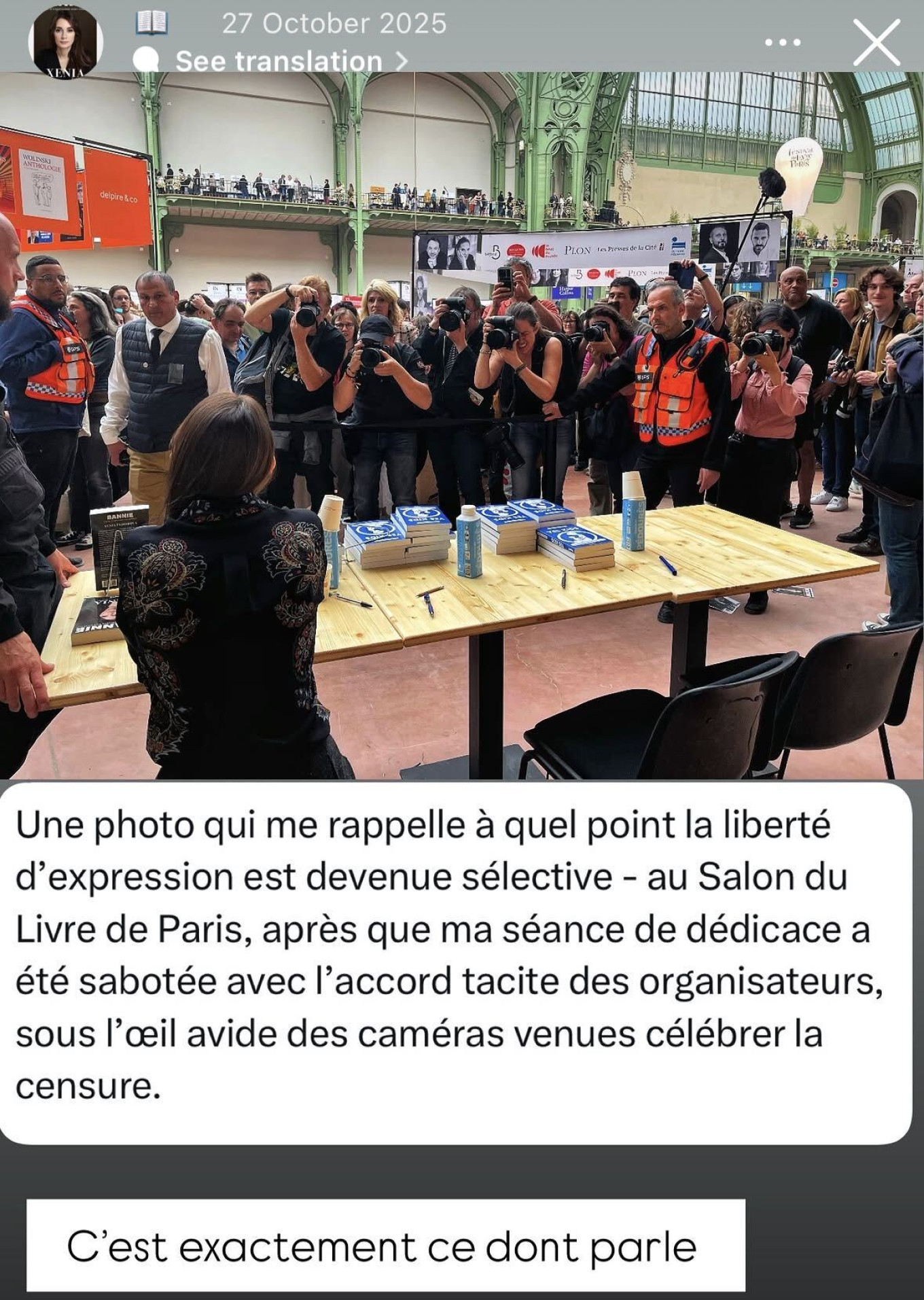
She did not publicly address the disruption until October, when she posted a photo from the event on Instagram.
“A photo that reminds me how selective freedom of speech has become,” she wrote. “At the Paris Book Festival, after my book signing was sabotaged with the silent consent of the organizers, under the hungry gaze of cameras that came to celebrate censorship.”
Bernard of Reporters Without Borders rejected her characterization of the incident.
“Let’s not fall into the trap of freedom of expression versus censorship,” Bernard said. “We’re talking about journalism. And journalism is an obligation towards the audience to be honest, to be pluralistic, to be independent. Obviously, she’s not.”
Fedorova often frames her Russian nationality as the reason for the criticism and alleged prejudice she has faced.
On the day Russia launched its full-scale invasion of Ukraine, Fedorova’s Telegram channel featured statements from French politicians and a post citing calls to shut down RT as evidence of what she described as “russophobia.”
“RT France journalists were literally attacked on every talk show by experts, and they received threats. The pressure was enormous,” she later said.
In an interview with the French publication Front Populaire last year, she said: “Because I am Russian, I’m immediately labeled a Kremlin agent, a propagandist, a virus. After 2022, this became especially difficult.”
Olga Prokopieva, the director of anti-war organization Russie-Libertés, which co-organized Wednesday’s protest, disputes that interpretation.
“There is no russophobia here,” Prokopieva told The Moscow Times. “France is one of the leading countries in providing humanitarian and other types of visas to Russians in exile, including Russian journalists.”
Still, other former RT employees have gone on to continue their careers in foreign media without sparking as much outcry as Fedorova has.
Former RT France host Frédéric Taddei now works as editorial director of the weekly magazine Marianne and hosts programs on Europe 1, which is also part of the Bolloré media empire.
Shadia Edwards-Dashti, who worked at RT UK, now reports for TRT World, Turkey’s state-owned, English-language international news channel.
![A protester holds a sign with Fedorova's image that reads "CCCR [U.S.S.R.] News: Here in Moscow." Angelina Trefilova / MT](https://static.themoscowtimes.com/image/1360/2e/IMG_7733.jpg)
Despite her criticism, Fedorova obtained a 10-year French residence permit in 2024. Le Monde reported last month that her residence permit had become a source of embarrassment within “the highest levels” of the French government.
Fedorova has denied any link to the Kremlin and maintained that RT France was “independent.”
“No one could call us, not even Vladimir Putin, to tell us what to say. And we worked in a constant fight for survival,” Fedorova said in an interview with the French outlet Frontières.
According to Reporters Without Borders, between 1,500 and 1,700 independent journalists left Russia after the invasion of Ukraine to evade prosecution under wartime censorship laws. The organization says 45% of them continue to face threats in exile.
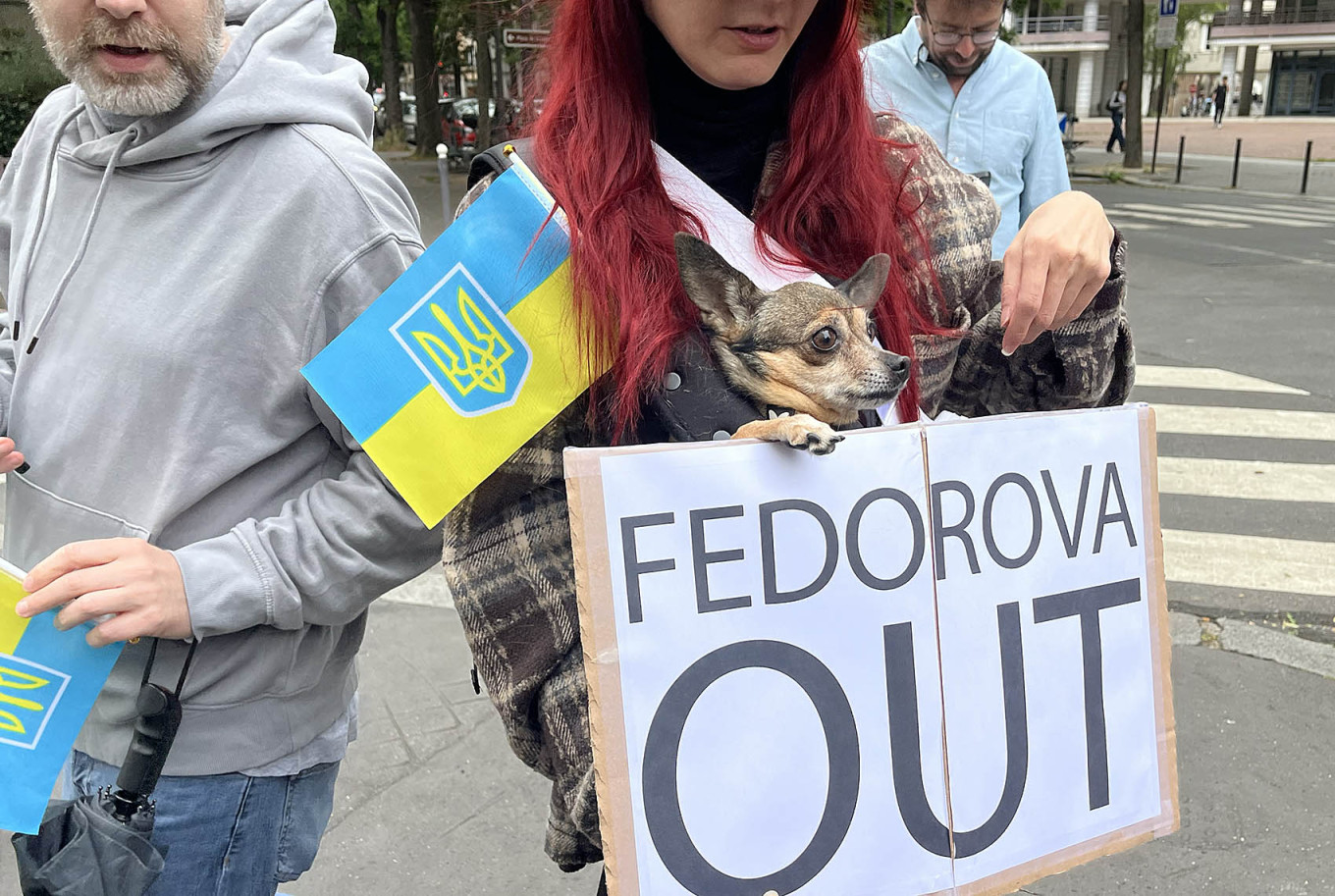
‘We want to stop it’
Among the protesters on Wednesday is Nadezhda Skochilenko, the mother of former Russian political prisoner Sasha Skochilenko.
Speaking to The Moscow Times, Skochilenko brought up the case of programmer Mikhail Loshchinin, a dual Russian-Belgian citizen who was sentenced to 16 years in Russian prison on treason charges for donating to Ukraine after he returned to Russia from Belgium.
“He didn’t follow the news in Russia,” she tells The Moscow Times. “The same thing can happen here in France. A person can listen to official sources, say, from Fedorova, and calmly assume that everything over there in Russia is just fine and safe. That has to stop.”
Bernard of Reporters Without Borders said Fedorova’s status should be determined by ARCOM, the French broadcast regulator responsible for monitoring whether media outlets meet standards of pluralism and accuracy.
Prokopieva of Russie-Libertés agreed.
“ARCOM and the European Union authorities responsible for sanctions should examine her statements under the existing legal framework. Nothing more,” she said.
“This is not a case of her being forbidden to speak,” Prokopieva said. “What is restricted is the spread of disinformation and propaganda. We want to stop it.”
A Message from The Moscow Times:
Dear readers,
We are facing unprecedented challenges. Russia's Prosecutor General's Office has designated The Moscow Times as an "undesirable" organization, criminalizing our work and putting our staff at risk of prosecution. This follows our earlier unjust labeling as a "foreign agent."
These actions are direct attempts to silence independent journalism in Russia. The authorities claim our work "discredits the decisions of the Russian leadership." We see things differently: we strive to provide accurate, unbiased reporting on Russia.
We, the journalists of The Moscow Times, refuse to be silenced. But to continue our work, we need your help.
Your support, no matter how small, makes a world of difference. If you can, please support us monthly starting from just $2. It's quick to set up, and every contribution makes a significant impact.
By supporting The Moscow Times, you're defending open, independent journalism in the face of repression. Thank you for standing with us.

Remind me later.