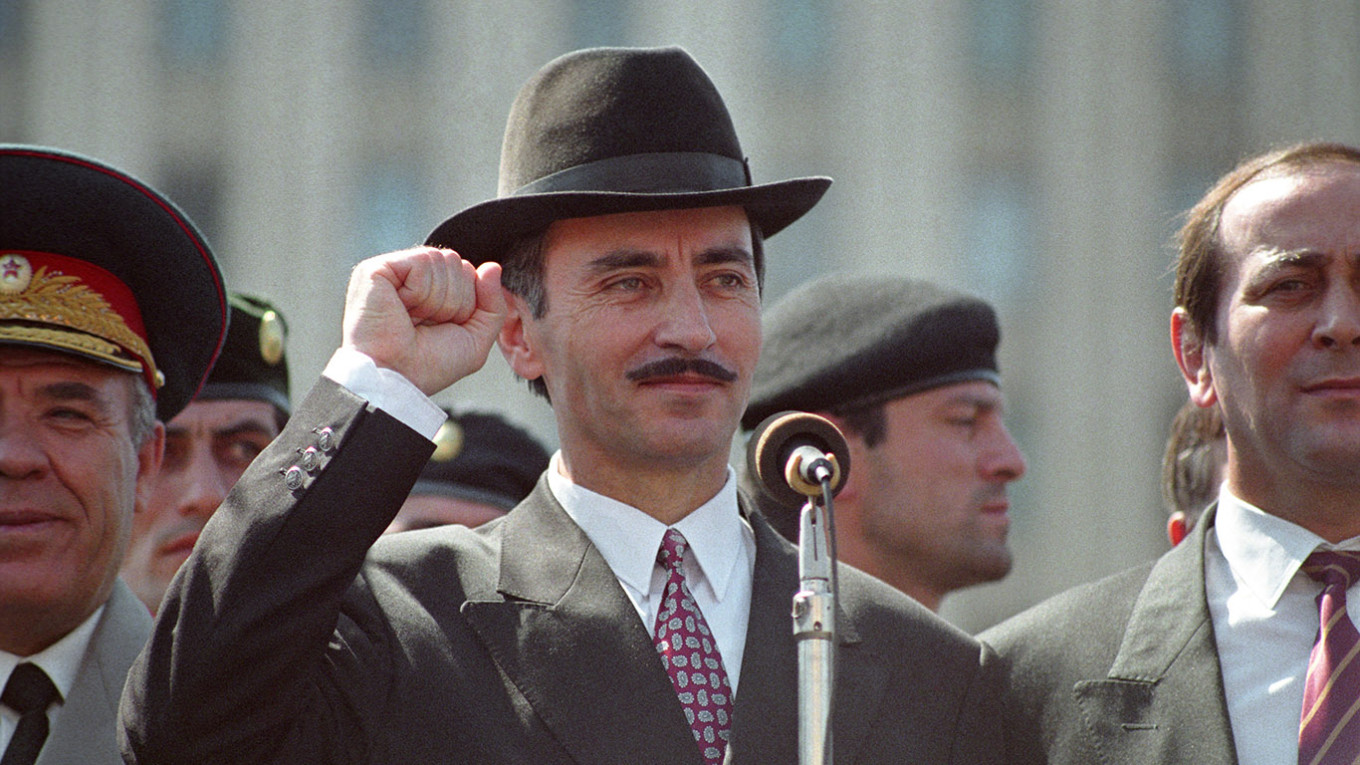
Thirty years ago, Dzhokhar Dudayev was assassinated by Russian forces. The former Soviet air force general served as the first president of the Chechen Republic of Ichkeria after declaring its independence in 1991.
Despite occurring at the same time as Soviet Socialist Republics (S.S.R.) left the U.S.S.R., Ichkeria’s claim was not recognized as, unlike other secessionist regions, it was an Autonomous Soviet Socialist Republic (A.S.S.R.) inside the Russian Federative Soviet Socialist Republic.
The lesson of Dudayev’s legacy is that Russia’s imperialism remains unsatiated, which requires solidarity across ideological and national boundaries. This lesson continues to ring true today.
Dudayev was born in Yalkhoroy, Checheno-Ingush A.S.S.R., a week before Stalin’s 1944 deportation of the Chechens and Ingush to Central Asia, with roughly one-third of their populations dying en route. Dudayev joined the military, rising through the ranks to become a major general in charge of the strategic bomber garrison in Tartu, Estonia.
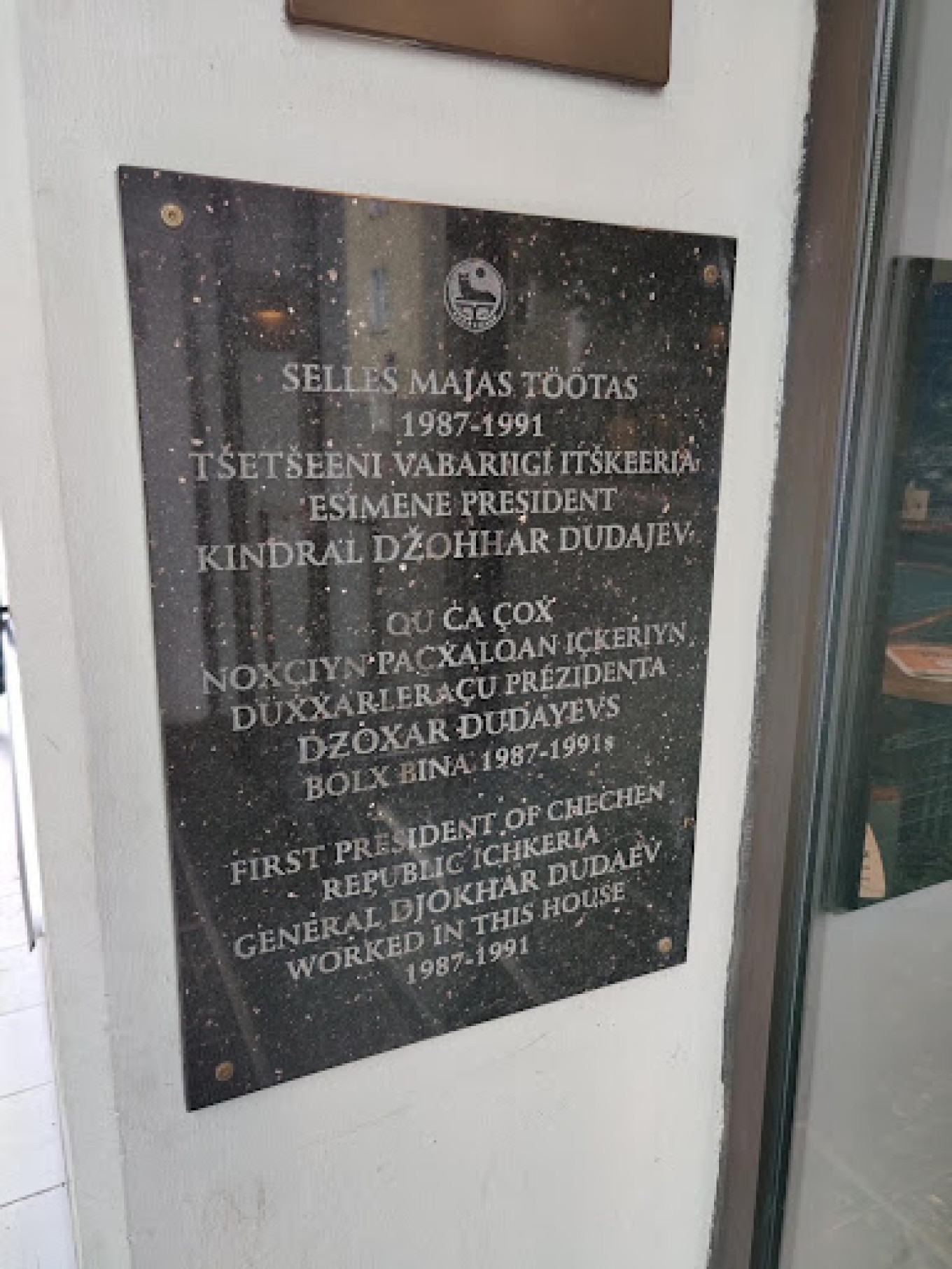
In 1990, Dudaev refused orders to crack down on pro-independence protests in Estonia. He retired from the military, returned to Chechnya and began pursuing independence. By the end of 1991, Dudayev had overthrown the local Communist Party and held a successful independence referendum. The First Chechen War commenced in December 1994.
In a May 1995 interview, Dudayev predicted that Crimea would become a bloodbath amidst a Russia-Ukraine war. He asserted that a facade of “Slavic unity” would be utilized to target Ukraine and Belarus. He further described Russian imperialistic nationalism as fundamentally misanthropic, with no regard for civilian lives. According to Dudayev, Russia’s imperial ambitions extend to the Indian Ocean, the Middle East, the Bosphorus, the Red Sea and, eventually, to Europe.
The first two predictions have been proven correct. Crimea is occupied amidst Russia’s larger invasion of Ukraine. The Kremlin denies the existence of Ukrainian identity, going as far as kidnapping children for indoctrination. In Belarus, the price of keeping Alexander Lukashenko in power was the further subsumption of his will to Putin’s.
Dudayev’s diagnosis of misanthropy being a guiding principle of Russian military adventurism appears as applicable now as it was then. Both wars in Chechnya were marked by the indiscriminate killing of civilians. Russian troops massacred hundreds in Samashki in 1995. By 2003, the United Nations referred to Grozny as “the most destroyed city on earth.” Russian war crimes in both wars against Chechnya have been thoroughly documented.
Evidence of such ferocity in Ukraine is abundant. Only considering the direct targeting of civilians yields many tragedies such as the Bucha massacre, the untold thousands of dead in Mariupol, Kherson’s “human safari,” and the multitude of double-tap strikes on residential and commercial buildings. Indirect targeting of civilians includes strikes on the electrical grid, especially nuclear power plants and the Kakhovka dam.
The last of Dudayev’s predictions falls short. However, its ambitions were sufficient to prompt Finland and Sweden to abandon neutrality and join NATO. While Russia has not pursued such a large territorial expansion, it has enacted a broader project to support democratic erosion and authoritarianism around the world, even directly propping up its closest allies.
The Kremlin’s staunchest allies have included Austrian politicians and intelligence officials, Belarusian dictator Alexander Lukashenko, Viktor Orbán’s government in Hungary, Serbia’s Aleksandar Vučić and Bashar al-Assad for a decade in Syria. Russian influence operations have recently failed in Hungary, Moldova and Romania, in all of which Russia made significant investments.
Russia has otherwise lent material or symbolic help to supporters in France, Georgia, the Netherlands, Slovakia, Britain and the United States. Russia has also drawn support from the U.S.’s most hostile states to enable the war against Ukraine.
The second resonant part of Dudayev’s legacy is solidarity across ideological and national boundaries in the face of Russian imperialism. Dudayev first established this standard in Estonia when he refused orders to repress Estonian independence protests. He furthered this when assembling a broad coalition for Chechen independence, incorporating secular and religious factions cohesively under one chain of command, plus some foreign fighters, ranging from Ukrainian nationalists to jihadis. Other international support was otherwise lacking.
After Dudayev’s death, this coalition was severely tested and frayed significantly under the governance of Aslan Maskhadov. Any splintering between ideological factions and across geography, however, began to resolve itself with Russia’s first invasion of Ukraine in 2014, and certainly with its full-scale invasion in 2022. Chechen volunteers formed two units, the Dzhokhar Dudayev and Sheikh Mansur Battalions, at the start of the war in 2014. Their number substantially increased after the full-scale invasion, with ideologies noted to lack overt significance across units. Herein returns Dudayev’s legacy: the objective of fighting Russian expansion supersedes differences of opinion.
Awareness of Dudayev’s legacy has surged due to the popularization of his statements in the context of Russia’s full-scale invasion. It carries weight beyond those statements, however.
Chechens and Ukrainians have an informal coalition against Russia’s imperialism and support for authoritarians around the world. After the North Caucasus theater subsided, Chechen fighters moved first to Syria, then to Ukraine. Other retired fighters moved abroad, but have re-mobilized due to the full-scale invasion of Ukraine. In 2022, Ukraine made repeated overtures in support of Chechen independence.
Ukrainian special forces and military advisers have aided Tuareg fighters in Mali, GNU-aligned forces in Libya, anti-junta militants in Myanmar and Hay’at Tahrir al-Sham ahead of its 2024 overthrow of Assad in Syria. In all cases, Ukraine struck notable blows against Kremlin interests, at the very least by demonstrating a willingness to confront Russia wherever it operates.
Transnational solidarity against Russian global authoritarian networks has recently grown, albeit with nearly immediate consequences. The Orbán government, Putin’s chief operatives in the EU, have been removed after more than a decade in power, during which he impeded EU aid for Ukraine and conducted intelligence operations in western Ukraine. However, less than a week after the Kremlin’s prime operative was removed, Lukashenko reportedly is preparing to actively join the invasion of Ukraine, having regretted Minsk not taking more action earlier.
Whether Dudayev’s legacy reignites a push for Chechen independence is unclear and limited by geopolitics. But many of the other parts of his legacy remain not only relevant but prescient.
A Message from The Moscow Times:
Dear readers,
We are facing unprecedented challenges. Russia's Prosecutor General's Office has designated The Moscow Times as an "undesirable" organization, criminalizing our work and putting our staff at risk of prosecution. This follows our earlier unjust labeling as a "foreign agent."
These actions are direct attempts to silence independent journalism in Russia. The authorities claim our work "discredits the decisions of the Russian leadership." We see things differently: we strive to provide accurate, unbiased reporting on Russia.
We, the journalists of The Moscow Times, refuse to be silenced. But to continue our work, we need your help.
Your support, no matter how small, makes a world of difference. If you can, please support us monthly starting from just $2. It's quick to set up, and every contribution makes a significant impact.
By supporting The Moscow Times, you're defending open, independent journalism in the face of repression. Thank you for standing with us.

Remind me later.