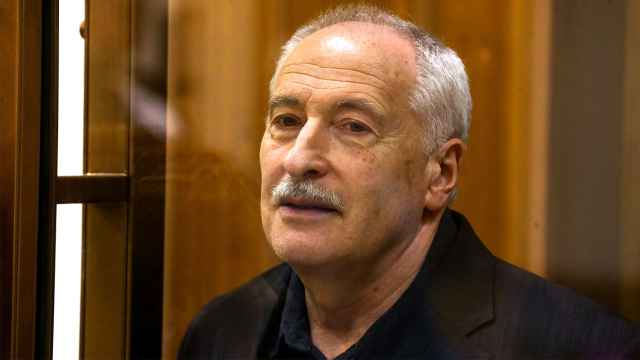

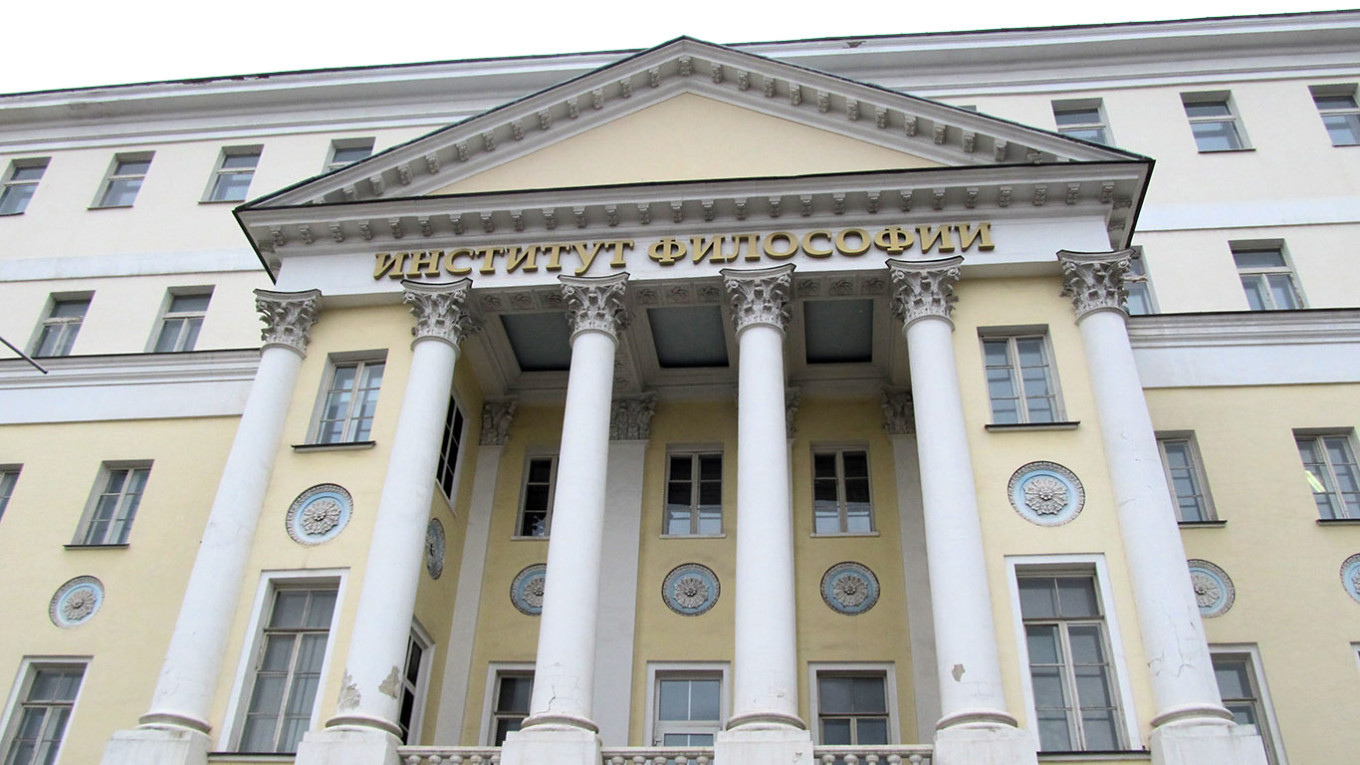
On May 19, Russian law enforcement arrived at the Institute of Philosophy of the Russian Academy of Sciences in Moscow and interrogated several scholars concerning allegations of fraud connected to a new complete translation of Aristotle's works into Russian. Svetlana Mesyats was detained for four days before being charged and placed under house arrest over a reporting error in a state grant.
The institute has resisted Kremlin-aligned pressure since 2021, when loyalists backed by "Orthodox oligarch" Konstantin Malofeyev attempted to install a compliant director, but the scientists resisted.
This did not happen in a vacuum. On March 3, Russia designated the Russian-American Science Association (RASA) an "undesirable organization." Under Russian law, individuals affiliated with such entities can face up to four years in prison; organizers of related activities risk up to six.
Since then, many among the organisation’s leadership — including current president Sergei Erofeyev and former presidents Alexander Kabanov and Igof Efimov — have been declared “foreign agents.”
None of these people did anything new recently. They have been outspoken against the Russian invasion of Ukraine right from its first day. They haven’t changed, but something new is moving inside the Russian state machine that is turning methodically against scientists. Inside Russia, scientists are regularly being prosecuted for assumed treason, just for performing their regular work, like publishing internationally or cooperating with foreign colleagues.
The United States is not raiding philosophy institutes — for now, at least. But the current picture in the country is uncomfortably familiar. Universities lose funding for political reasons, NSF grants are being screened for undesirable activities like promoting diversity. NIH restructured all foreign research partnerships into a new system requiring each foreign co-author to register independently with federal databases. Proposed budget cuts of 40% to NIH and 57% to NSF signal science's diminished place among Washington’s national priorities.
A 2025 Nature poll found 75% of American scientists were considering leaving the country. They are forced out by bureaucracy, not the clenched fist of the state. But both countries are telling their scientists the same thing: make sure your politics conform first, then (maybe) do your research.
But this does not work in science. Max Weber explained this more than a hundred years ago in “Science as a Vocation,” one of the most important texts in the philosophy of intellectual life ever composed. Science and politics, he argued, operate by fundamentally different value systems. Science asks about what is true and how we can find out. Politics asks what can serve its cause and who is an ally. When political criteria become the premise of acceptable research, loyalty replaces rigor, collaborations are screened for foreign contamination, science loses its very essence. I am not making a case of moral judgment here — though I could. The incompatibility is inherent to the subject.
It is not the first time such a thing has happened; the historical costs are well documented. Nazi Germany and Fascist Italy devastated their scientific communities in the 1930s, basically handing the United States and the Manhattan Project its most brilliant minds. But Western states themselves were not free of ideology. Bruno Pontecorvo, trained by physicist Enrico Fermi, spent his career being kicked between countries, each finding his communist background more troubling than his physics. Suspect in Britain, effectively unwelcome in the U.S., he defected to the U.S.S.R. in 1950, probably not out of ideology, as Soviet myth assumes, but out of professional desperation. The Joint Institute of Nuclear Research in Dubna let him work more or less at the level he deserved and he made seminal contributions to neutrino research.
The question is who collects the dividend now. Europe is positioning itself as a refuge: France's Choose Europe for Science initiative, programs at Max Planck and Karolinska, Spain's researcher relocation grants. But the EU is not enjoying an era of abundance; research positions are very competitive and funding is quite scarce. Instead, many emerging economies, like China and Gulf states, are building research infrastructure and offering scientists more freedom, both from specific local political pressures and from overly tight ethical regulations that many argue put strong obstacles to biomedical research in Europe and the U.S.
It’s easy to conclude that the ideals of democracy and science are aligned. But mroe specificially, Weber argued science is organized around the values of intellectual honesty, the pursuit of truth through evidence and method, the abandonment of mythology and ideology, the free flux of ideas and the communality of knowledge facilitated by open communication. Historically, these values often coincided with liberal democracies. Living in an age where democracies are in crisis while autocracies are on the rise, we may be witnessing the creation of a world where scientists are forced to live without the ideal conditions Weber described. The country whose scientists will be most successful is the one that allows scientists to simply live by the values of science, not politics, of any kind.
A Message from The Moscow Times:
Dear readers,
We are facing unprecedented challenges. Russia's Prosecutor General's Office has designated The Moscow Times as an "undesirable" organization, criminalizing our work and putting our staff at risk of prosecution. This follows our earlier unjust labeling as a "foreign agent."
These actions are direct attempts to silence independent journalism in Russia. The authorities claim our work "discredits the decisions of the Russian leadership." We see things differently: we strive to provide accurate, unbiased reporting on Russia.
We, the journalists of The Moscow Times, refuse to be silenced. But to continue our work, we need your help.
Your support, no matter how small, makes a world of difference. If you can, please support us monthly starting from just $2. It's quick to set up, and every contribution makes a significant impact.
By supporting The Moscow Times, you're defending open, independent journalism in the face of repression. Thank you for standing with us.

Remind me later.