
Yaroslav Dronov, the controversial Russian singer who goes by the stage name Shaman, posted a video on social media in which he licks the ice of Lake Baikal. This sparked outrage, primarily among Indigenous Buryats, for whom Baikal is a sacred sea.
When arriving at Lake Baikal, the first thing one is expected to do is greet it and ask for permission to enter. There is a common belief that if someone drowns or a tragedy occurs on Baikal, it means the person has, in some way, angered Grandfather Baikal.
From childhood, we were taught that every land, every lake, and every river has its own spirit and guardian. Water is meant to be treated with respect because people believe it is alive. Lake Baikal, too, has its spirit — one who must not be angered, or he will punish those who show disrespect.
Every Buryat knows the legend of Grandfather Baikal, and whenever we pass by it, as with other sacred places, it is customary to make offerings to the spirit of the land. Our legends, traditions, and culture are deeply connected to Baikal. It must not be angered; the spirit of Baikal may not forgive reckless behavior.
According to legend, long ago there lived a mighty, grey-haired hero named Baikal. He had only one daughter, Angara, whom he raised strictly and kept under close watch.
One day, Angara heard of a handsome and powerful hero beyond the mountains, Yenisei, and decided to flee from her strict father. When Baikal learned of her escape, he was filled with anger and hurled a massive stone to block her path.
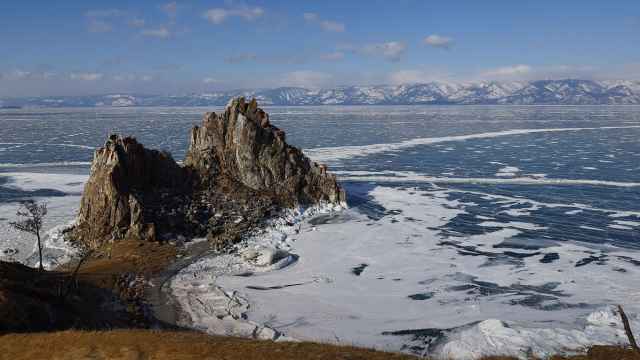
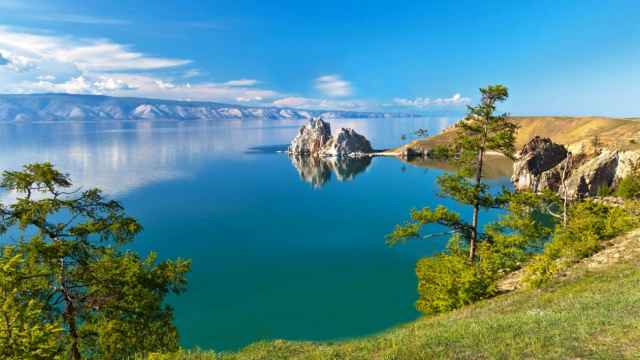
But Angara slipped between the rocks and continued her journey to meet Yenisei. That stone is known as the Shaman Stone. It still stands today at the point where the Angara River flows out of Lake Baikal. It is the only river that flows out of the lake.
That is why Shaman’s act provoked so much disgust and contempt among many people in the Russian Federation. The singer was dismissive when he explained his actions on his Telegram channel. It was an impulsive act, he said, to lick the famously clean lake like children eat snow.
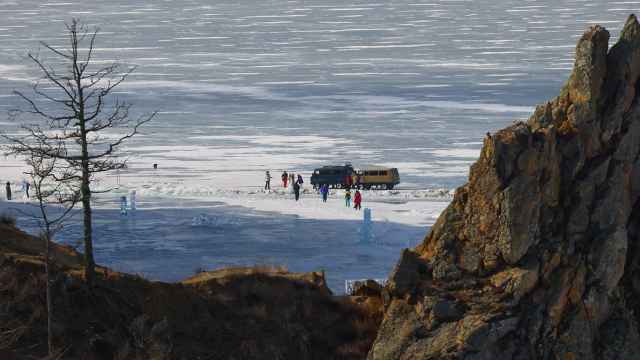
“I hope that by doing this I have desecrated the lake no more than people who walk on the ice of Lake Baikal with their feet, ride quad bikes," he wrote.
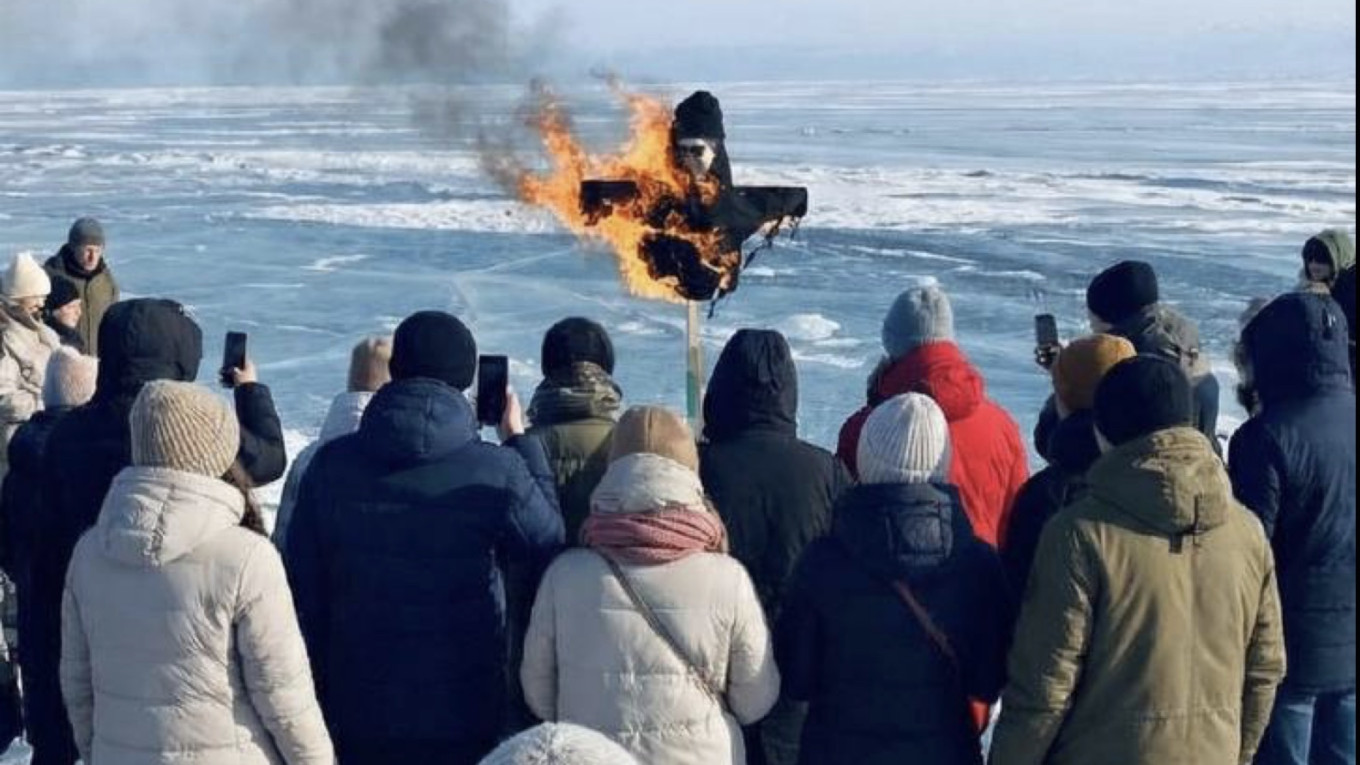
A viral video soon appeared online showing a straw effigy with Shaman’s face being burned in a local cleansing ritual during the Maslenitsa folk holiday.
I would like to hope that this incident would once again lead to discussions about the ecological catastrophe facing the lake’s ecosystem, particularly the planned lifting, starting March 1, 2026, of the long-standing ban on clear-cut logging in the central ecological zone of Baikal.
Clear-cutting in this region, the most sensitive around the lake, could devastate both forest and aquatic ecosystems, destroying wildlife habitats and reducing biodiversity. Baikal is one of the oldest lakes in the world and is home to hundreds of species, many of them endemic, found nowhere else on Earth.
The law was reportedly lobbied for by deputies and business interests from Irkutsk. It has also been linked to Oleg Deripaska, who is said to be seeking to expand the Sobolinaya Mountain ski resort.
It is striking that more anger is directed at a singer licking the ice of a sacred lake than at the clear-cut logging that could permanently damage Baikal’s ecosystem. Baikal was declared a UNESCO World Heritage site in 1996 and contains the largest volume of freshwater on Earth.
What will our children and future generations say if one day nothing remains of Baikal? If it becomes polluted, overdeveloped, and turned into yet another appendage of Moscow’s oligarchs? For decades, environmentalists have warned about the critical condition of Baikal, and it seems the authorities have decided to drive the final nail into the coffin of the greatest lake on earth, which may never again be an oasis of protected natural beauty. Will we forgive ourselves for this?
Lake Baikal holds a special place in local belief and identity. That is why many viewed the act of licking the lake’s ice as desecration and a sign of deep disrespect, sparking outrage among local residents.

A Message from The Moscow Times:
Dear readers,
We are facing unprecedented challenges. Russia's Prosecutor General's Office has designated The Moscow Times as an "undesirable" organization, criminalizing our work and putting our staff at risk of prosecution. This follows our earlier unjust labeling as a "foreign agent."
These actions are direct attempts to silence independent journalism in Russia. The authorities claim our work "discredits the decisions of the Russian leadership." We see things differently: we strive to provide accurate, unbiased reporting on Russia.
We, the journalists of The Moscow Times, refuse to be silenced. But to continue our work, we need your help.
Your support, no matter how small, makes a world of difference. If you can, please support us monthly starting from just $2. It's quick to set up, and every contribution makes a significant impact.
By supporting The Moscow Times, you're defending open, independent journalism in the face of repression. Thank you for standing with us.

Remind me later.