
News of the liquidation of the Gulag History Museum in Moscow was long-awaited and sad. But the announcement that it will be replaced with a museum of the “genocide of the Soviet people” is a horrific sign of the Kremlin’s instrumentalization of Russian history.
On the way out of the Gulag History Museum, visitors were invited to write their own ending to the phrase "There will be no repeat if I…"
But history has repeated itself. True to the authorities’ mendacious style, the museum was allegedly closed temporarily for fire safety violations. Yet it was immediately clear that it would never reopen; no flame can ignite in today’s suffocating atmosphere.
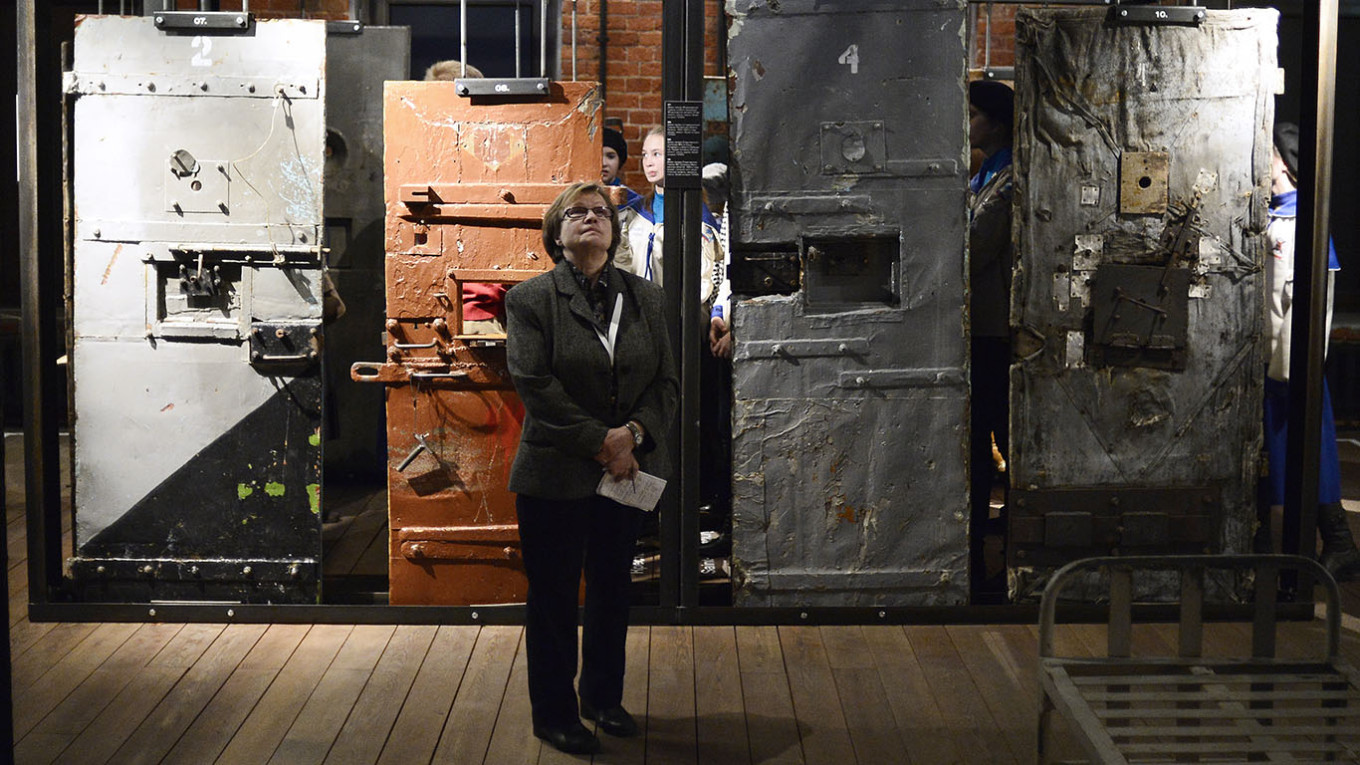
When I think of the museum, the first thing I think about is all of the doors. Doors behind which lay hell and kept prisoners closed off from the world. Prison cell doors brought from Butyrka and Vladimir Central — heavy, patched with metal sheets, with little windows, washed in blood, tears and vomit; doors delivered from former camp sites in Dalstroy and the Krasnoyarsk region.
Alongside them stood doors that stood for people targeted by the pruges. The House of the Construction Bureau was built in 1928 for members of the Bolshevo Labor Commune. It wasn’t long before they were all arrested. The building itself was illegally demolished in 2015.
There were doors from Moscow, too, the place where decisions were made and ordersfor arrests issued. Those orders hung on the museum walls and left no room for the comforting illusion that repression contained an element of chance. They showed that everything had been planned exactly so.
The museum also explained that there were camps in Moscow, too. Behind almost every fence guarding a construction site, there was free labor. A map of Moscow’s camps demonstrated that the city was the capital of the Gulag,
There was also a door from the Execution House on Nikolskaya Street, bearing a quotation from the theatrical director Vsevlovod Meyerhold: “They beat me here, a sick 66-year-old man, laid me face down on the floor, beat my heels and back with a rubber strap.”
It seems absurd now to recall that there was once serious discussion about incorporating it as a branch of the Gulag History Museum. A branch at the Museum of the House on the Embankment was closed back in 2023.
Nearby, before a door brought from the high-rise on Kotelnicheskaya Embankment, there might have hung a quotation from Vasily Aksyonov. The son of two former prisoners, he spent his final years in such an apartment. On the kitchen door’s little window, he said, someone had scratched: “Built by prisoners.”
There was also a door from the Mosodezhda trust on Leninsky Prospekt—because that, too, was built by prisoners, among them Solzhenitsyn, who at the time was in Camp Site No. 15.
And many other doors, echoing Memorial’s great project “It’s Right Here,” about the Gulag in Moscow. But now there is neither Memorial nor the Gulag History Museum.
Yet the Gulag — political repression, a state that manipulates history — remains.
My friend, the literary critic Mikhail Edelshtein, imagined how wonderful it would be if the new museum retained the old exhibition. I would gladly agree with him. But of course, nothing could remain that even deviated slightly from the official line.
“Here, new generations will learn about the suffering and heroism of our people, about the crimes of the Nazis. And this memory — its pulse, this alloy of pain, anger, gratitude to our ancestors, and pride in their resilience — will always unite us as a nation,” declared director Konstantin Bogomolov, eager to flatter the fathers of the nation.
There is no point even speculating about what “genocide” the new museum intends to discuss. The victims of terror will be erased just as portraits of the arrested and executed were inked out, painted over, and scratched from books in the 1930s. Then they were removed from print and from life; today they are being removed from official history, replaced with something more convenient.
Just look at the museum’s leadership. Natalya Kalashnikova previously led the Smolensk Fortress Museum for less than a year and earlier served as vice-rector of the Moscow State Institute of Culture, where she took an “active role” in organizing cultural projects, including forthe Movement of the First — the Kremlin’s new Pioneers. Most importantly, she holds a veteran’s ID, a medal for “strengthening the defense of the Russian Federation” and one awarded to participants in the war in Ukraine.
According to Artguide, the new museum will be based on archival materials from the project “No Statute of Limitations,” by the Search Movement of Russia, which recovers the remains of soldiers from battlefields. The exhibition will focus on Nazi crimes during the Great Patriotic War, displaying a railcar used to transport people to death camps, a reconstructed room of residents of blockaded Leningrad and scales from a concentration camp used to weigh prisoners’ hair before sale.
It’s hard to imagine how the railcar will even fit. But TASS promises that visitors will learn about manifestations of Nazism, Japanese biological weapons experiments on Soviet citizens, the Red Army’s liberation mission and trials of Nazi criminals.
Not only will the new museum occupy to the old building, but it has already taken over the original website. “The exhibition will cover all stages of Nazi war crimes during the Great Patriotic War,” reads the website of the new institution, now occupying the same address in reality and online.
This is clearly not a one-time action but a long-term PR strategy, launched long ago, meant to counter criticism of Russia — abroad and, horror of horrors, at home. The proposed Museum of Memory appears to be a convenient instrument for spreading yet another fanciful version of the past.
While Ukraine seeks international recognition of genocide committed against its people by Russia, Moscow is formulating its own version of victimhood, reshaping and expanding the established narrative of the Great Patriotic War in hopes of turning it to its advantage.
The museum's building used to be a modest four-story brick industrial structure secured for the museum by Moscow’s then–deputy mayor Leonid Pechatnikov. Remember him? He once told off a Komsomolskaya Pravda correspondent who expressed regret that the Nazis had not made lampshades out of all the Jews.
Space inside was limited, so architects placed insulation and technical systems outside, concealed them behind sheets of oxidized copper. When the museum opened in 2015, the copper roof gleamed in the sun. According to the design concept, it was meant to darken over time — and darken it did as dark days returned.
The Gulag History Museum was the only museum in the country devoted not to glorification but to self-reflection and self-criticism. There was much to be ashamed of and nothing to celebrate. No other Russian museum let itself do that — and none likely will again.
Founded in 2001 on the initiative of the historian Anton Antonov-Ovseenko — son of an “enemy of the people” — and directed for years by Roman Romanov, the museum’s first iteration was a modest exhibition in 2004 on Petrovka Street, in a building slated for demolition.
Only part of the building was allocated to the museum. But the location was symbolic, nevertheless. Visitors passed Louis Vuitton and Hermès boutiques on Stoleshnikov Lane only to come face to face with an arch crowned with the word “GULAG.”
Later came the new building, first with a temporary exhibition, then a permanent one arranged as a labyrinth. The Greek ouroboros tried to bite its tail. The exhibition was not circular; its open ending suggested hope.
In 2021, the Council of Europe recognized the museum as the best in Europe. Who remembers that now? It’s like a different world.
The exhibition was imperfect. It told primarily the story of victims, not executioners beyond Stalin, former NKVD chief Lavrenty Beria, his predecessor Nikolai Yezhov and prosecutor Andrey Vyshinsky. The question of who wrote millions of denunciations hung in the air but was never personified.
Still, the museum strove to name victims individually, preserved in a Garden of Memory. It collected testimonies, objects, artworks, staged performances, screened films and organized school tours, which was perhaps its most important work.
There were temporary exhibitions, a major publishing program and constantly organized expeditions to former camp sites.
What will happen to those collections now? Nothing. They have been locked away in storage. They cannot be destroyed as they belong to the State Museum Fund of the Russian Federation. So in a symbolic way, they remain imprisoned too.

A Message from The Moscow Times:
Dear readers,
We are facing unprecedented challenges. Russia's Prosecutor General's Office has designated The Moscow Times as an "undesirable" organization, criminalizing our work and putting our staff at risk of prosecution. This follows our earlier unjust labeling as a "foreign agent."
These actions are direct attempts to silence independent journalism in Russia. The authorities claim our work "discredits the decisions of the Russian leadership." We see things differently: we strive to provide accurate, unbiased reporting on Russia.
We, the journalists of The Moscow Times, refuse to be silenced. But to continue our work, we need your help.
Your support, no matter how small, makes a world of difference. If you can, please support us monthly starting from just $2. It's quick to set up, and every contribution makes a significant impact.
By supporting The Moscow Times, you're defending open, independent journalism in the face of repression. Thank you for standing with us.

Remind me later.