Russian companies are increasingly moving employees to part-time work amid worsening economic conditions, the pro-Kremlin daily Izvestia reported Wednesday.
The number of partially employed workers in Russia now stands at its highest level in over a decade, Izvestia said, citing an analysis of Rosstat data by Moscow-based auditing network FinExpertiza.
While the official unemployment rate is currently hovering around 2.2%, the surge in part-time work highlights the hidden strain on Russia’s economy as the invasion of Ukraine nears its four-year mark.
Some 5.5 million Russians were classified as partially employed in the third quarter of 2025, up 12% from the previous quarter and the highest figure since 2015.
Around 4 million workers were placed on unpaid leave between July and September, a 9.3% increase over the previous three months, while the number of employees idled due to downtime surged 62.6% to 165,000.
About 1.27 million people worked reduced hours, a 12.7% increase from the previous quarter, while 69,200 employees faced shortened workweeks in an eightfold increase.
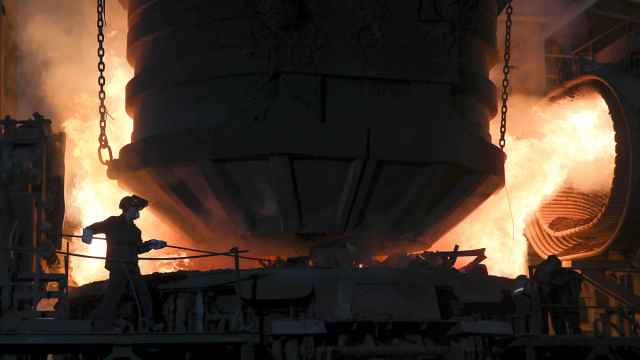
The hospitality sector represented the biggest shift to part-time work, with 33.9% of its workforce, or 124,900 people, moved to partial employment. Manufacturing followed at 27% (1.6 million workers) and construction at 22.7% (271,300 workers).
Part-time employment was concentrated in the industrially developed Perm region (21.7% of the workforce), Nizhny Novgorod region (21.6%), Chelyabinsk region (20.9%), Yaroslavl region (19.8%) and the republic of Udmurtia (19.8%) as well as St. Petersburg and the Sverdlovsk region (both 19.5%).
While companies are moving workers to partial employment to avoid layoffs and retain staff, this effectively works as a form of hidden unemployment, Olga Yepifanova, an expert at the Agency for Strategic Initiatives (ASI), told Izvestia.
The increase is primarily driven by an economic slowdown and falling output at enterprises that had seen growth in 2023-2024 thanks to import substitution, State Duma lawmaker and ex-Labor Minister Oksana Dmitriyeva told the newspaper.
Workers placed on downtime see their real incomes fall by at least one-third, while those on unpaid leave lose their earnings altogether.
Falling incomes in turn make it harder for workers to meet financial obligations like loan repayments and utility bills, which become less urgent than spending on food and medicine, Yepifanova said.
A separate poll by the financial services provider Action Finance showed that Russian businesses do not expect the economy to improve in 2026 and are preparing to cut costs through staffing measures.
Some 38% of medium and large firms plan to reduce their payroll budgets, with 32% intending to do so through layoffs and automation.
Others said they would cut bonuses, revise their pay structures and expand the use of part-time work.
Read this story in Russian at The Moscow Times’ Russian service.
A Message from The Moscow Times:
Dear readers,
We are facing unprecedented challenges. Russia's Prosecutor General's Office has designated The Moscow Times as an "undesirable" organization, criminalizing our work and putting our staff at risk of prosecution. This follows our earlier unjust labeling as a "foreign agent."
These actions are direct attempts to silence independent journalism in Russia. The authorities claim our work "discredits the decisions of the Russian leadership." We see things differently: we strive to provide accurate, unbiased reporting on Russia.
We, the journalists of The Moscow Times, refuse to be silenced. But to continue our work, we need your help.
Your support, no matter how small, makes a world of difference. If you can, please support us monthly starting from just $2. It's quick to set up, and every contribution makes a significant impact.
By supporting The Moscow Times, you're defending open, independent journalism in the face of repression. Thank you for standing with us.

Remind me later.