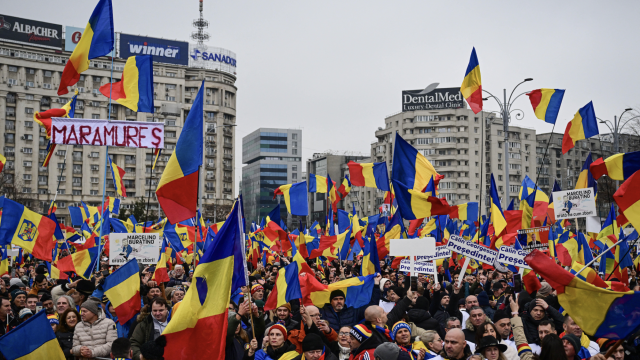

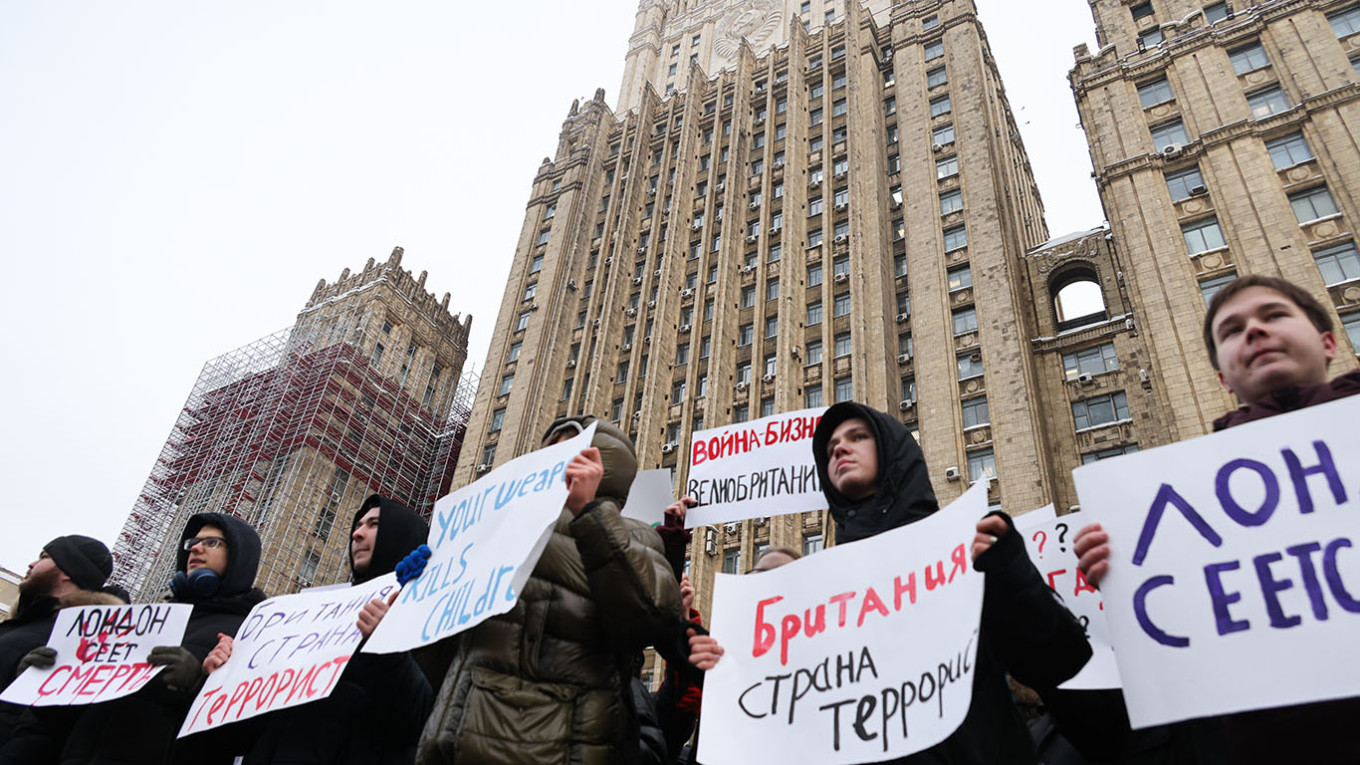
There were unpleasant scenes outside the Russian Foreign Ministry as the British charge d’affaires, Danae Dholakia, left the building on Jan. 15. Having been informed that yet another British diplomat was to be expelled from the British Embassy in Moscow, she was confronted by a crowd shouting that “Britain is a terrorist state” while holding placards reading “Britain kills children” and “London spreads death.” After further haranguing and jostling by an assembled media circus, the British team managed to get to their car and leave.
Running the gauntlet of concerned citizens and client journalists outside the Foreign Ministry is familiar to anyone who has worked as a diplomat in Moscow. They are an attempt by Maria Zakharova, the ministry’s toxic, tipsy, thin-skinned press director, to intimidate, discombobulate and belittle unwelcome visitors. They’re the tip of the iceberg of a coordinated state campaign to harass and pressure Western diplomats and prevent Russians from speaking to them. This campaign is getting worse.
There is a long tradition of Russian state hostility against Britain, always regarded as an implacable ideological opponent of the U.S.S.R., one of NATO’s most hawkish voices, and a skilful and clever adversary. Soviet leader Leonid Brezhnev reportedly once said that Britain was “an old lion, but one that got old by being craftier” than the rest of the pride.
This perception is no different today. Following Russia’s appalling invasion of Ukraine, Britain has been described as Russia’s “main bastard.” Atop a list of countries deemed “unfriendly,” Britain has been blamed variously for falsifying evidence of Russian war crimes, derailing efforts at peace, striking targets in occupied Ukraine, blowing up the Nord Stream 2 pipeline and even being behind jihadist terrorist attacks in Moscow itself.
State hostility has driven and continues to drive relentless activity by the Federal Security Service, or FSB, against British diplomats. Staged protests by bored-looking youngsters holding suspiciously similar posters, spurred on by agent provocateurs, have long been part of the Moscow experience. Supposedly concerned citizens protested outside the Embassy in 1927 following a Special Branch raid on a Soviet trade delegation in London.
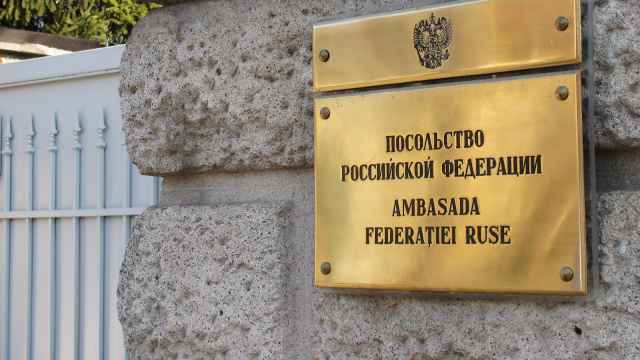
When I served in Moscow, the Kremlin regularly staged protests outside our embassy, including against Britain’s support for Ukraine and against LGBTQ+ rights. They renamed its address to one of Russia’s Donbas satrapies. After Boris Johnson said that President Vladimir Putin “would not have invaded Ukraine if he were a woman,” they hung up a large poster of the then-prime minister with the words “if my granny had balls she'd be my grandpa.”
After they built a library after state media said that English-language books were seditious, enterprising locals took the books home to read instead. When Gordon Brown said that the Russians made him sit on a small chair for a meeting with Putin, they built a huge wooden chair marked "For Gordon." Furthermore, for reasons lost to time, the Foreign Ministry hired two London buses, hung Falkland Island flags from them, and filled them with 60 students in Argentinian football kit.
I didn’t enjoy my own experience of the scrum outside the Foreign Ministry just after HMS Defender transited through occupied Crimean waters in 2021. Talking things through with colleagues and staying calm were paramount, as was having someone already there on your arrival to point you toward the right door (Zakharova’s pettiness in locking normally open doors to make you look stupid is legendary). On exit, when they were still there, what worked was sticking together, not engaging with the protesters, the occasional 15 stone shoulder and firm word.
But as Putin’s Russia has descended further into dictatorship, things have become darker. The previous ambassador was confronted by protestors and media on arrival in Vladivostok, saying she was not welcome. The current ambassador was harassed on a visit to the Urals city of Yekaterinburg, accused of recruiting spies. The previous deputy ambassador was ambushed at a Moscow airport in ugly scenes.
Similar and worse treatment, including violence, has been meted out by the FSB since the full-scale invasion of Ukraine to other diplomats, including me, and always accompanied by round-the-clock surveillance. Unwarranted expulsions of diplomats and refusal to issue new visas drive down staff numbers to further increase the pressure and sense of isolation.
Russian citizens are also targeted. Protests have been staged outside the ambassador’s residence on the evening of the king’s birthday to intimidate invited guests, who are questioned afterwards. This is a deliberate tactic, as in the U.S.S.R., to reduce the number of people meeting British diplomats, minimise contact and hamper our ability to communicate. All part of a systemic and broad campaign to build lasting barriers between Russia and Europe.
This activity is a gross violation of the Vienna Convention which governs the right of diplomats to work unfettered. The Foreign Office has said that Russia’s “targeting of British diplomats comes out of desperation” and that the Kremlin’s actions undermine the basic conditions required for diplomatic missions to operate.” But modern lawless Russia is seldom concerned with its legal obligations.
Things are unlikely to change for the foreseeable future. Britain is still being portrayed as Russia’s Enemy No. 1, Putin’s geopolitical obsessions haven’t altered and there is no prospect for any warming of the bilateral relationship. The embassy is now, as the current ambassador put it to the BBC, “the slender thread” upon which all diplomatic relations hang.
Western embassy staff will remain in the crosshairs of the Kremlin’s ire. Moscow will remain perhaps the toughest diplomatic gig and Zakharova’s staged protests will continue.
A Message from The Moscow Times:
Dear readers,
We are facing unprecedented challenges. Russia's Prosecutor General's Office has designated The Moscow Times as an "undesirable" organization, criminalizing our work and putting our staff at risk of prosecution. This follows our earlier unjust labeling as a "foreign agent."
These actions are direct attempts to silence independent journalism in Russia. The authorities claim our work "discredits the decisions of the Russian leadership." We see things differently: we strive to provide accurate, unbiased reporting on Russia.
We, the journalists of The Moscow Times, refuse to be silenced. But to continue our work, we need your help.
Your support, no matter how small, makes a world of difference. If you can, please support us monthly starting from just $2. It's quick to set up, and every contribution makes a significant impact.
By supporting The Moscow Times, you're defending open, independent journalism in the face of repression. Thank you for standing with us.

Remind me later.