
In recent months, members of the State Duma and prominent Russian conservatives have turned against one of the central figures of Soviet childhood — Cheburashka.
This apparently ridiculous culture war actually makes sense when you explore the character’s creation: Cheburashka was almost destined to irritate all of these people by virtue of his outsider status.
The cartoon character first appeared in “Gena the Crocodile.” The film’s 1969 release was not without delays from official censors. In later interviews after the U.S.S.R. collapsed, director Roman Kachanov recalled that censors suspected the scene where differently colored characters Gena the crocodile, Cheburashka, Tobik the dog and Galya the girl build the House of Friendship community center poked fun at the construction of the Council for Mutual Economic Assistance headquarters in Moscow. Such a representation of the alleged "friendship of peoples" threatened to undermine the U.S.S.R.'s leadership of the communist world.
Upon its release, the film found instant and overwhelming success. Cheburashka and his friends almost immediately became part of a shared mythology that has not faded to this day.
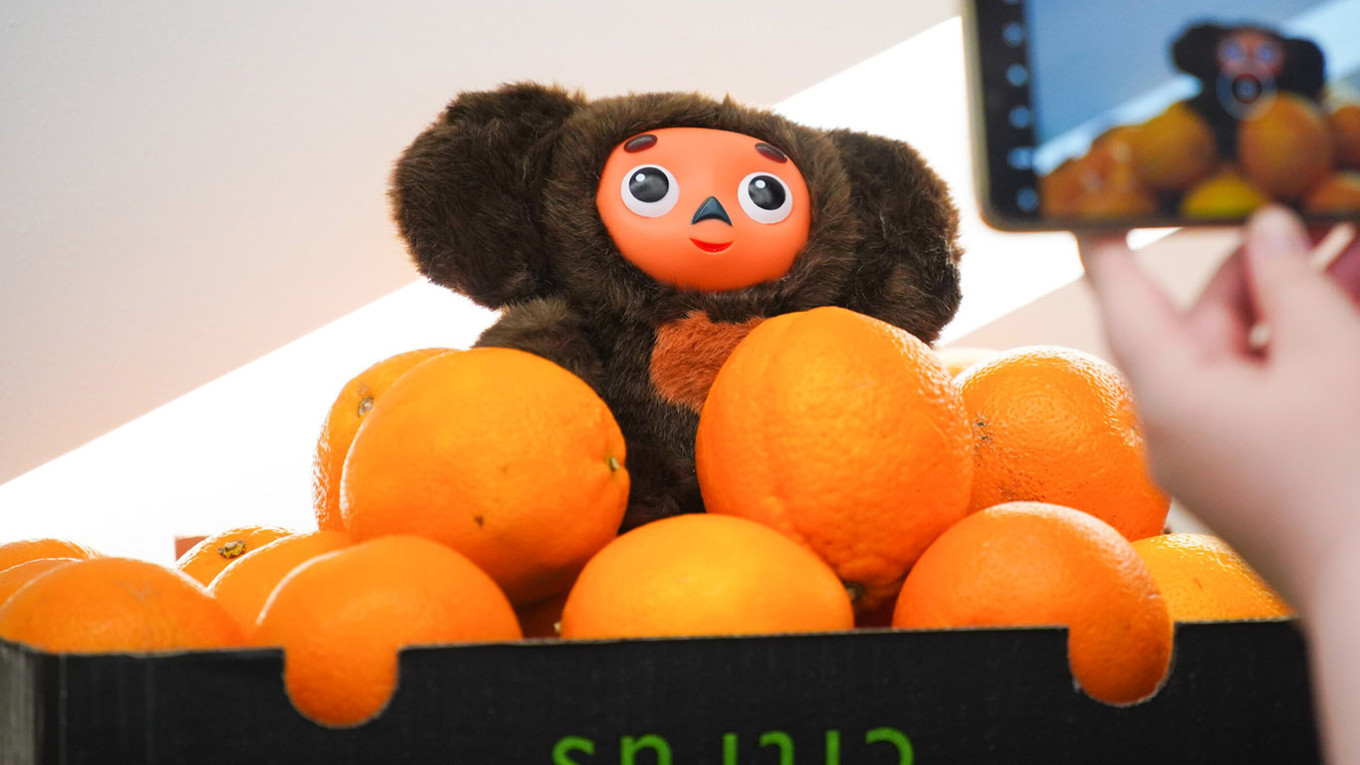
The story goes that once upon a time in the late 1960s, a fruit stall in central Moscow ran out of oranges. The crate sold out instantly, as the fruit was considered an exotic rarity at the time.
The vendor — a respectable man in a tweed cap — brought out a new crate and opened it only to find that it was not filled with fruit fruit but a sleeping creature that resembled a bear but had enormous, round ears.
The vendor checked the invoice, read the foreign product name written in English — O-RAN-GES — realized there had been a mistake and decided to wake the mysterious guest. The sleepy animal obediently tried to stand up, but kept toppling over. The creature thus acquired its name: Cheburashka, from cheburakhnulsya, “to take a tumble.”
In 2021, I made “Find a Jew,” a film devoted to uncovering hidden Jewish narratives in Soviet mass culture. Its main character was Cheburashka. The film was supposed to premiere in spring 2022. But then the war began, censorship tightened even further and I became persona non grata (though not yet a “foreign agent”). No premiere was held and “Find a Jew” was never released in theatres. The film appeared in a slightly edited form on a paid streaming service. Yet somehow, people found it, watched it and told others about it.
And so I unexpectedly became something like Russia’s leading expert on Cheburashka.
I enjoyed my new status at first. Three years ago, when I had just left Russia and felt a profound psychological dislocation, I was invited to a religious community in Berlin that was helping refugees with children. Some families were from Russia, others from eastern Ukraine. The children got along; the parents did not. I was asked to talk to the kids about Cheburashka. We watched the cartoon together and discussed it — children and adults alike — and it became one of the most hopeful evenings of that early period of exile.
Lately, however, this status has brought mostly trouble. Media outlets outside Russia decided I should comment on the blizzard of nonsense Russian lawmakers and ideologues have begun spewing about Cheburashka.
And spewing, they are.
Last November, State Duma Budget Committee Chair Andrei Makarov discussed the need to create a domestic alternative to the supposedly hostile children’s toy, Labubu. Cheburashka looked like the perfect alternative. But the creature was dismissed on the grounds that he is allegedly Jewish.
I suspect Makarov came across the story in my film. It is noteworthy that Cheburashka arrived in a crate of oranges, a fruit long associated with Israel. Don’t tell me they were Moroccan or bring up Vasily Aksyonov’s “Oranges from Morocco” — Soviet authorities allegedly glued Israeli Jaffa labels onto Moroccan fruit.
After Makarov’s remarks, my phone exploded with requests for comment. I had to draft a standard reply explaining that I had no desire to waste time on such nonsense.
Then things escalated.
Alexander Dugin joined the war against Cheburashka, accusing him of perpetuating low moral standards and even of contributing to the collapse of the U.S.S.R. State Duma lawmakers piled on following the enormous box office success of the sequel to the feature-length Cheburashka film, claiming Cheburashka “corrupts” children.
The outrage from Duma members — including actors like Dmitry Pevtsov and singers like Denis Maidanov — is easily explained by envy: Cheburashka is more famous and profitable than they ever were.
But Dugin is more interesting. His claim that Cheburashka helped destroy the Soviet Union by embodying “bourgeois values and infantilism” is not entirely wrong. In fact, his euphemism explains a lot.
For instance, it explains why Russian propaganda has failed to turn Cheburashka into a symbol of the invasion of Ukraine. None of the photos of soldiers at the front clutching plush Cheburashkas or posters depicting him with a helmet and ammunition worked. This character simply cannot be militarized.
Why? Cheburashka is the perfect outcast. And, of course, he’s a Soviet Jew.
Not because of his association with oranges. By definition, he is “a creature unknown to science” — not accepted, not categorized, not part of any collective.
You can see this in the cartoon when the fruit seller takes Cheburashka to the Moscow Zoo. The guard checks his “documents” — the orange label — and turns him away. “He doesn’t suit us,” the guard says. “A beast unknown to science. We don’t know where to put him.”
Cheburashka cannot be classified. He is not a bear, not an elephant, not a puppy. He fits into no category, nor cage. He is an alien — an outcast.
His name itself does not appear in the dictionary. Crocodile Gena searches for it but fails. Cheburashka exists in a zone of silence — just as Jews did in late Soviet society, erased by censorship.
Cheburashka’s arrival at the zoo is a distilled version of the Soviet Jewish experience: a creature with invalid papers, rejected not for wrongdoing but for not fitting in. Gena has a job at the zoo; Cheburashka cannot.
Even the opening credits matter. The names were pasted on a low stone wall reminiscent of the wall near Moscow’s Choral Synagogue, where notices for Jewish funerals and weddings were once posted. To a Soviet viewer, the crew was a parade of Jewish surnames: Schwartzman, Golomb, Ziv, Bitman, Rautbart. Even Kachanov’s patronymic, Abelevich, quietly signaled his origin.
Far from a conspiracy, this was a product of the creators’ lived experience as they processed their own marginalization. Each could have said, after Flaubert: “Cheburashka is me.” Cheburashka is the one who doesn’t fit in, who recognizes “his own” by their shared difference.
Khazanov once told me that as a young man in the late 1960s, he auditioned for a variety program and was rejected. Standing at a bus stop, devastated, tears streaming, a woman hugged him and said: “Remember, boy, as long as you’re a Jew, you’ll have trouble.”
Another case was recent. An American friend asked what song we sang for birthdays as children. I played “Gena the Crocodile’s Song.” He was stunned: “How can a birthday song be so sad?”
That is the point. A Soviet Jew learns to live while being different, builds his own community center and becomes independent of the state. No wonder Jewish characters in Soviet jokes are the only ones who speak freely. Cheburashka was constitutionally unsuitable to be twisted for war propaganda.
A Message from The Moscow Times:
Dear readers,
We are facing unprecedented challenges. Russia's Prosecutor General's Office has designated The Moscow Times as an "undesirable" organization, criminalizing our work and putting our staff at risk of prosecution. This follows our earlier unjust labeling as a "foreign agent."
These actions are direct attempts to silence independent journalism in Russia. The authorities claim our work "discredits the decisions of the Russian leadership." We see things differently: we strive to provide accurate, unbiased reporting on Russia.
We, the journalists of The Moscow Times, refuse to be silenced. But to continue our work, we need your help.
Your support, no matter how small, makes a world of difference. If you can, please support us monthly starting from just $2. It's quick to set up, and every contribution makes a significant impact.
By supporting The Moscow Times, you're defending open, independent journalism in the face of repression. Thank you for standing with us.

Remind me later.