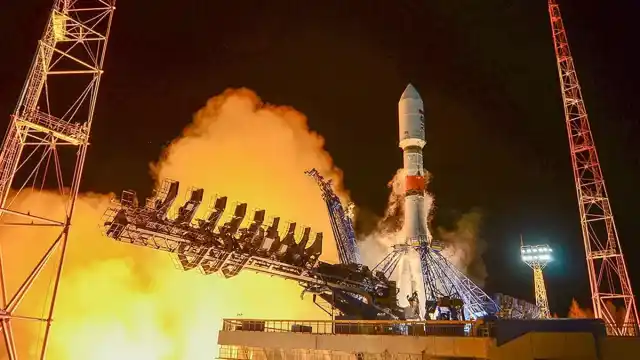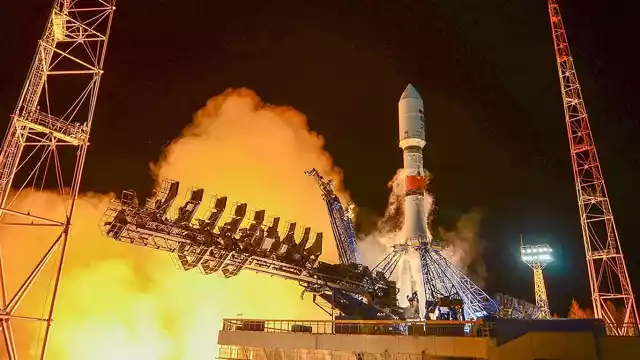
Russia has postponed the launch of the first batch of low-orbit broadband internet satellites under a project meant to rival SpaceX’s Starlink, the Kommersant business daily reported Friday.
The launch of 16 satellites, originally scheduled for late 2025 and to be carried out by private aerospace company Bureau 1440, has been pushed back to 2026, according to the report.
Roscosmos chief Dmitry Bakanov said in September that deployment of the first 300 satellites under the Rassvet (Dawn) project would begin by the end of 2025.
The constellation is intended to provide broadband internet access across Russia and serve as a domestic alternative to Starlink, owned by billionaire Elon Musk.
Two sources in Russia’s space industry told Kommersant that the delay may be linked to the satellites not yet being fully assembled.
Bureau 1440 denied missing deadlines, saying work was proceeding “in line with target timelines.”
“Specific launch dates and other sensitive information are not subject to disclosure,” the company said, adding it would provide updates as project milestones are reached.
The sources’ claims contradict a statement made by Deputy Digital Development Minister Dmitry Ugnivenko, who said in December that Bureau 1440 had produced all 16 satellites required for the initial launch last year.
The Rassvet project is funded under the Data Economy National Project.
The federal budget has allocated 102.8 billion rubles ($1.3 billion) for its implementation. Bureau 1440 plans to invest an additional 329 billion rubles ($4.3 billion) of its own funds through 2030.
Bakanov said in June 2025 that more than 900 low-orbit satellites are planned to be launched by 2035, with commercial operation of over 250 of them expected to begin in 2027.
The project also envisages deploying more than 100 Earth-observation satellites.
According to official project documentation, 16 satellites were to be launched in 2025, rising to 156 in 2026, 292 in 2027 and 318 in 2028, with a total of 24 launches planned by 2030.
Only six Bureau 1440 satellites are in orbit to date. These were launched as part of two experimental missions.
By comparison, SpaceX’s Starlink network has deployed more than 7,000 satellites in low Earth orbit at an altitude of around 550 kilometers.
In October, the head of key Roscosmos subsidiary Reshetnev Information Satellite Systems was dismissed amid criticism over slow progress in import substitution in satellite manufacturing.
Read this story in Russian at The Moscow Times' Russian service.
A Message from The Moscow Times:
Dear readers,
We are facing unprecedented challenges. Russia's Prosecutor General's Office has designated The Moscow Times as an "undesirable" organization, criminalizing our work and putting our staff at risk of prosecution. This follows our earlier unjust labeling as a "foreign agent."
These actions are direct attempts to silence independent journalism in Russia. The authorities claim our work "discredits the decisions of the Russian leadership." We see things differently: we strive to provide accurate, unbiased reporting on Russia.
We, the journalists of The Moscow Times, refuse to be silenced. But to continue our work, we need your help.
Your support, no matter how small, makes a world of difference. If you can, please support us monthly starting from just $2. It's quick to set up, and every contribution makes a significant impact.
By supporting The Moscow Times, you're defending open, independent journalism in the face of repression. Thank you for standing with us.

Remind me later.