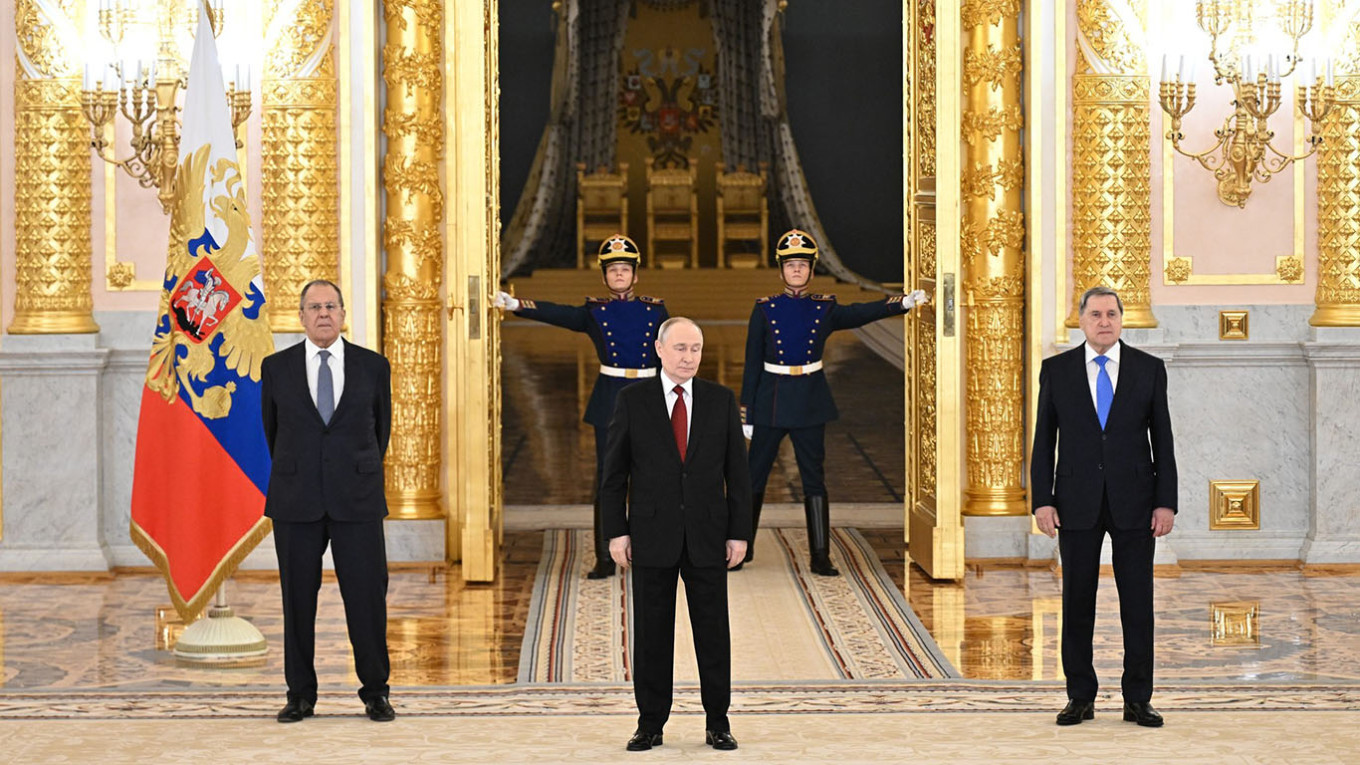
Russia is ready to restore diplomatic relations with Europe to pre-war levels, President Vladimir Putin said Thursday, as ties remain at an all-time low following the full-scale invasion of Ukraine.
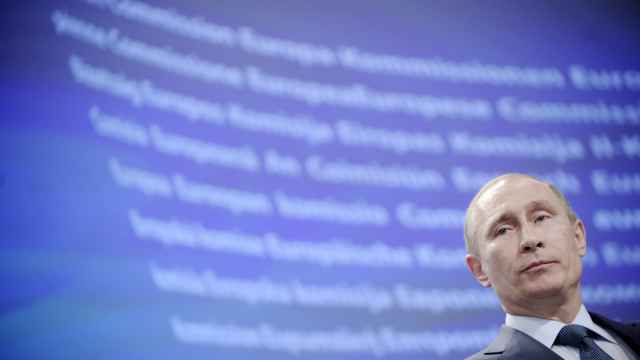
Speaking at a Kremlin ceremony for newly arrived foreign ambassadors, Putin lamented that official and business contacts between Russia and European countries had sharply declined. Engagement on key foreign policy issues was also “frozen,” he said.
“One would like to believe that, over time, the situation will nonetheless change, and our states will return to normal, constructive dialogue,” Putin said, emphasizing that “respect for national interests and consideration of legitimate security concerns” were his preconditions for a return to amicable relations.
“Russia was and remains committed to precisely these approaches and is ready to restore the level of relations we require,” the president added. “Our relations have deep historical roots, full of examples of mutually beneficial partnership and mutually enriching cultural cooperation.”
Putin’s remarks came after Italian Prime Minister Giorgia Meloni said Friday that “the time has come” for the EU to resume high-level dialogue with Russia.
French President Emmanuel Macron also said last month that Europe should put together a “framework” in which to begin directly engaging with the Kremlin in the “coming weeks.”
On Monday, European Commission chief spokesperson Paula Pinho said, “Unfortunately, we’re not seeing any signs by President Putin to be engaging... so we’re not there yet.”
European leaders previously pushed back against calls for direct talks with Putin, citing his apparent lack of interest in genuine peace talks.
However, there are growing concerns in Brussels that Europe does not have a seat at the table in Ukraine peace negotiations, which the Kremlin and the Trump Administration have so far dominated.
A Message from The Moscow Times:
Dear readers,
We are facing unprecedented challenges. Russia's Prosecutor General's Office has designated The Moscow Times as an "undesirable" organization, criminalizing our work and putting our staff at risk of prosecution. This follows our earlier unjust labeling as a "foreign agent."
These actions are direct attempts to silence independent journalism in Russia. The authorities claim our work "discredits the decisions of the Russian leadership." We see things differently: we strive to provide accurate, unbiased reporting on Russia.
We, the journalists of The Moscow Times, refuse to be silenced. But to continue our work, we need your help.
Your support, no matter how small, makes a world of difference. If you can, please support us monthly starting from just $2. It's quick to set up, and every contribution makes a significant impact.
By supporting The Moscow Times, you're defending open, independent journalism in the face of repression. Thank you for standing with us.

Remind me later.