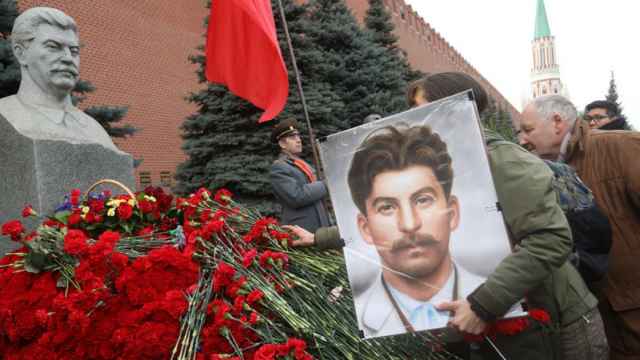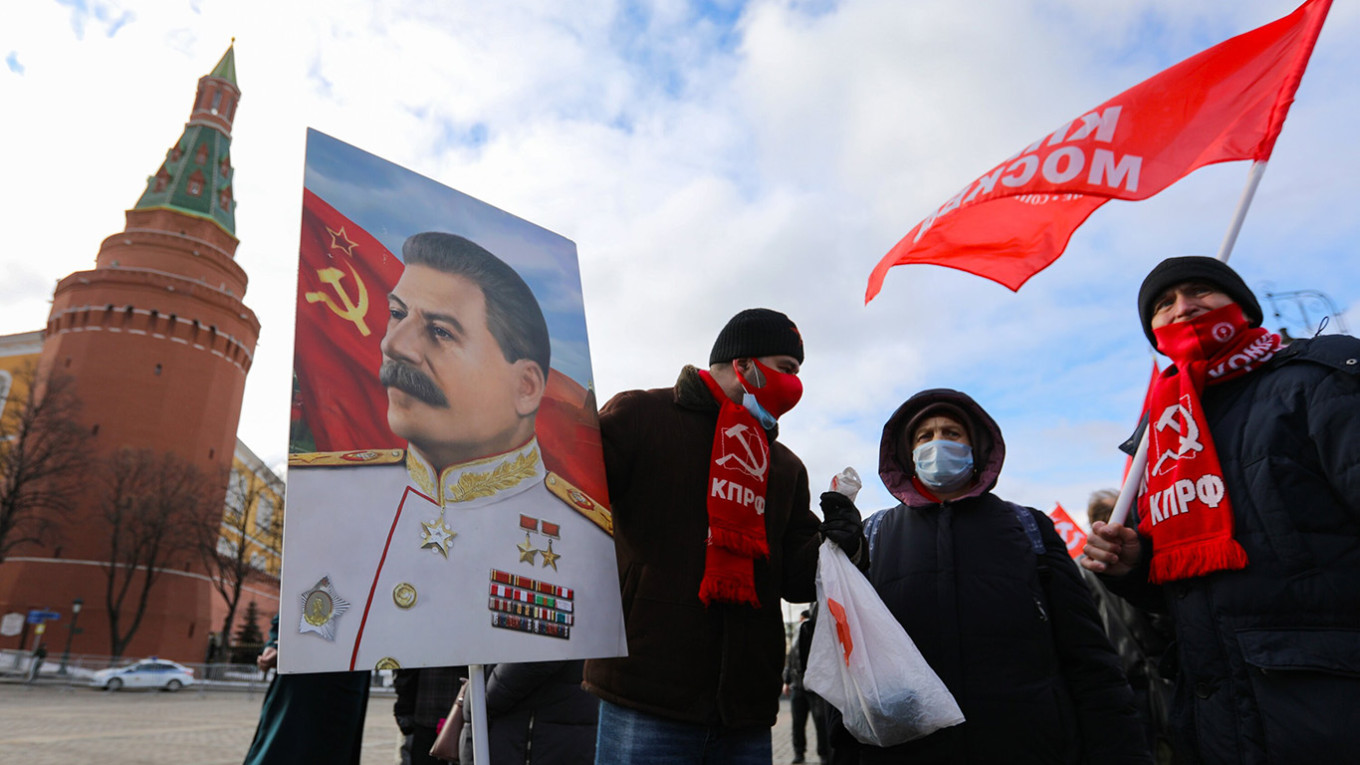
Russia is preparing a new economics textbook for university students that aims to challenge what its authors call a “myth” that democracy drives economic growth and to revive the socialist economic theories of Soviet leader Josef Stalin, the head of a Kremlin-linked advisory body said.
Moscow has ramped up efforts to enforce its view of history and global politics in schools since launching its full-scale invasion of Ukraine in 2022, introducing mandatory patriotic classes and rewriting history curricula to align with the Kremlin’s wartime narratives.
Valery Fadeyev, chairman of Russia’s presidential human rights council, told the RBC news website that he is leading work on the textbook, which could be introduced as early as the next academic year for students of sociology, political science and history.
The 350-400-page book, tentatively titled “Essays on Economics and Economic Science,” is intended to present a broader view of economic development than mainstream liberal theory, Fadeyev said.
“Our task is not to refute anything or denounce liberalism,” Fadeyev said. “Liberalism is simply too narrow. Our task is to show students the full complexity of life.”
Fadeyev said the textbook would avoid extensive mathematical modelling, arguing that some highly mathematical areas of modern economics have little connection to real-world science.
The book will also challenge what Fadeyev described as widespread assumptions about the economic benefits of democracy and the harms of protectionism.
“If we look at economic history, and this is described even in Western textbooks, economic growth has always taken place in countries with more or less strict regimes,” he told RBC.
Fadeyev said he was not opposed to democracy but argued that Russia’s own development took place under Soviet rule in conditions of strict political control.
A major chapter will focus on Russia’s industrialization between the 1930s and the 1960s, with Stalin presented as the author of “Economic Problems of Socialism in the U.S.S.R.,” a work written shortly before his death.
The textbook will also examine the ideas of Russian economists Nikolai Kondratiev, Alexander Chayanov, Mikhail Tugan-Baranovsky and Russian Academy of Sciences member Sergei Glazyev.
It will not, however, include the work of recent Nobel Prize-winning economists such as Daron Acemoglu.
“They are weak,” Fadeyev said. “Economic science has withered. We need to return to the origins.”
A separate chapter will cover the modern Russian economy, spanning what Fadeyev described as the collapse of the 1990s, the recovery of the 2000s and the current period. The authors do not plan to assign a specific label to Russia’s present economic system.
“Why put labels on it?” Fadeyev said.
A Message from The Moscow Times:
Dear readers,
We are facing unprecedented challenges. Russia's Prosecutor General's Office has designated The Moscow Times as an "undesirable" organization, criminalizing our work and putting our staff at risk of prosecution. This follows our earlier unjust labeling as a "foreign agent."
These actions are direct attempts to silence independent journalism in Russia. The authorities claim our work "discredits the decisions of the Russian leadership." We see things differently: we strive to provide accurate, unbiased reporting on Russia.
We, the journalists of The Moscow Times, refuse to be silenced. But to continue our work, we need your help.
Your support, no matter how small, makes a world of difference. If you can, please support us monthly starting from just $2. It's quick to set up, and every contribution makes a significant impact.
By supporting The Moscow Times, you're defending open, independent journalism in the face of repression. Thank you for standing with us.

Remind me later.