
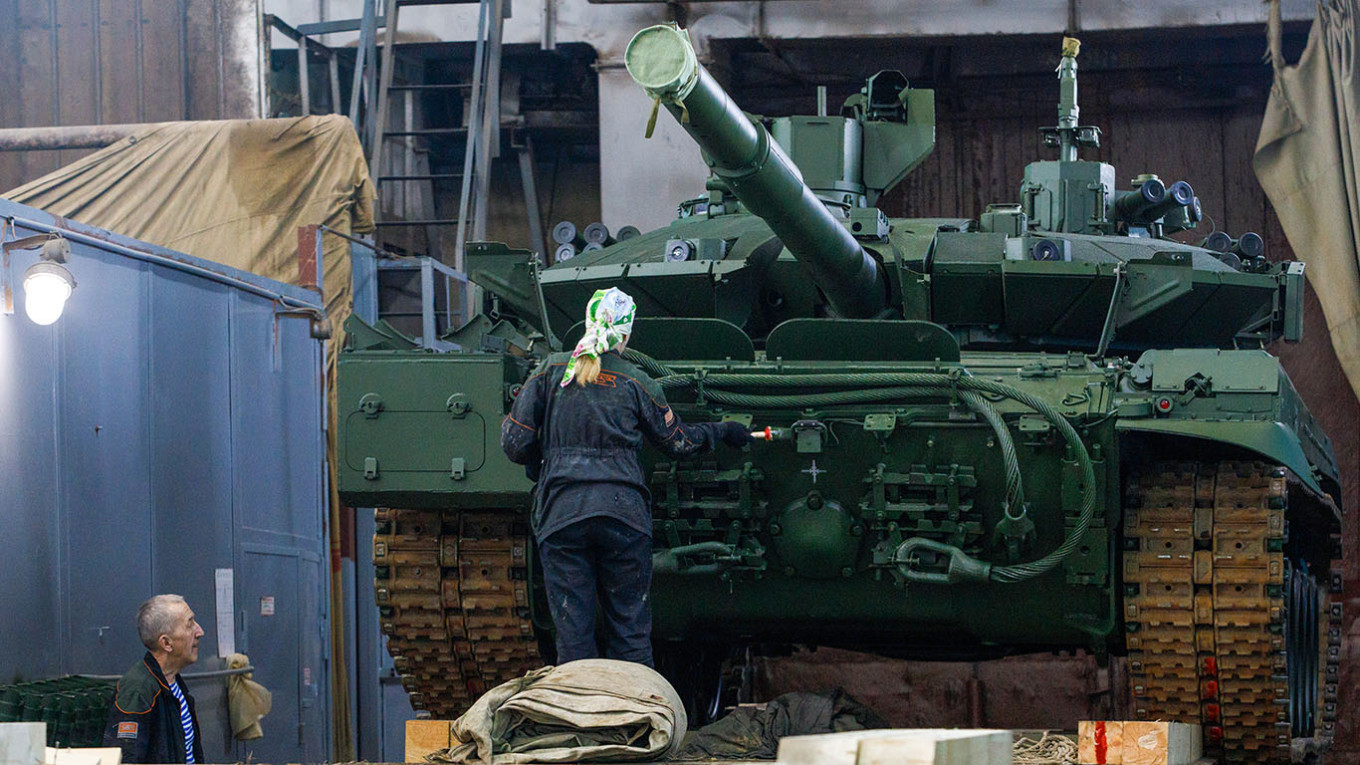
Commenting on the prospect of Russia’s war spreading beyond Ukraine, President Vladimir Putin said this month that his country was ready to take on Europe in a direct military conflict if needed.
"We are not planning to go to war with Europe, but if Europe wants to and starts, we are ready right now," he said.
Meanwhile, Sergei Chemezov, a longtime Putin ally and head of state defense conglomerate Rostec, warned Western countries against underestimating Russia’s military-industrial capacity.
“I’ll put it this way,” he said. “Our opponents couldn’t even dream of such volumes.”
With the Kremlin’s full-scale invasion of Ukraine nearing the four-year mark, Russian military spending has indeed risen to post-Soviet highs.
But in 2025, signs have increasingly pointed to a slowdown in the war industry, raising questions about how long Moscow can sustain its current level of military output under sanctions and financial strain.
Russia’s military expenditures have risen nearly 300% since the pre-war year of 2021, increasing from 3.6 trillion rubles ($39 billion) to 13.5 trillion rubles ($147 billion) earmarked for 2025.
Drawn by higher salaries, workers from other sectors have poured into defense enterprises. Large manufacturers like the Kalashnikov Concern and the Alabuga drone factory have advertised hundreds of vacancies, with some shop-floor jobs offering monthly pay of around 150,000 rubles ($1,870), nearly double the national median wage.
Official estimates show that 600,000-700,000 people joined the military-industrial complex in 2023-24, bringing total employment in the sector to about 3.8 million, or roughly 5% of the workforce.
“This really amounts to a new social contract and an economic model in which growth is driven by military-related production,” Mathieu Boulegue, a specialist in the Russian military at Chatham House, told The Moscow Times. “It is a form of defense Keynesianism, and this dynamic is likely to continue to pervade the broader economy going forward.”
While that model fueled industrial and economic growth in 2023 and 2024, it is now showing signs of losing momentum.
The Economic Development Ministry forecasts industrial output growth of just 1% in 2025, down from 5.6% last year.
Growth in Russia’s war-related industries is also slowing.
Production growth in key war-related sectors has also slowed.
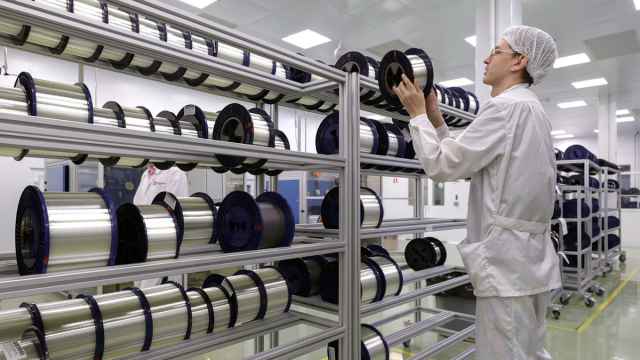
Output of fabricated metal products used in artillery and ammunition rose 15.9% in January-October 2025, down from 31.6% in 2024. Production of computer, electronic and optical goods linked to military use grew 13.6%, compared with 27.9% a year earlier.
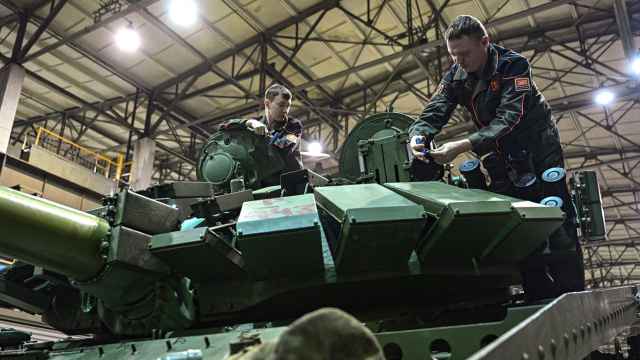
Only the “other transport equipment” category, which includes tanks and drones, has remained broadly stable, growing 33.1% versus 34.2% in 2024.
Imports of dual-use goods — items the West bans from shipping to Russia due to their potential military applications — have also declined.
Imports of battlefield-related goods from Russia’s main supplier China fell 3.7% year on year to $2.6 billion in January-November 2025, and were down 14.4% from the same period in 2023.
Other indicators suggest that the sugar rush from the injection of government military demand is beginning to fade.
Exiled news outlet Novaya Gazeta Europe reported in September that recruitment in the defense sector had fallen to levels last seen in the early months of the war. Its analysis of online job postings showed about 34,500 vacancies at defense and military-affiliated firms in summer 2025, down from roughly 52,000 a year earlier.
While details of military plants’ operations are mostly classified, sporadic reports point to persistent structural problems like graft or gaps in state procurement.
Prosecutors recently moved to nationalize KIMP, a holding company supplying bearings to defense plants, accusing its owners of enriching themselves “at the expense of the vital interests of society and the state.”
The United Shipbuilding Corporation, a key naval building corporation, has begun layoffs at its Rybinsk yard amid a lack of new contracts, while electronics producer Optron-Stavropol and microelectronics group Angstrem have reported financial difficulties.
At the same time, the state is cracking down on firms that fail to meet their contractual obligations. At least 34 people have faced criminal charges over failures to fulfill state defense contracts since the full-scale invasion of Ukraine.
Vladimir Arsenyev, the head of the Volna Central Scientific Research Institute, set himself on fire on Red Square in July 2024 in a dramatic protest against what he described as the state’s “Stalinist-style” treatment of defense suppliers.
“The volume of government orders has risen significantly, that’s true, but problems with low advance payments, gaps in government orders and delays in final payments persist,” a source at one company working with defense procurement told The Moscow Times.
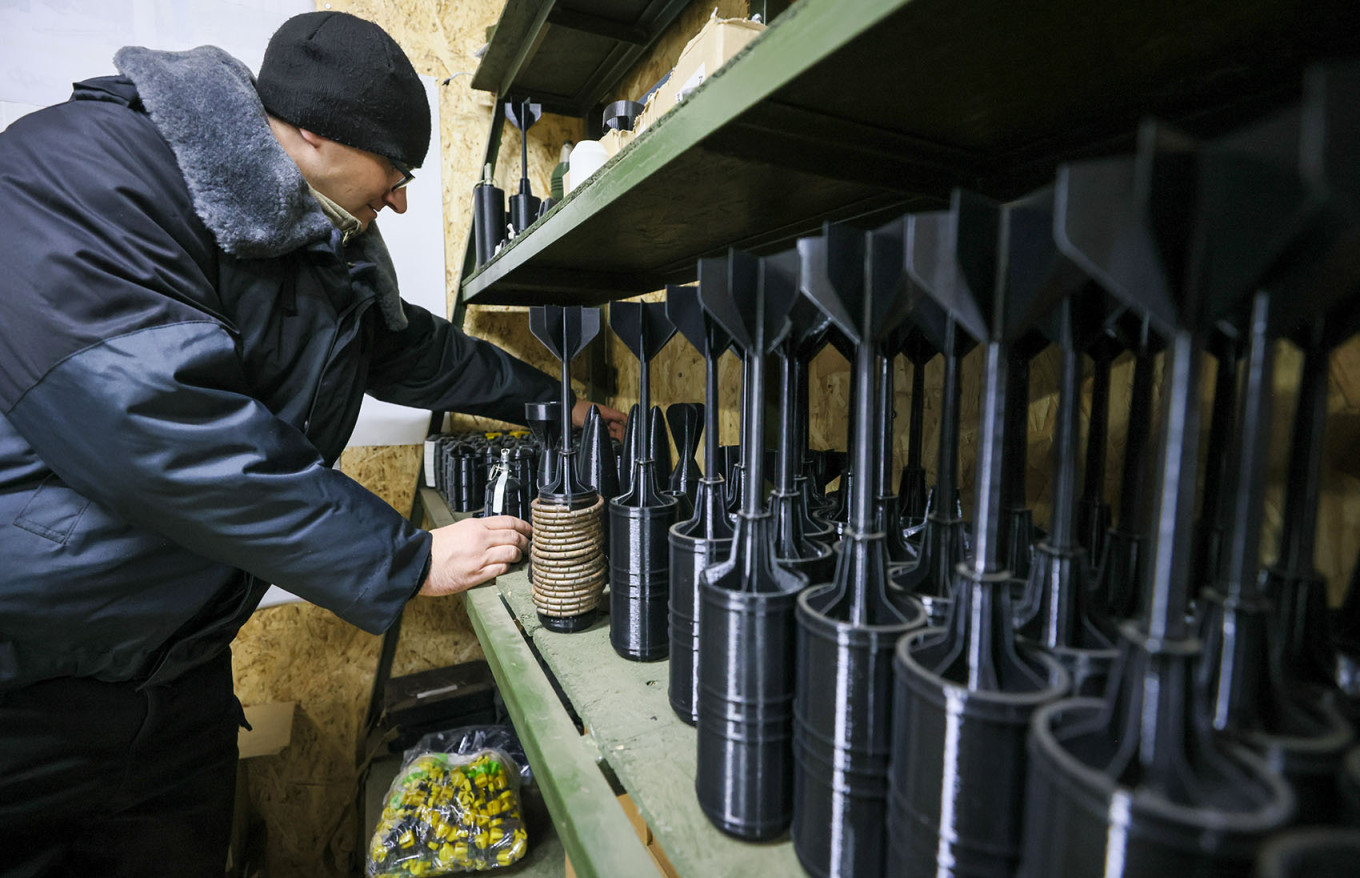
This combined with high interest rates creates chronic cash-flow gaps that leave some plants stuck in limbo, he added, speaking on condition of anonymity.
Despite these strains, Boulegue of Chatham House said that Russia’s defense industry has not yet reached a tipping point.
“Russia has enough resources to sustain its military machine at current, if not higher, levels of output of core equipment such as drones, tanks or ammunition,” he added.
However, he noted that sanctions are gradually eroding Russia’s ability to produce more advanced weapons systems.
“Over time, and under the impact of sanctions, Russia may find it increasingly difficult and costly to procure advanced components such as microelectronics and silicon-based items needed for electronic warfare, space systems and precision targeting and so on,” he said.
A Message from The Moscow Times:
Dear readers,
We are facing unprecedented challenges. Russia's Prosecutor General's Office has designated The Moscow Times as an "undesirable" organization, criminalizing our work and putting our staff at risk of prosecution. This follows our earlier unjust labeling as a "foreign agent."
These actions are direct attempts to silence independent journalism in Russia. The authorities claim our work "discredits the decisions of the Russian leadership." We see things differently: we strive to provide accurate, unbiased reporting on Russia.
We, the journalists of The Moscow Times, refuse to be silenced. But to continue our work, we need your help.
Your support, no matter how small, makes a world of difference. If you can, please support us monthly starting from just $2. It's quick to set up, and every contribution makes a significant impact.
By supporting The Moscow Times, you're defending open, independent journalism in the face of repression. Thank you for standing with us.

Remind me later.