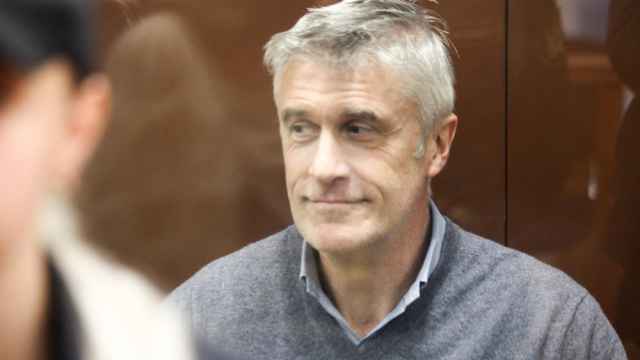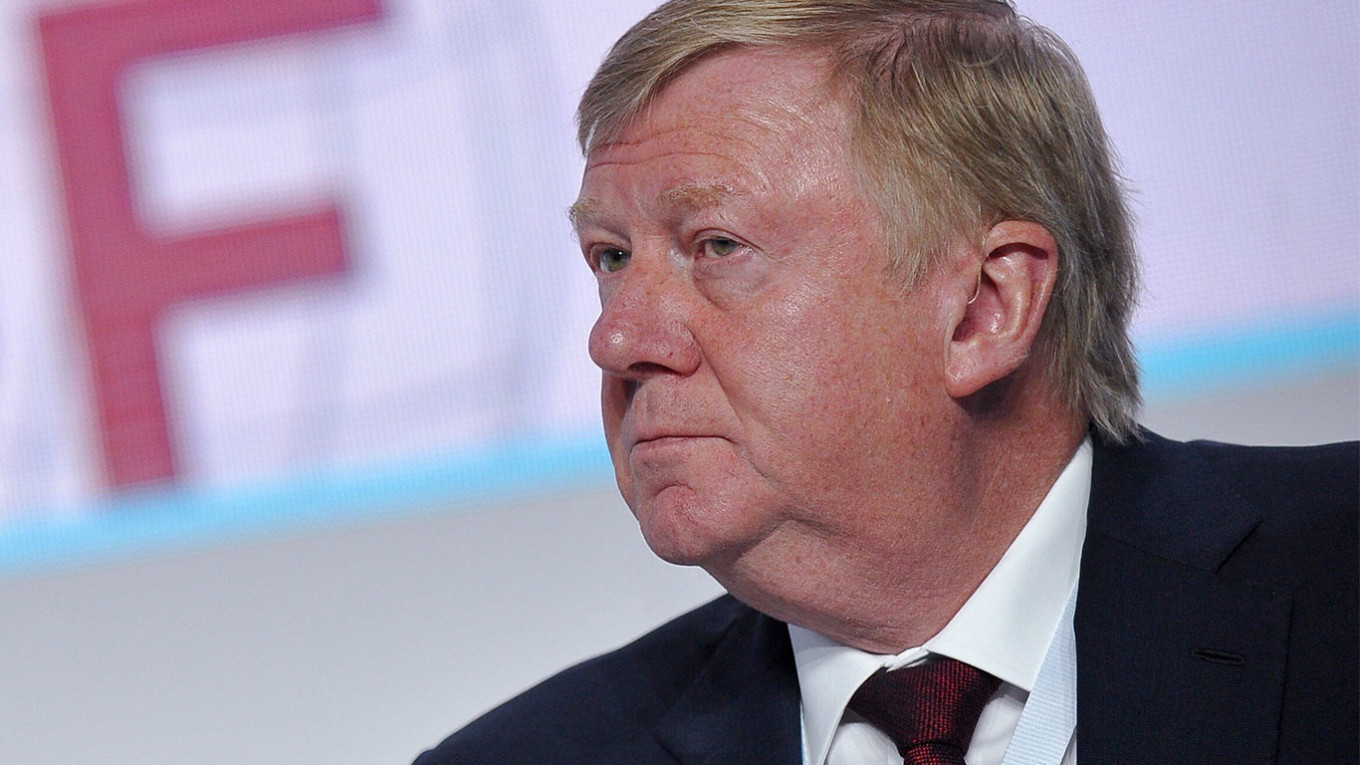
A Moscow court has ordered the seizure of an additional 11.9 billion rubles ($152 million) from exiled former Kremlin insider Anatoly Chubais and 12 co-defendants in a civil lawsuit over a failed memory chip project.
Russia’s state-owned nanotechnology corporation Rosnano sued Chubais and other former executives earlier this month for failing to develop full-scale production of MRAM memory chips, a technology promoted as unique to Russia’s microelectronics sector.
Rosnano accused its former leadership of making “unreasonable and irresponsible” decisions in the project, dubbed Crocus, which was a joint venture with the French company Crocus Technology approved in 2011.
Total investments in Crocus Nanoelectronics exceeded 200 million euros ($236 million) by April 2023, but the company filed for bankruptcy in August 2024.
The Moscow Arbitration Court justified this week’s asset seizure, citing concerns that some defendants living abroad and facing criminal charges could move assets offshore while the civil proceedings, expected to be lengthy, continue. A preliminary hearing is scheduled for April 1, 2026.
The same court in April ordered the seizure of 5.6 billion rubles from Chubais and seven other co-defendants in the case.
Chubais founded Rosnano in 2007 and led the company until 2020. The current leadership requested a review of the previous management in early 2022, triggering multiple investigations into alleged fraud, embezzlement and abuse of power.
Chubais served as the Kremlin’s climate envoy before resigning and leaving Russia shortly after Moscow launched its full-scale invasion of Ukraine in February 2022. He later settled in Israel, where he founded a research center at Tel Aviv University.
President Vladimir Putin has suggested Chubais fled Russia to evade potential criminal prosecution over financial irregularities at Rosnano. Russian officials have also called for his extradition on corruption charges.
This is Rosnano’s second major lawsuit against its former leadership. In January, Moscow’s Arbitration Court is scheduled to hear a case seeking 5.6 billion rubles ($71 million) from Chubais and his associates over the failed Plastic Logic flexible tablet project.
A Message from The Moscow Times:
Dear readers,
We are facing unprecedented challenges. Russia's Prosecutor General's Office has designated The Moscow Times as an "undesirable" organization, criminalizing our work and putting our staff at risk of prosecution. This follows our earlier unjust labeling as a "foreign agent."
These actions are direct attempts to silence independent journalism in Russia. The authorities claim our work "discredits the decisions of the Russian leadership." We see things differently: we strive to provide accurate, unbiased reporting on Russia.
We, the journalists of The Moscow Times, refuse to be silenced. But to continue our work, we need your help.
Your support, no matter how small, makes a world of difference. If you can, please support us monthly starting from just $2. It's quick to set up, and every contribution makes a significant impact.
By supporting The Moscow Times, you're defending open, independent journalism in the face of repression. Thank you for standing with us.

Remind me later.