

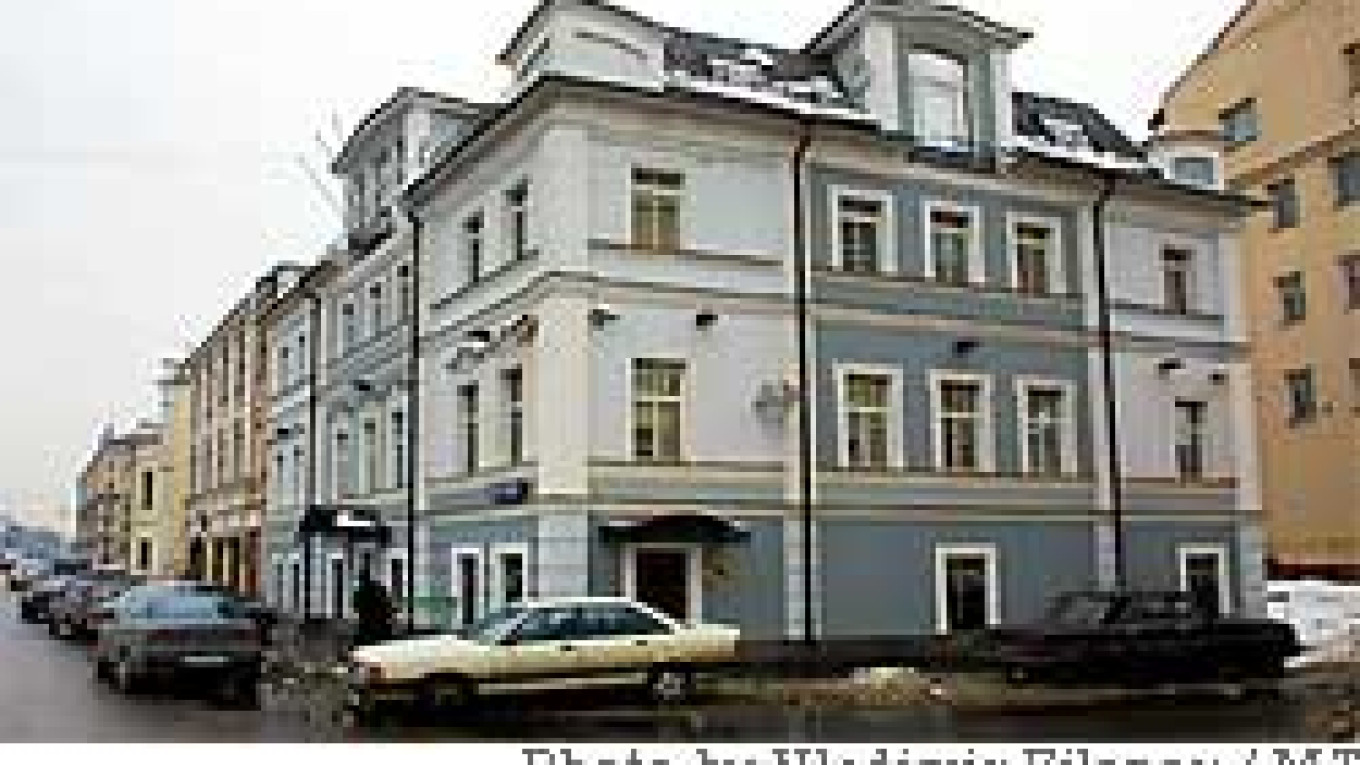
The number of tourists traveling to Italy has been growing so fast that the former consulate at the embassy at 5 Denezhny Pereulok was unable to cope, Italian officials said Monday.
But the Italians hope to change all that by putting the consulate section in the new 881.5-square-meter building.
The embassy said it had sought a building in the center of the city with architectural significance and prestige.
It found what it wanted in Villa Yakimanka, which has a postal address of 2/10 Ulitsa Bolshaya Polyanka, but is on the Yakimanskaya Naberezhnaya with a view of the Kremlin and the Cathedral of Christ the Savior.
Italian Ambassador Giancarlo Aragona said Monday at a news conference that two more employees were hired with the move, bringing the consulate's total staff up to 20.
Additional temporary help will be hired as needed, he said.
Villa Yakimanka was first constructed as two adjacent buildings in the 1830s and 1840s. These were later united into a single building.
Construction company Spetsres-tavratsia began restoring the four-story building in 1998 under the guidance of architectural restorer Boris Ganzin.
In mid-December the building was registered with the Moscow city government as the property of Italy.
Michele Quaroni, the embassy's press attach?, said the value of the building was $1.4 million, not including the cost of adapting the renovated building to the needs of the consulate. He did not specify how much this work cost.
"The area is very beautiful. It's near the Tretyakov Gallery, and we are very pleased about the location. It will give more prestige to the office of the consulate," Quaroni said.
The embassy said that about 150,000 Russians visited the peninsula republic last year, 40 percent more than in 1999. The new consulate is capable of processing about 180,000 visas a year.
The number of expected applicants will still be less than those seen from 1991 to 1997, when more than 200,000 visas were issued a year from the old embassy.
The old embassy, however, was hardly capable of handling such a flow, sparking anger from would-be tourists and travel agencies alike. A crowd of about 100 people, frustrated that they had not received their visas, attempted in June to break into the embassy immediately after it closed for the day.
Also, travel agencies last year ranked the Italian consular section in last place among 31 foreign embassies, according to the Russian Association of Travel Agents.
The red tape a government faces in getting a historic site reconstructed for an embassy is little different than the paperwork any company has to muddle through to develop similar sites for commercial or residential use, said Engin Colpan, regional director of Turkish construction and contracting firm Alarko. Alarko built new Turkish and Iranian embassies in Moscow in the 1990s.
The location of the consulate means that city regulations concerning the preservation of historic buildings applied, he said, adding that Italians are used to such regulations because in their homeland the restrictions are even greater than in Moscow.
In moving, the Italian consulate leaves a building rich with history.
The embassy at 5 Denezhny Pereulok, which the Italian mission has occupied since 1924, was built in 1897 by architect Pyotr Boitsov for textile industrialist Sergei Berg.
The building became the German Embassy, the first foreign mission accredited in Bolshevik Russia, in April 1918 after the signing of the Brest-Litovsk Treaty.
Under the peace treaty, Germany received control of territories that had been part of the Russian empire and privileged access to Russia's economy.
The treaty incensed the public, and the German Embassy became a target of attacks by Left Socialist-Revolutionaries.
The assassination of the German ambassador, Count Wilhem von Mirbach, on July 6 was to serve as the signal for a national uprising and a resumption of hostilities with Germany. The rebellion was quickly put down.
In a bid to placate the Germans, a stream of Bolshevik leaders ?€” including Yakov Sverdlov, Felix Dzerzhinsky and Vladimir Lenin ?€” visited Denezhny Pereulok that day.
The Italians now hope to placate visa-hungry Russians with their new premises.
And they will get their first chance to win higher marks shortly. The Russian Association of Travel Agents said Monday that a new survey will begin this month that will enable members to rate the new consulate.
A Message from The Moscow Times:
Dear readers,
We are facing unprecedented challenges. Russia's Prosecutor General's Office has designated The Moscow Times as an "undesirable" organization, criminalizing our work and putting our staff at risk of prosecution. This follows our earlier unjust labeling as a "foreign agent."
These actions are direct attempts to silence independent journalism in Russia. The authorities claim our work "discredits the decisions of the Russian leadership." We see things differently: we strive to provide accurate, unbiased reporting on Russia.
We, the journalists of The Moscow Times, refuse to be silenced. But to continue our work, we need your help.
Your support, no matter how small, makes a world of difference. If you can, please support us monthly starting from just $2. It's quick to set up, and every contribution makes a significant impact.
By supporting The Moscow Times, you're defending open, independent journalism in the face of repression. Thank you for standing with us.

Remind me later.