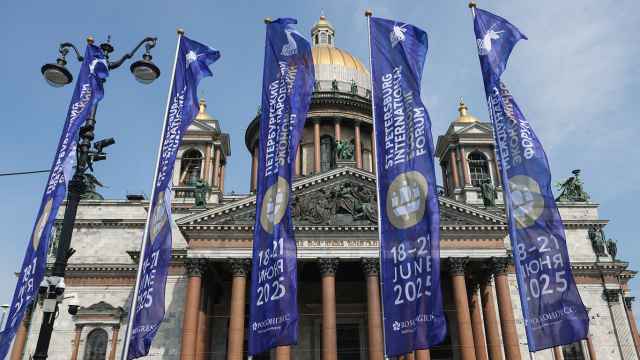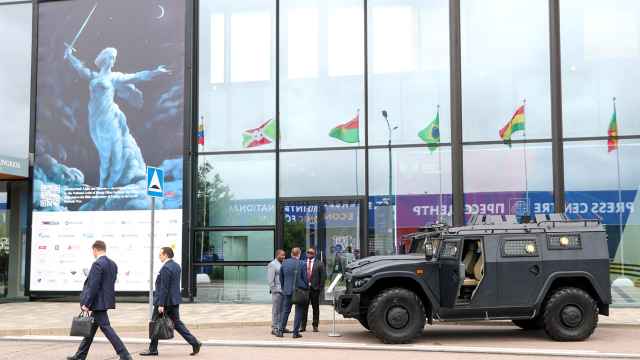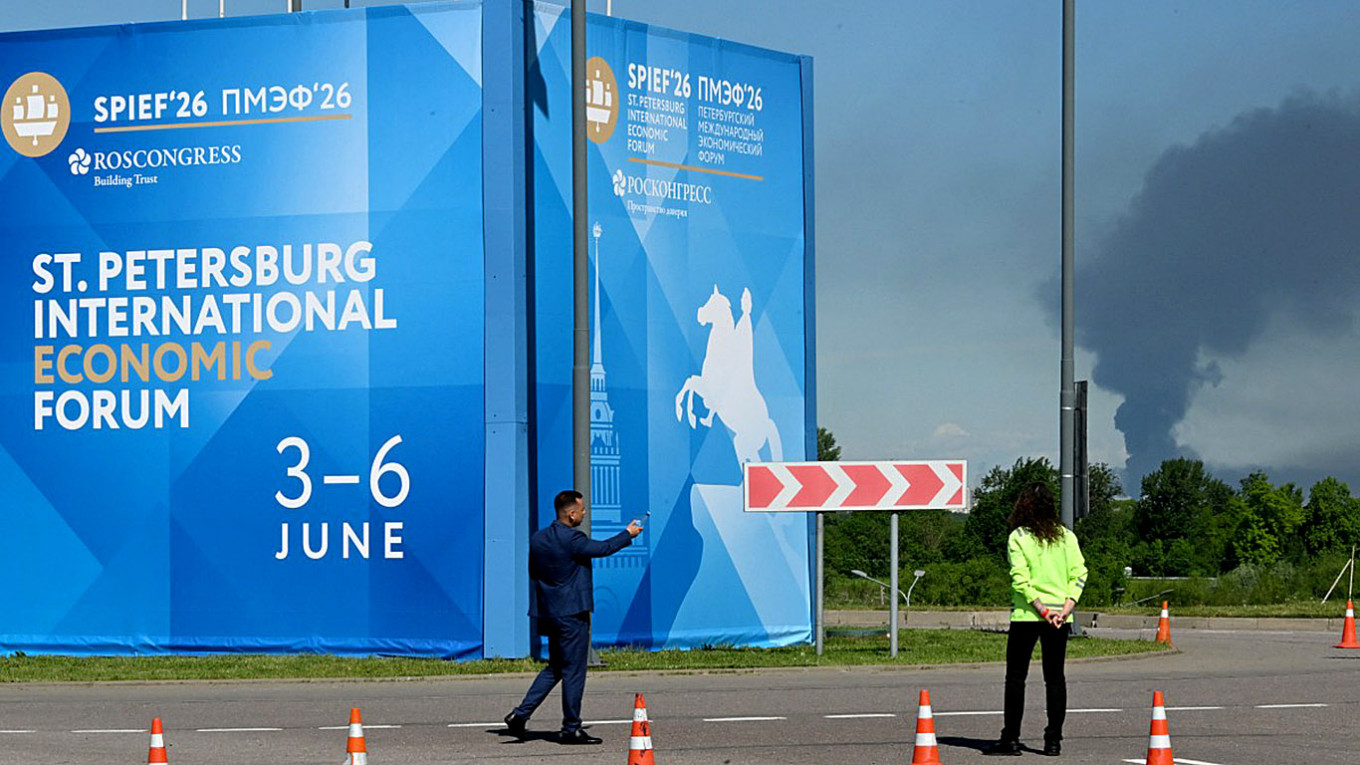
The St. Petersburg International Economic Forum (SPIEF) began with an epic backdrop as clouds of black smoke from a Ukrainian drone strike on a local oil terminal billowed across the sky. Those present played down the scene, of course. But by the end of the conference, the flagship event had become almost comical.
While the closure of Pulkovo Airport due to the attack held back the arrival of some guests, those already gathered were entertained by the notorious media mogul Konstantin Malofeyev and philosopher Alexander Dugin, who presented their visions for Russia’s future. In brief: if Russia continues its killing and defeats and robs its enemies, grabbing the world by its throat, everything will turn out well for Moscow. But if the war ends, everything would get worse. Much worse.
Of course, the organizers did not choose this opening for SPIEF by accident. But that the conference went ahead was clearly meant to show that nothing could stop the Kremlin. Moreover, early events on SPIEF’s agenda are often, shall we say, entertaining in character, leaving the officials for later. So, should anything happen, the Kremlin can always tell Washington that these marginal figures are talking nonsense and don’t represent Moscow’s position.
But the script hadn’t accounted for a Ukrainian drone attack, leaving many people trying to act as if everything was normal. Russian television reporters breathlessly relayed that “foreign delegations” were arriving. Even Americans!
Only, it wasn’t an official delegation, as Secretary of State Marco Rubio told a Senate Committee. In time, it emerged that the so-called United States delegation consisted of an architect advising Trump on the construction of the White House ballroom, along with ever-present actor Steven Seagal and Candace Owens, a blogger and conspiracy theorist.
And the epic performance continued. Kirill Dmitriev announced that documents on the construction of the notorious “Putin-Trump tunnel” under the Bering Strait would be signed “as soon as tomorrow.” Journalists — and experts too — were somewhat surprised and Dmitriev was forced to admit that the deal was actually with an engineering company to design the tunnel. Designing is not building. Russia designed Power of Siberia 2, but there is not even a hint of an agreement with China that the pipeline will ever be built.
In short, everyone did what they could — in tune and out of tune, either unable to leave the well-worn track or trying not to notice the smoke spreading over the waters of the Neva. But, of course, everyone was outdone by Governor Alexander Beglov, who declared that St. Petersburg had become the capital of drone technologies. All that was missing was Lieutenant Colonel Bill Kilgore from Apocalypse Now announcing: “I love the smell of napalm in the morning… It smells like victory.”
By the end of the first day, the main question had become whether President Vladimir Putin would turn up for his scheduled speech on Friday. While people were speculating, the sensational news that Central Bank Governor Elvira Nabiullina had not come to the forum emerged. The initial explanation for her untimely absence from the bright lights of SPIEF was the funeral of her adviser and good friend Alexei Mozhin, who had long represented Russia at the IMF.
The Central Bank’s press service offered a different version: Nabiullina was on sick leave. In Russia, the presence of two purported truths is interpreted as the lack of any truth. Still, perhaps one should not blame the press service. Nabiullina’s absence had to be explained somehow.
Her conspicuous absence affected the substance of the economic debates too. In brief: we will live badly — and for a long time.
Andrei Makarov, chair of the State Duma Budget and Taxes Committee, a regular SPIEF speaker and the life of the party, joked in vain that attendees should not use Nabiullina’s absence to blame her for everything. He offered his own criticism: “The old world is dying, the new world is born in pain, the time of monsters has come.” Then, mangling a quotation from the philosopher and politician Antonio Gramsci: “In this interregnum, a great variety of morbid symptoms appear.”
Finance Minister Anton Siluanov explained that there is not enough money in the budget and until 2029, things will not get better. That means expenses will have to be tightened somehow. Not spending on the war, of course — that will only grow. And, yes, he noted that people were afraid that tax rises had gone too far, but insisted they hadn’t. Businesses are holding up, the economy is getting stronger, growth is no worse than in Europe, debt is lower and, in general, Russia has almost achieved complete independence from foreign loans. No one dared question who would even consider lending to Russia in the first place.
Maxim Oreshkin, the deputy head of Putin’s administration, artlessly repeated the already worn-out claim that 50% of global economic growth comes from BRICS, while Western countries account for only 20%. No one asked what share of that belongs to China and what share to Russia.
But there is, as they say, good news too. The levy on electronics may be postponed until December 2026, Deputy Industry and Trade Minister Vasily Shpak said.
Entrepreneurs, one imagines, have already drawn their own conclusions. Just in time for SPIEF, Rosstat released statistics showing that business investment in fixed capital had collapsed to its lowest level in 16 years. It’s unsurprising. Who would invest in times as uncertain as these?
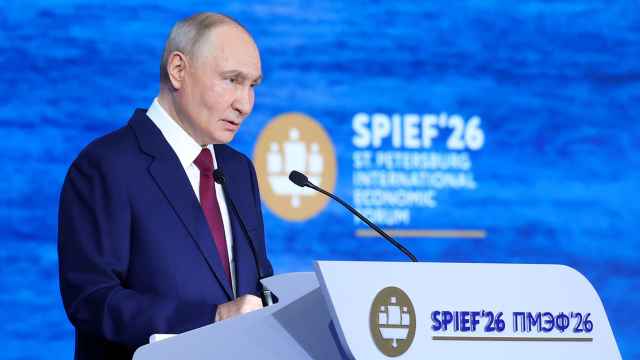
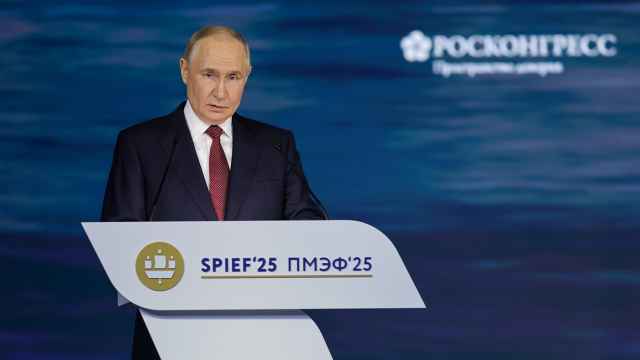
Despite speculation that he wouldn't, Putin did appear in St. Petersburg.
As usual, he led with successes. It turned out that everything is going well for Russia: it has already seized enough Ukrainian territory to conquer the country four times over — 2,400 “thousand” square kilometers, though the Kremlin scrubbed the errant “thousand” from the transcript on its website. Russia is still in fourth place in terms of GDP by purchasing power parity and, in general, Ukraine’s President Volodymyr Zelensky should not be writing open letters inviting negotiations, but holding elections.
In contrast, Putin takes part in elections of sorts regularly and does not rule out running in 2030 in order to rule until 2036 and beyond, God willing. And why not? He can just edit the Constitution again to allow it.
Of course, everyone noted that Putin does not call Zelensky by name, referring to him, as he did to Alexei Navalny, as “this gentleman.” Of course, everyone noted that Putin was unusually incoherent. But on the morning of the forum’s final day, his spokesman Dmitry Peskov was doing his utmost to hype up the president’s speech.
The prisoner exchange between Ukraine and Russia must have guaranteed that there would be no drone attacks that day. Putin was only late by 80 minutes. By his standards, that’s on time. A leader like him can keep everyone waiting for hours.
Then came an hour and a half of asserting that Russia was actually in a better position than Europe as a whole. So no matter how bad things feel, they could be worse. Europeans apparently have higher debt and lower economic growth — which is, to put it mildly, not entirely true.
Even Russia’s isolation from the rest of the world was cast as a strength, spurring innovation. In short, as the scandalous governor of the Vologda region, Georgy Filimonov, correctly observed earlier, the invasion of Ukraine made it possible to “unlock dormant potential.”
Still, Putin made some positive headlines. First, he announced that the headquarters of major state companies would move to Russia’s regions to stimulate economic growth. The companies destined for exile included Russian Railways, whose debt amounts to a fantastical 4 trillion rubles ($55.6 billion).
The camera cut to Moscow Mayor Sergei Sobyanin at the news of redistributing assets from his city. To give him credit, he knows how to keep a poker face. Perhaps he was suppressing his joy at all the real estate these companies would free up. At least tax revenues from Russian Railways hardly amount to anything.
Second, Putin solemnly promised that the business revenue threshold for paying VAT would not be lowered to 10 million rubles ($139,000), as planned, but would be fixed at the current level of 20 million rubles ($277,000) a year. That threshold will cause around a third of small businesses to close, according to a study by the servile Opora Russia business platform. Retailers and catering services are already keeping some of their profits off the books.
The only interesting moment of the Q&A was Putin’s admission that he had, after all, read Zelensky’s open letter: “Peskov slipped me a piece of paper here. I glanced over it,” he said before spending ten minutes reiterating his earlier points. What exactly he said is not interesting. What is interesting is the dismissive way he admitted to having read the letter.
Meanwhile, in the halls of SPIEF, the exhibition of Russian economic achievements continued. Domestically produced robot soccer players and Chinese robots dressed in sarafans toppled over. There were Russian cars that were actually poor copies of Chinese models.
The most impressive of all was the stand run by Donetsk separatists, which displayed regionally themed fragrances with names “The Resilience of Metal.” Or “Steppe Wind.” But the most successful fragrance of the week was, of course, the “Smoky Spoil Tips” drifting over the city.
Nobody said they loved the smell of burning oil in the morning. But to paraphrase the satirist Fertoke, political scientists from all over the world are pointing their fingers at the screen, able to see the obvious quagmire that Russia continues to deny it’s in.
A Message from The Moscow Times:
Dear readers,
We are facing unprecedented challenges. Russia's Prosecutor General's Office has designated The Moscow Times as an "undesirable" organization, criminalizing our work and putting our staff at risk of prosecution. This follows our earlier unjust labeling as a "foreign agent."
These actions are direct attempts to silence independent journalism in Russia. The authorities claim our work "discredits the decisions of the Russian leadership." We see things differently: we strive to provide accurate, unbiased reporting on Russia.
We, the journalists of The Moscow Times, refuse to be silenced. But to continue our work, we need your help.
Your support, no matter how small, makes a world of difference. If you can, please support us monthly starting from just $2. It's quick to set up, and every contribution makes a significant impact.
By supporting The Moscow Times, you're defending open, independent journalism in the face of repression. Thank you for standing with us.

Remind me later.