

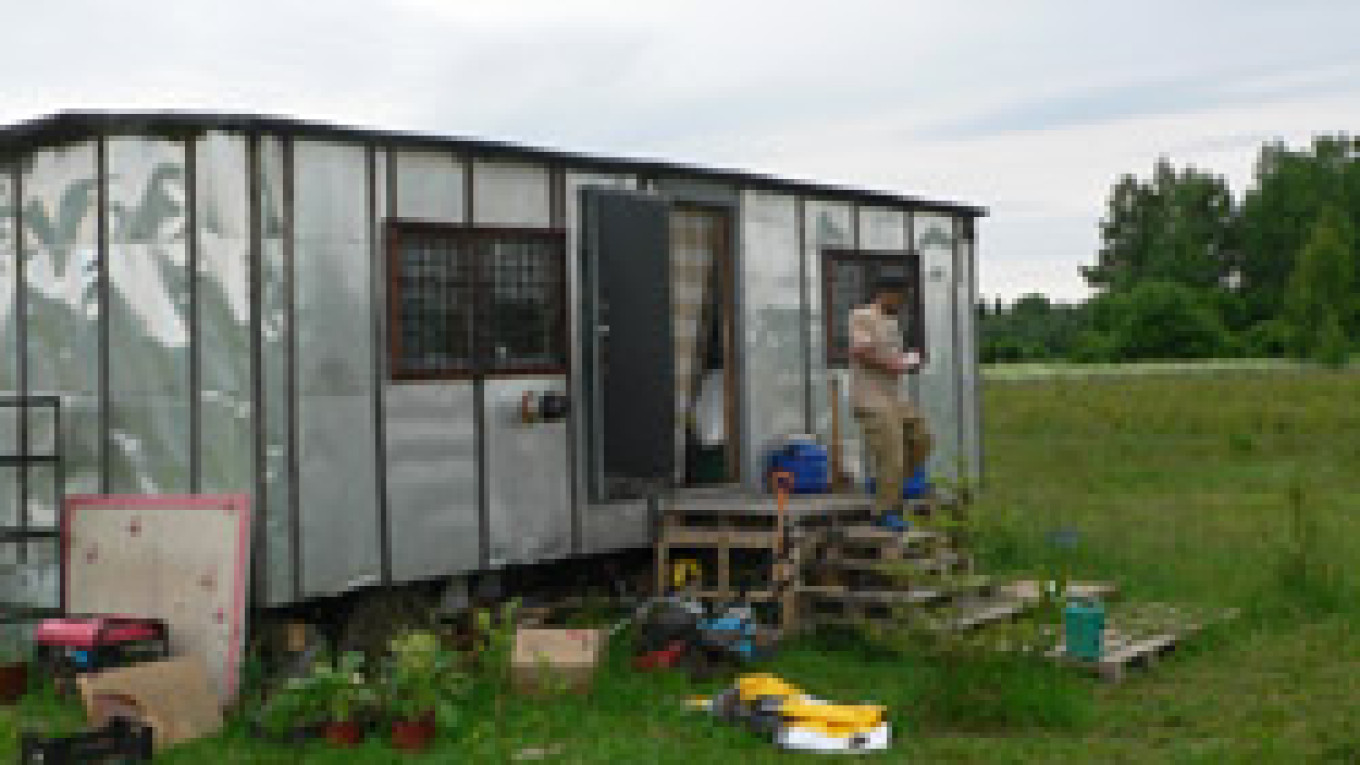
For now, the people here mostly visit on the weekends to escape the bustle of the city. But they all dream of one day building their own family estate in the so-called ecovillage Luchezarnoye, or The Radiant, set up three years ago some 80 kilometers north of Moscow.
It’s difficult to say where the fields end and settlement begins. The scattered homes here look more like lost dachas than the beginnings of a new community.
“We want to unite with nature,” said Yelena Plastinina, one of its first residents. “No metal fences. Only the hedges are allowed, but it will take them time to grow.”
Plastinina, a lively young woman who studied to be an economist, lives in the nearby town of Zelenograd. Presently, she can only come here on weekends and free days, but she says she’s sure to move to Luchezarnoye in two or three years.
There are more than 200 such ecosettlements in Russia, and unlike environmental villages in Europe and the United States they typically aren’t connected with the Green movement.
Instead, most of the residents are united by the ideas of contemporary Russian writer Vladimir Megre, whose books tell about the naturalistic traditions of ancient pre-Russia, which he claims to have glimpsed in forlorn Siberian villages. His ideas have gained traction with thousands of urban Russians since 1996, when Megre’s first book appeared.
As it gained followers, the movement was also strongly criticized for falsifying history and for what might seem like an attempt to create a cult. Its adherents, however, were never bothered by the authorities — perhaps because there’s no aggression against modern society, and they do not reject most of its institutions.
“Our goal is not simply becoming closer to nature,” Plastinina said. “It is to remember our ancient Russian traditions, to make our kids happier, to create a little ecological world for every loving family.”
“All the settlements start from Megre’s books,” said another Luchezarnoye resident, Marina Zhiltsova. “We learned that there is an alternative way of life. And that was our salvation.”
|
|
Alexander Velikanov / MT
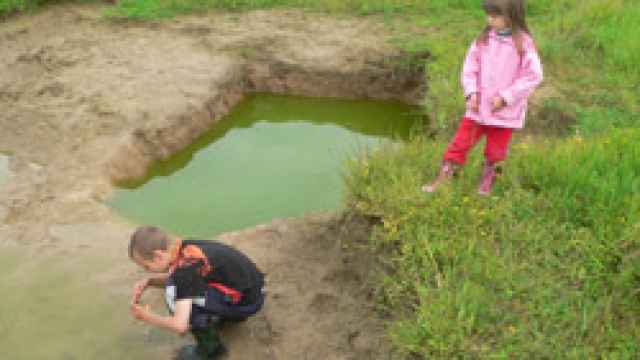
Children playing in the mud near where their parents are hoping to some day build a permanent family estate. |
Marina and her husband, Alexei, occupy a plot almost unseen from neighboring homes, hidden behind a grove. Here, she is going to create a big currant garden and start a little business making soft drinks from the fruit.
Luchezarnoye got its start three years ago, when a group of Moscow residents, united by the idea of “returning to natural life,” decided to found a settlement, she said.
A web site was created as a gathering point for others who share the idea.
They purchased a 90-hectare plot that was once part of a collective farm and began organizing their village. The field was cut into 70 plots, of which 62 are already owned by families.
But the place does not seem densely populated at all. A few little buildings are seen amid the untrodden grass. These are not even houses, just bytovkas, or small wagons made of steel and wood. In Russia, they are often used for temporary living by workers or watchmen on construction sites.
Such shelters, separated by big distances and woods, are all that make up the settlement for now.
Starting a village is a long and difficult process, the settlers said, but they proudly claim that they are steadily moving forward.
Alexei Frolenkov and his wife, Viktoria, run a retail business in Moscow but spend more and more time at the place where they plan to build their estate.
Few of their belongings recall the city life they plan to leave behind. The one exception is a car battery that they use to power a few environmentally friendly lamps. Once or twice a week, Frolenkov returns to Zelenograd and recharges it.
“Anyway, it’s so great to live here,” he said. “It’s not like the city at all. It’s like comparing heaven and earth.”
All of Luchezarnoye’s settlers work in Moscow or nearby towns — there are businessmen, accountants and many IT specialists.
“We’re different from the village people,” Frolenkov said. “We dislike the idea of traditional agriculture, of pressing nature hard and toiling ourselves.”
They believe that a more modest lifestyle and alternative plant-growing methods based on imitating natural ecosystems may support a man without stretching him and the land.
Unlike the homegrown Megre philosophy, the settlers’ agricultural ideology was formed by scientific research in Australia and Japan.
“A man can live autonomously from his hectare,” Zhiltsova said. “Not with the modern needs, of course. When you start living here, you begin to lower your necessities.”
Ecosettlers gradually become vegetarians and forget cigarettes and alcohol, she said.
Zhiltsova showed off her orchard, which is nothing like the traditional Russian vegetable patch. The wild grass and weeds are not pulled out — they’re natural, and thus not harmful, she argues.
Settlers also try gradually downshifting from their work and business, opting for freer schedules and jobs they can do from home, which will allow them to live in Luchezarnoye year-round.
But so far, the settlement has existed mostly as a meeting place on weekends and a web site. Only a few families live here for longer periods.
The residents complain that legally establishing a new village in Russia is very difficult. It requires mountains of paperwork, knocking on too many doors and not a small amount of money, they said.
“The idea of patrimonial estates is a positive one,” Dmitry Medvedev, then a first deputy prime minister, said during an Internet conference in March 2007. “It fits into our ideas of low-rise building development, which are put to practice in the national projects.”
But apart from this fleeting praise, the government has no official position on the ecosettlements, many of which exist on a semilegal basis. Residents typically purchase the land, but because it is classified as agricultural they are prohibited from building permanent structures.
“People from all the patrimonial villages around the country are writing letters to the president and prime minister and asking them to pass a law on ecosettlements,” Frolenkov said. “But we are still treated as a group of lunatics.”
Kovcheg, or The Ark, in the Kaluga region is the only one that has managed to gain official recognition as a settlement. It took their leader, Fyodor Lazutin, seven years of legal work.
Most of the natural settlements, however, still look like Luchezarnoye — a few huts lost in the woods and fields, slowly but steadily built by their idealistic owners.
A Message from The Moscow Times:
Dear readers,
We are facing unprecedented challenges. Russia's Prosecutor General's Office has designated The Moscow Times as an "undesirable" organization, criminalizing our work and putting our staff at risk of prosecution. This follows our earlier unjust labeling as a "foreign agent."
These actions are direct attempts to silence independent journalism in Russia. The authorities claim our work "discredits the decisions of the Russian leadership." We see things differently: we strive to provide accurate, unbiased reporting on Russia.
We, the journalists of The Moscow Times, refuse to be silenced. But to continue our work, we need your help.
Your support, no matter how small, makes a world of difference. If you can, please support us monthly starting from just $2. It's quick to set up, and every contribution makes a significant impact.
By supporting The Moscow Times, you're defending open, independent journalism in the face of repression. Thank you for standing with us.

Remind me later.