
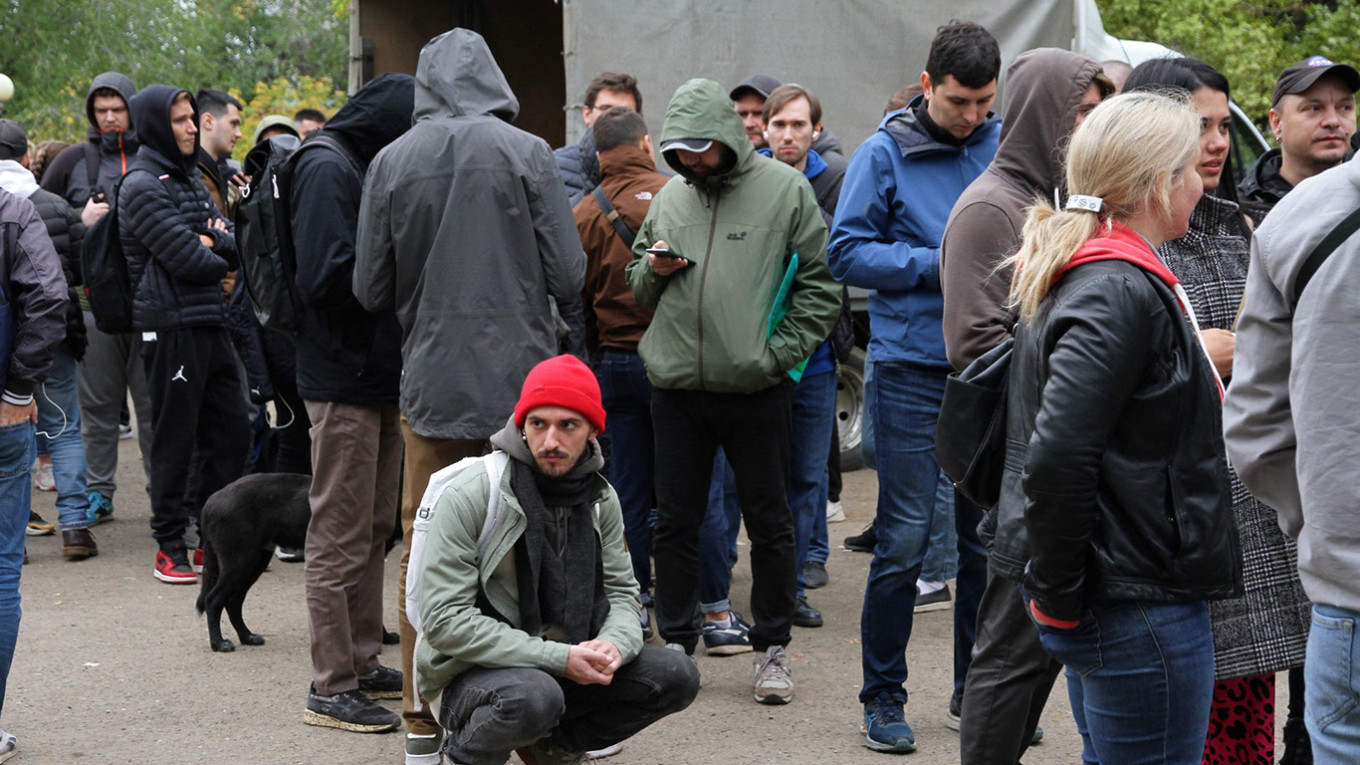
I recently returned from Tashkent, Uzbekistan, where conversations with old Russian friends and newer arrivals in the city who weren’t even of military age in 2022 left me with an unsettling sense of déjà vu.
One Russian software CEO, who was on a business trip, told me he had sent a dozen male employees of military age on “extended vacation” to Armenia for a few months. Several of my contacts who fled Russia in 2022, but had since returned, are now preparing to leave again or have already gone back to Georgia or Turkey.
“My plan is simple: wait it out outside Russia until it’s safe to return,” said 29-year-old Ruslan, who featured in my recently published book, “Leaving Russia.”
When the partial mobilization was announced in September 2022, Ruslan fled Moscow with his pregnant fiancée and their Labrador, Smeliy, driving almost 2,000 kilometers (1,240 miles) to Georgia in their battered Renault Duster. They struggled to settle in Tbilisi and, in 2024, returned home after a year in Serbia, convinced it was safe to do so.
“This time, I’m leaving on my own for a while,” explained Ruslan, who flew back to Georgia last month. “I never imagined I’d have to go through this all over again.”
There are growing signs of a new wave of Russian emigration, with people already leaving ahead of the State Duma elections on Sept. 18-20. Meduza reported that rumors of post-election mobilization sent Russian arrivals and housing demand surging in Georgia, Armenia and Serbia. Serbian realtors described long lines for apartments, with demand at its highest level since early 2024. Some clients were already booking accommodation for late September.
There is also mounting evidence that Russia is preparing to expand its military manpower, but it may not need another headline-grabbing mobilization order to do so.
Unlike in 2022, the Kremlin now has quieter ways to replenish and expand its ranks: sustained recruitment, conscription, pressure on potential recruits and coercive mobilization in occupied Ukraine. In June, authorities in the Penza region conducted raids to detain local men and pressure them into signing military contracts.
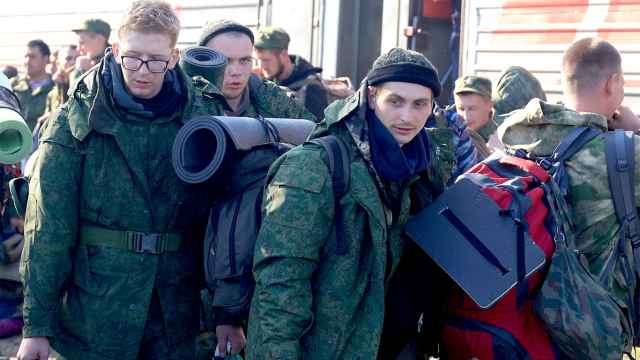
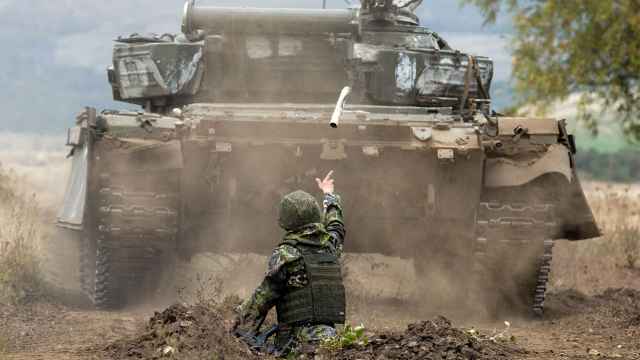
Russia needs more soldiers. Western estimates put Russian casualties at more than 30,000 a month, a staggering toll from the army’s attritional meat-grinder tactics, in which troops are repeatedly sent into infantry assaults despite heavy losses.
But replacing battlefield losses is only part of the problem. Modern warfare demands increasingly specialized skills, from drone operators and engineers to programmers and technicians capable of operating sophisticated weapons.
The Kremlin knows it. Russia is already offering university students vast financial incentives to join drone units as operators and engineers. The message is unmistakable: the next generation of Russia’s military will need brains as well as bodies.
If volunteers and mercenaries from North Korea and Nepal are no longer enough, the new draft is likely to target the country's educated youth. That puts the country’s universities at the heart of a new manpower drive. With more than 2 million men in higher education, they represent a vast pool of young people with precisely the skills the military increasingly needs.
Moscow is increasingly treating lecture halls as a recruitment pool. The military is offering university students substantial financial incentives to join drone units as operators and engineers. There have been unconfirmed reports of universities being given recruitment quotas and students, particularly those who failed exams or are in debt, being pressured to enlist.
According to the independent Russian student magazine Groza, 269 Russian universities and colleges are now actively promoting military contracts, effectively turning campuses into recruitment centers.
The offer is hard to ignore, with large payments, academic leave and free tuition after service. In some cases, however, the pressure goes further, with students threatened with academic penalties or expulsion if they refuse.
But signing up does not guarantee a safe distance from the battlefield. Groza reports that drone recruits can be reassigned to combat units, with no guarantee that their contracts will end after a year.
None of this proves that a new mobilization is imminent. But it points to a broader anxiety that has been building for months: requests for emigration assistance have surged, while online searches for mobilization, property in Yerevan and ways to leave Russia have risen sharply.
Unlike four and a half years ago, when emigration was triggered by a sudden shock, in 2026 it is being driven by accumulated risk. Years of war, tighter internet controls, economic decline, the erosion of familiar services, drone attacks and shrinking opportunities have worn people down. Whispers of another mobilization have added to the pressure.
Another reason Russians I spoke to are preparing for the worst is that they no longer trust official assurances. Before the election, the Kremlin promised no new tax rises. Days later, it unveiled new taxes and levies to help fund military spending. The lesson was simple: promises made before the vote can disappear after it.
That loss of trust matters because another mobilization would now hit a population already primed to leave.
The first, in September 2022, came after a series of battlefield defeats. The Kremlin called up 300,000 reservists, triggering a historic exodus of an estimated 1 million Russians. Nearly five years into the war, a second mobilization could turn that exodus into a brain drain on steroids.
Another wave of engineers, programmers, scientists and entrepreneurs leaving would drain the very skills Russia needs to sustain its economy, drive innovation and expand its military-industrial base.
The problem is that the West has been making that escape harder. Since 2022, the European Union has suspended its visa facilitation agreement with Russia and, in 2025, tightened the rules further, effectively ending multiple-entry visas for most Russian citizens.
At the same time, a rise in Russian-linked hybrid attacks across Europe has deepened suspicion of Russian nationals, blurring the distinction between those fleeing the Kremlin and the state they are trying to escape. Dissidents and anti-war activists are finding it harder to secure humanitarian visas, while some exiles have had bank accounts frozen or closed under financial compliance rules.
Even routine travel can now become a bureaucratic ordeal. My Russian wife’s relatives applied for tourist visas to visit us in Ireland in March. The process once took six weeks, but they are still waiting.
The contrast is striking. As ordinary Russians face ever tighter barriers to entering the West, the EU has shockingly just agreed to remove two of Russia’s richest billionaires, Mikhail Fridman and Alisher Usmanov, from its sanctions list. The bloc renewed sanctions on thousands of others, but the contrast will not be lost on Russians watching from inside the country.
If Putin orders another mobilization, the West should be ready with practical escape routes for the Russians he is trying to conscript. That means accelerated visas, workable banking arrangements, recognition of qualifications and help establishing themselves abroad.
This is not simply a humanitarian obligation. It is also a strategic opportunity.
Every engineer who escapes the draft is one fewer engineer Putin can put to work on the war and potentially one more who can help rebuild Russia when the war is over.
Putin wants to conscript Russia’s future. The West should help it escape.
A Message from The Moscow Times:
Dear readers,
We are facing unprecedented challenges. Russia's Prosecutor General's Office has designated The Moscow Times as an "undesirable" organization, criminalizing our work and putting our staff at risk of prosecution. This follows our earlier unjust labeling as a "foreign agent."
These actions are direct attempts to silence independent journalism in Russia. The authorities claim our work "discredits the decisions of the Russian leadership." We see things differently: we strive to provide accurate, unbiased reporting on Russia.
We, the journalists of The Moscow Times, refuse to be silenced. But to continue our work, we need your help.
Your support, no matter how small, makes a world of difference. If you can, please support us monthly starting from just $2. It's quick to set up, and every contribution makes a significant impact.
By supporting The Moscow Times, you're defending open, independent journalism in the face of repression. Thank you for standing with us.

Remind me later.