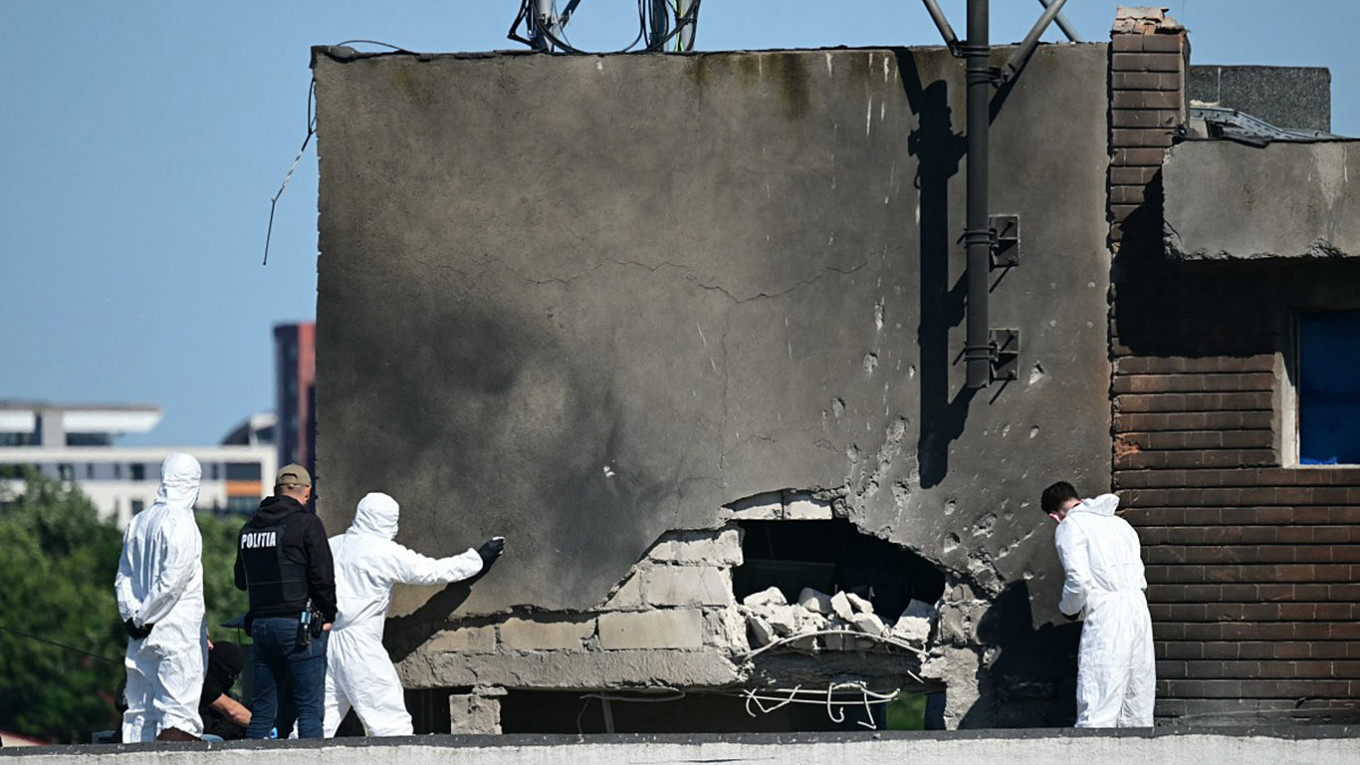
Romania has ordered the closure of the Russian consulate in the city of Constanta after a Russian drone crashed into an apartment building in the eastern part of the country and wounded two people, coming amid a broader uptick of both Russian and Ukrainian drones straying into the airspace of NATO members as the two countries continue attacks on each other.
Romanian President Nicușor Dan announced the closure of the consulate on Friday afternoon and declared the Russian consul in the Black Sea port city persona non grata. Romania’s foreign ministry also summoned the Russian ambassador in Bucharest over the incident.
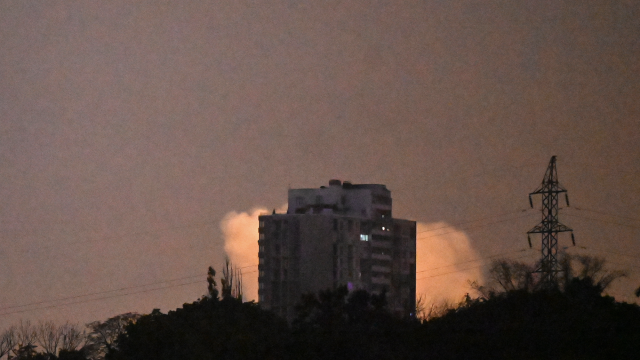
The country’s military said that a Geran-2, the Russian version of the Iranian-designed Shahed drone, crashed into the roof of an apartment building in the city of Galati, located right across the border from southern Ukraine and Moldova.
“During the night of May 28-29, the Russian Federation resumed drone attacks on civilian and infrastructure targets in Ukraine, near the river border with Romania,” the defense ministry said in a statement.
“One of these drones entered Romanian airspace, was tracked by radar as far as the southern part of the city of Galati and crashed onto the roof of an apartment building, with the impact triggering a fire," the statement added.
Two people were wounded and hospitalized, the military added. Emergency services later put out the blaze.
Russian President Vladimir Putin said it was too soon to say that the drone that crashed was Russian, and called for Moscow to be shown evidence.
"No one can say the origin of this or that aircraft until an examination of that aircraft is conducted," Putin told a press conference in Kazakhstan. "If they provide us with any objective data... in that case, will we assess what happened."
Russia’s Foreign Ministry vowed a response to the closure of its consulate in Constanta.
Romania said the drone crash “represents a serious and irresponsible escalation on the part of the Russian Federation,” adding that it had informed the NATO Secretary General Mark Rutte about the incident and “requested measures to accelerate the transfer of anti-drone capabilities to Romania.”
In a call with Romania’s president later on Friday, Rutte pledged the alliance’s “absolute solidarity” with Bucharest and slammed “Russia’s reckless behaviour is a danger to us all.”
Sources at NATO told AFP it remained unclear whether Romania planned to invoke Article 4 of the military alliance’s treaty, a rarely used mechanism that initiates consultations with other members and can potentially lead to some form of joint decision or action on behalf of NATO.
Article 4 was last invoked in September 2025 after Russian drones entered Polish airspace during an overnight attack on Ukraine.
While drone incursions have been detected in Romania dozens of times since Russia invaded Ukraine in February 2022, the latest incident marks the first time a stray drone has hit a residential building.
Romania’s military scrambled two F-16 fighter jets immediately after the aerial targets were detected in the country’s airspace.
The cross-border incident coincided with a nationwide air raid alert issued in neighboring Ukraine overnight in anticipation of Russian strikes. Authorities in southern Ukraine’s Zaporizhzhia reported that at least two people were wounded following attacks there.
AFP contributed reporting.
A Message from The Moscow Times:
Dear readers,
We are facing unprecedented challenges. Russia's Prosecutor General's Office has designated The Moscow Times as an "undesirable" organization, criminalizing our work and putting our staff at risk of prosecution. This follows our earlier unjust labeling as a "foreign agent."
These actions are direct attempts to silence independent journalism in Russia. The authorities claim our work "discredits the decisions of the Russian leadership." We see things differently: we strive to provide accurate, unbiased reporting on Russia.
We, the journalists of The Moscow Times, refuse to be silenced. But to continue our work, we need your help.
Your support, no matter how small, makes a world of difference. If you can, please support us monthly starting from just $2. It's quick to set up, and every contribution makes a significant impact.
By supporting The Moscow Times, you're defending open, independent journalism in the face of repression. Thank you for standing with us.

Remind me later.