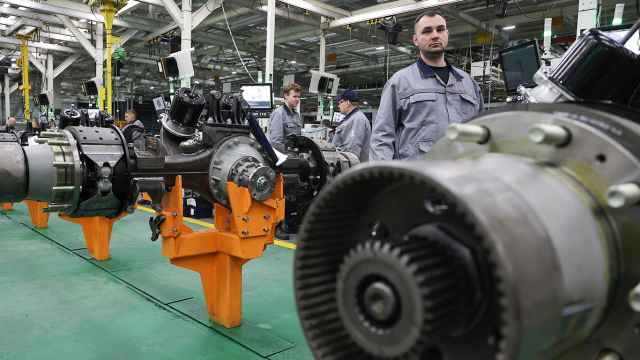
Russia’s manufacturing sector extended its downturn in March as weak demand dragged on output, hiring and business confidence, surveys showed, adding to signs that the economy may contract in early 2026.
The S&P Global Purchasing Managers’ Index (PMI) for Russian manufacturing fell to 48.3 in March from 49.5 in February, remaining below the 50 threshold that separates growth from contraction.
Companies continued to report subdued demand, forcing them to cut production and reduce their workforces, S&P Global said.
At the same time, business expectations dropped to their lowest level since April 2022 amid concerns over customers’ purchasing power.
Output fell at the sharpest pace in three months in March, while weaker consumer purchasing power accelerated the decline in new orders.
Firms have sharply cut back on purchases of raw materials and components in response, marking the steepest fall in input buying since March 2022. Producers increasingly drew down existing inventories to meet new sales, the survey showed.
Rising costs added to the pressure, but companies struggled to pass these on to customers due to weak demand and strong competition. This has resulted in output prices rising more slowly than input costs.
S&P Global’s survey primarily covers private-sector companies and does not fully capture Russia’s defense industry, which is dominated by state-run manufacturers benefiting from wartime spending.
However, analysts who account for these sectors say the broader picture for manufacturing remains weak.
“The consequences are already evident in slowing industrial performance in the second quarter,” said Vladimir Chernov, an analyst at Freedom Finance Global.
He added that the survey also pointed to easing inflationary pressures as companies struggle to raise prices.
“Our baseline forecast envisages PMI fluctuating in the 47-49 range, reflecting stagnation in the sector,” Chernov said, adding that while some improvement is possible in the second half of the year if demand stabilizes and monetary policy is eased, “a quick return to growth above 50 is not yet in sight.”
Given the close link between industry and overall economic activity, analysts at Promsvyazbank said the likelihood of a slight contraction in real GDP in the first quarter has increased. The Kremlin-linked think tank CMAKP warned that both the first quarter and possibly the first half of the year could show negative growth.
Economic Development Minister Maxim Reshetnikov has acknowledged that the government’s 1.3% growth forecast for 2026 is too optimistic and said it would be revised downward in April.
Other surveys also point to deteriorating sentiment. The Central Bank’s business climate index slipped into negative territory in February for the first time since September 2022, after standing just above zero in January.
The industrial optimism index calculated by the Russian Academy of Sciences fell further in March to its lowest level since the pandemic, and to levels last seen in the late 1990s. March marked the 16th consecutive month in which pessimism outweighed optimism among businesses, with the index turning negative in December 2024.
Consumer sentiment has also weakened. The Public Opinion Foundation’s index fell to 98 in February, dropping below the 100 mark that separates optimism from pessimism for the first time since late 2022.
Read this story in Russian at The Moscow Times' Russian service.
A Message from The Moscow Times:
Dear readers,
We are facing unprecedented challenges. Russia's Prosecutor General's Office has designated The Moscow Times as an "undesirable" organization, criminalizing our work and putting our staff at risk of prosecution. This follows our earlier unjust labeling as a "foreign agent."
These actions are direct attempts to silence independent journalism in Russia. The authorities claim our work "discredits the decisions of the Russian leadership." We see things differently: we strive to provide accurate, unbiased reporting on Russia.
We, the journalists of The Moscow Times, refuse to be silenced. But to continue our work, we need your help.
Your support, no matter how small, makes a world of difference. If you can, please support us monthly starting from just $2. It's quick to set up, and every contribution makes a significant impact.
By supporting The Moscow Times, you're defending open, independent journalism in the face of repression. Thank you for standing with us.

Remind me later.