
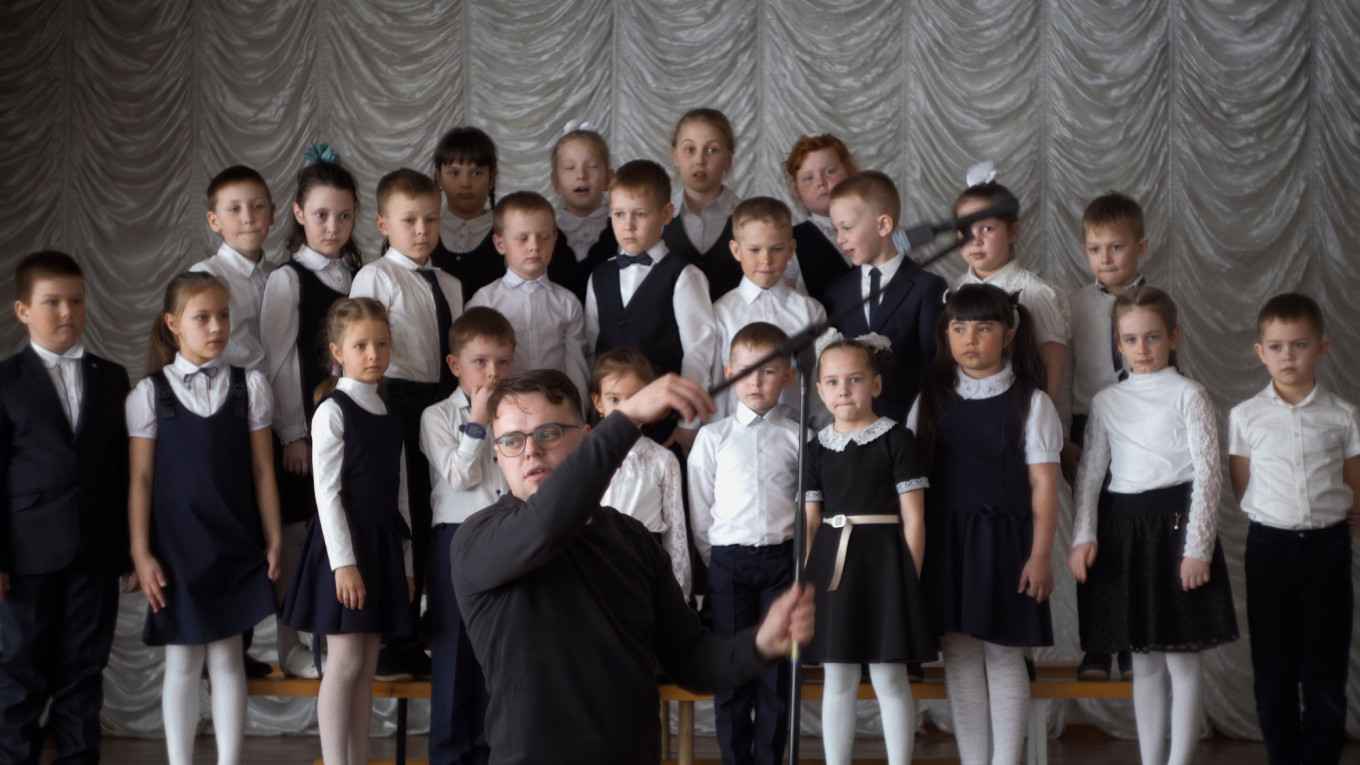
Pavel Talankin has said “Mr. Nobody Against Putin,” his Oscar-winning documentary film about a Russian school during the war in Ukraine, is for audiences in Russia and abroad.
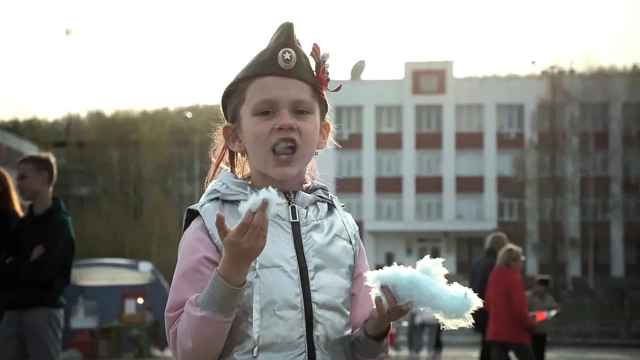
The film, which shows Talankin witnessing the indoctrination of schoolchildren into the Kremlin’s state ideology after the invasion of Ukraine, took home best documentary feature at the 2026 Academy Awards on Sunday.
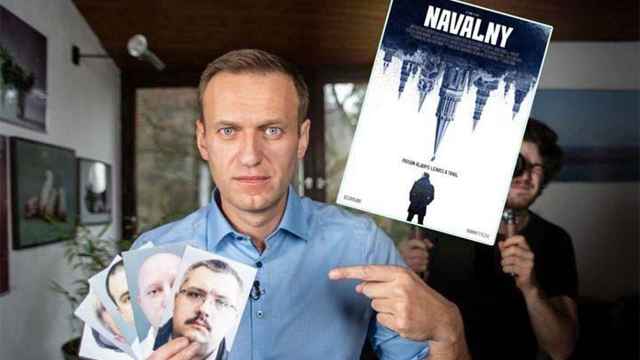
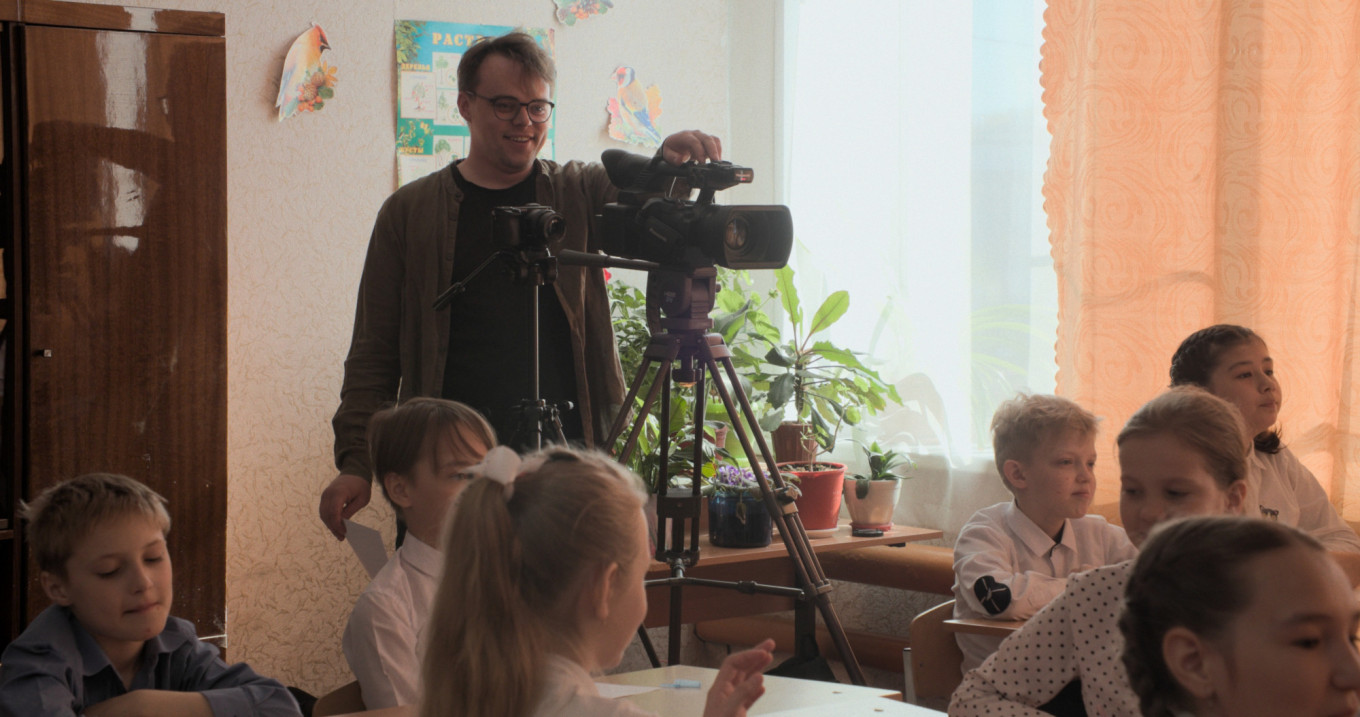
Talankin secretly preserved footage he filmed while working at the school before leaving Russia in 2024. His co-director, American filmmaker David Borenstein, said he sought to frame the footage around broader themes of free speech and indoctrination.
Speaking after an awards season that culminated in recognition at the Oscars and the British Academy Film Awards, he said he believes the debate around the film is already changing Russian society.
While the Kremlin said it hadn’t seen the film, Russia’s presidential human rights council this week accused it of featuring children without their parents’ consent.
The Moscow Times spoke with Talankin about the reception to the film at home and abroad, his experience at the Oscars and what comes next.
This interview has been edited for length and clarity.
MT: What was your reaction to the Oscar and the other awards? How are you feeling right now?
PT: Well, right now, I don’t know. It’s a bit nerve-wracking, but otherwise everything seems fine.
MT: Is all your time now taken up by promoting the film and doing interviews?
PT: Yes, we’re continuing screenings, traveling for Q&As. Right now, I’m getting ready to return to Europe.
MT: Has your attitude toward the film changed in the year or so since its release?
PT: It’s really a film about love. How could that change? No, my attitude hasn’t changed.
MT: Have you read the discussions and criticism on social media about your film?
PT: No. I’ve come across a little bit here and there, but that’s it.
MT: Critics accuse you of staging certain scenes and say the film wasn’t made for Russia, but rather aimed only at a Western audience.
PT: I think it’s actually good that people are talking about the film. If nobody said anything, that would be disappointing. But here, people are really split down the middle: some like it, some don’t. They argue with each other. The film sparks discussion. It makes you talk about these issues, also if you’re in Russia. It’s great that people are discussing the artistic and editing side too — how it’s shot, how certain episodes are edited, what music is used or not used. People are engaging with all of that.
It’s also great that people debate the content and the intended audience. When there’s a topic that resonates, that hits a nerve, that people watch and then discuss — it means they care. They’re not indifferent. That’s what's important.
I saw a comment by [pro-Kremlin film director and public figure Nikita] Mikhalkov — he said it’s all staged and that reality is not like in the film. I take it as an enormous compliment to me from him, if you look at Mikhalkov primarily as a filmmaker and not as a propagandist. It’s a very flattering compliment, because getting 900 children to act in a film at the same time is just a testament to superb directing skills and here I am — managing such a massive crowd as a director. I don’t know if he really thought about what he was saying but he gave me a huge compliment. I mean, how does he even imagine it in his head? The kids are standing there — all the schools, 900 of them. I’m with a megaphone saying: ‘Okay, everyone stand straight, raise the flag a little higher.’ And at that moment, the camera is rolling. And even with all that, there’s a discussion: ‘We didn’t know they were filming a movie.' That’s also some kind of absurdity.
As for the idea that the film isn’t for a Russian audience — I partly disagree. Yes and no. The film is about a school, about a small town, about Russia and what’s happening there are shown through that town and that small school.
[In the West] people don’t know anything about what’s happening in Russia. When David [Borenstein] and I were editing the film, I kept saying: ‘Let’s include this, let’s explain that,’ because I had a huge amount of footage. But he said if we try to show everything, the audience would feel overwhelmed by the sheer amount of information. As for this whole discussion about whether the film is for Russia or not — how can it not be for Russia if people there are debating it so passionately? I saw one comment where a woman wrote: ‘I watched the film and didn’t understand who it’s for.’ But you watched it from beginning to end. You found it somewhere [since it’s not screened in Russia], sat down, watched the whole thing — and then you say you don’t know who it’s for? It’s for you. You answered your own question.
We once met an artist at a screening who paints small postcards. A journalist asked him, ‘Who do you paint for?’ I’ll try to repeat his answer: ‘First and foremost — for you.’ It’s the same with this film. Who is it for? First and foremost — for you.
MT: What would you have liked to include in the film but couldn’t?
PT: There’s a lot of footage and many storylines that didn’t make it in. For example, how teachers are pressured to contribute money to the so-called ‘special military operation.’ But to show that, we would have had to introduce a whole new character and build a storyline around them.
MT: A year ago, we asked you about filming children and the ethical debate around using the footage. Since then, you’ve repeatedly said that you were filming for the Education Ministry and the footage was also posted online. Has your viewpoint changed?
PT: No. The protagonists who are in the film are doing fine — they’re continuing to study and work. They feel secure.
The film premiered last year at the Sundance Film Festival. After that, it was widely discussed and written about. And suddenly, only now, [state-run TV channel] Rossia 24 went to Karabash to film a report. What they’ve done there is awful. I haven’t seen the report yet — it hasn’t been aired. But what happened there was like chaos, like some predator arriving and looking for someone to attack when people didn’t want to give comments. I hope the residents of Karabash will see how Russian television behaves and draw their own conclusions.
MT: Do you think the film and the discussions around it can actually change anything in Russia?
PT: It is already changing. If there are discussions, if people are talking, then the film is already making a difference.
MT: Do you know if anything has changed within the school itself?
PT: Students are being silenced and told not to express any opinions about the film. But they write to me and tell me what’s going on. It’s terrible.
There’s an English teacher — well, she used to be an English teacher. But since English is now considered less important in the Russian curriculum, her hours were cut. Now she teaches Russian. So we’re losing [quality of] both English and Russian.
The students tell me that she criticizes me almost every lesson. She said something particularly absurd: she considers me a traitor, a Russophobe — but also claims I couldn’t even learn a simple English phrase I said at the Oscars. So in her view, I’m a Russophobe who spoke Russian. It’s completely absurd.
MT: Speaking of the Oscars — you were criticized for calling for ‘an end to all wars’ without specifically mentioning the invasion of Ukraine.
PT: I haven’t really seen or read that criticism. But I don’t quite understand the question. I was told I didn’t mention the most important war — that Russia invaded Ukraine. But I said ‘four years.’ For four years now, we’ve been making wishes. I did mention four years.
Also, everything there is very strict. You haven’t stood on that stage — there’s a countdown timer. We had 40 seconds total: 20 for David, 20 for me. My 20 seconds were split in half because of the interpreter. The interpreter was nervous the whole ceremony, worried we wouldn’t have time. Because if you think you can keep talking after your time is up — you can’t. They start playing music to drown you out, or they cut the microphone. Everything is timed to the second. I kept telling her to relax — we probably wouldn’t even go on stage. Honestly, I didn’t think we’d win.
MT: You didn’t expect to win the Oscar?
PT: No. We had very strong competitors in the documentary category. Even though the film is widely discussed — both positively and negatively — and even though many people in the West love it, the competition was very strong. I didn’t think it would end with an Oscar for us.
MT: What are your plans going forward?
PT: In the next few days, I’ll probably try to calm down the residents of Karabash, respond to those who write to me. I honestly never expected state media to behave like this. It’s unbelievable.
MT: And your longer-term plans?
PT: I haven’t planned that far ahead yet. Ideas are coming up, people are reaching out with project offers. But it was an intense Oscar campaign. For now, I just want to rest a bit from all of this.
A Message from The Moscow Times:
Dear readers,
We are facing unprecedented challenges. Russia's Prosecutor General's Office has designated The Moscow Times as an "undesirable" organization, criminalizing our work and putting our staff at risk of prosecution. This follows our earlier unjust labeling as a "foreign agent."
These actions are direct attempts to silence independent journalism in Russia. The authorities claim our work "discredits the decisions of the Russian leadership." We see things differently: we strive to provide accurate, unbiased reporting on Russia.
We, the journalists of The Moscow Times, refuse to be silenced. But to continue our work, we need your help.
Your support, no matter how small, makes a world of difference. If you can, please support us monthly starting from just $2. It's quick to set up, and every contribution makes a significant impact.
By supporting The Moscow Times, you're defending open, independent journalism in the face of repression. Thank you for standing with us.

Remind me later.